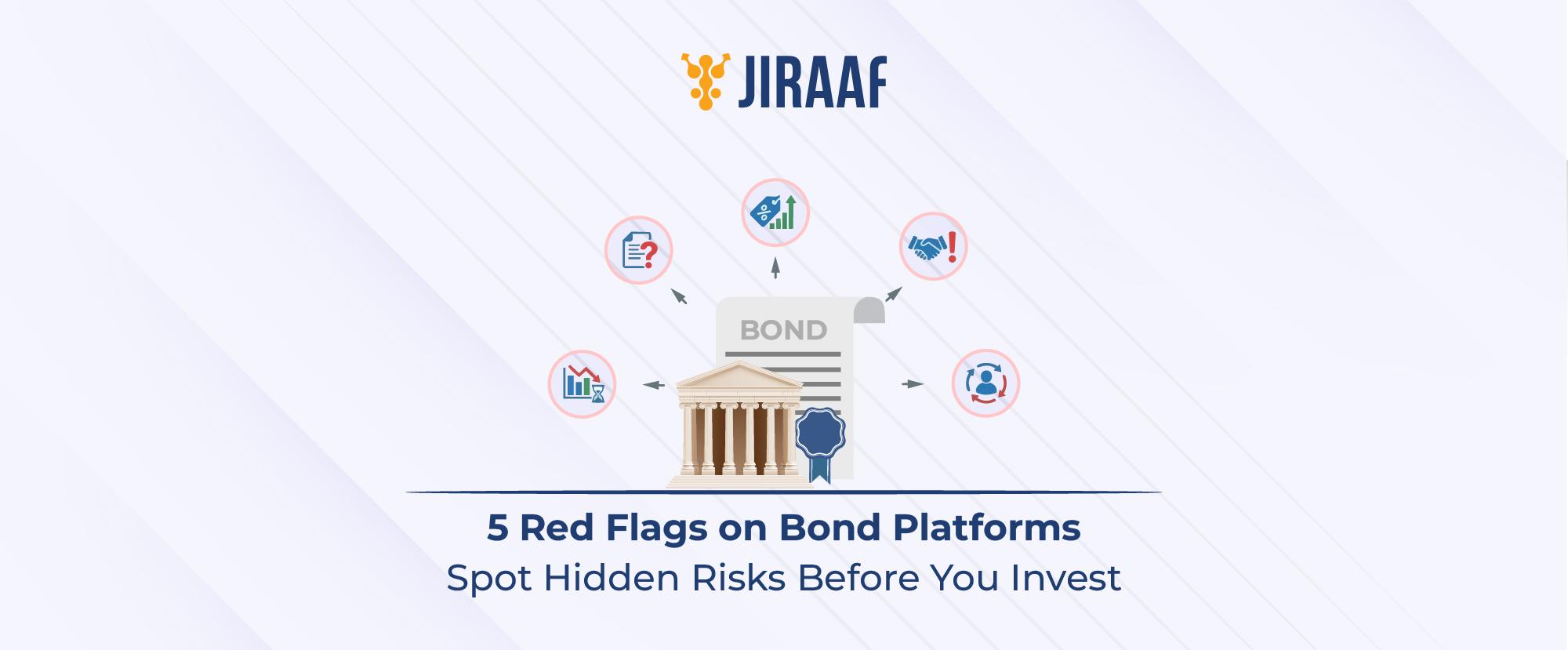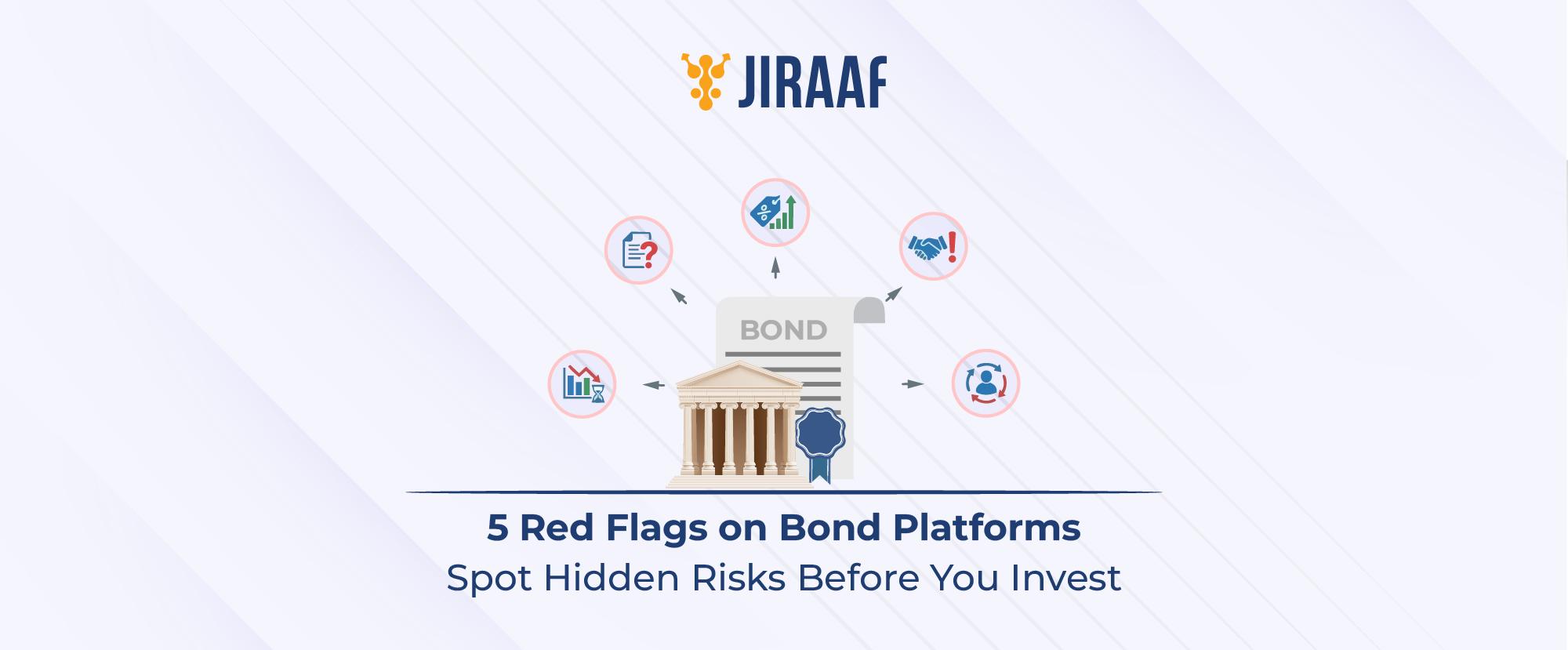
Evaluating fixed-income opportunities requires looking beyond attractive yield figures to protect your capital. This blog breaks down the five primary red flags in bond listings, covering fundamental financials, credit ratings, liquidity constraints, yield anomalies, and regulatory documentation.
If you are looking to grow your wealth beyond traditional fixed deposits in India, debt platforms offer attractive yields. Online Bond Providing Platforms (OBPPs) give you direct access to corporate bonds, non-convertible debentures (NCDs), and commercial paper. However, high advertised returns often mask serious underlying risks.
Unlike bank deposits, where your funds carry DICGC protection up to ₹5 lakh per bank, corporate debt exposes your principal to company performance. When you invest in a bond, your maximum return is capped at the coupon rate, but your downside risk is 100% loss of capital if the issuer defaults. Learning how to spot subtle warning signs before you hit “buy” protects your hard-earned savings.
Why Investors Must Analyze Bond Listings Carefully
When you buy a bond, you are lending your hard-earned money to a corporate borrower in exchange for periodic interest payouts and your principal back at maturity. Because bonds do not give you capital appreciation like equity shares, you must prioritize capital safety over high yields.
Learning how to analyze bond listings helps you verify whether the returns on offer justify the risks you take. Evaluating a bond listing requires looking deeper than the headline coupon rate; you must examine issuer balance sheets, credit reports, trustee oversight, and secondary trading activity. Spotting structural red flags in bonds early ensures you avoid default traps and illiquid instruments.
Red Flag #1: Weak Financials and Bond Issuer Risk
The core safety of your investment relies on the financial stability of the borrower. Bond issuer risk represents the chance that a company’s business deteriorates, leaving it unable to pay your interest or repay your principal.
Before you invest, inspect these three core metrics from the issuer’s latest audited financial statements:
- Interest Coverage Ratio (ICR): Shows how comfortably operating profits cover debt interest. An ICR below 1.5× indicates vulnerable cash flows.
- Debt-to-equity ratio: High leverage (above 3×3× or 4×4× for non-financial companies) signals heavy debt burden with little buffer during economic downturns.
- Cash flow from operations: Consecutive years of negative operating cash flows paired with growing debt obligations indicate severe stress.
Financial Health Check
| Metric | Healthy Issuer | High Issuer Risk (Red Flag) |
| Interest Coverage Ratio (ICR) | 4.2×4.2× | 0.9×0.9× |
| Debt-to-Equity Ratio | 0.8×0.8× | 4.5×4.5× |
| Operating Cash Flow | Consistently Positive | Negative for 2 Consecutive Years |
| Pledged Promoter Shares | 0%0% | >50%>50% of Promoter Holding |
If an issuer struggles to generate cash or carries excessive leverage, walk away. These red flags in bonds signal trouble regardless of how high the yield looks.
Red Flag #2: High Bond Default Risk and Rating Downgrades
Bond default risk is the likelihood that the borrower fails to make timely interest or principal payments. In India, SEBI-registered rating agencies, such as CRISIL, ICRA, CARE, and India Ratings, assess default probabilities and assign credit ratings to debt issues.
Understanding the rating spectrum helps you filter out risky bonds:
- Investment grade: Ratings from AAA down to BBB- are classified as investment grade. AAA represents maximum safety, while BBB- represents moderate risk with adequate protection.
- Speculative/high-yield grade: Ratings below BBB- (such as BB, B, C, or D) carry high default risk or indicate existing default and are called junk bonds.

Warning Signs in Credit Reports
- Unrated bonds: If a bond listing lacks a credit rating from a SEBI-recognized agency, you cannot independently verify its risk profile.
- Negative rating outlook: A rating of BBB with a “Negative Outlook” or “Rating Watch with Negative Implications” warns of imminent rating downgrades.
- Recent rating migration: A rapid drop from AA to BBB within a few months signals sharp operational or financial decline.
Red Flag #3: Unrealistically High Returns and Yield Disconnects
A common mistake you can make is selecting bonds based purely on eye-catching Yield to Maturity (YTM). In fixed-income markets, higher yield always reflects higher risk.
If benchmark AA-rated 3-year corporate bonds yield around 8.50%, but a listing offers 14.50% YTM, the extra 600 bps (6%) indicates severe credit stress. Market participants often price in bond default risk long before rating agencies formally downgrade the instrument.
Decoding Yield vs. Coupon Rates
- Coupon rate: The annual percentage interest paid on the bond’s face value (e.g., 9%9% on a ₹1,000 face value bond pays ₹90 per year).
- Yield to Maturity (YTM): Your true annualized return if you buy the bond at its current market price and hold it until maturity.
When a bond trades at a deep discount to face value (such as a ₹1,000 face value bond selling for ₹700), the YTM spikes. This gap signals market fear of default. Do not treat high yield as free return without investigating why the market heavily discounted the price of those risky bonds.
Red Flag #4: Poor Bond Liquidity and Secondary Market Constraints
Bond liquidity risk is the danger of being unable to sell your bond listing before maturity at a fair price. While Indian stock markets offer high liquidity, corporate bond trading volumes on the NSE and BSE remain concentrated in large institutional issues.
If you lock capital into long-duration corporate paper or unlisted private placements without checking liquidity, your money remains stuck until maturity.
Spotting Liquidity Constraints on Listings
- Wide bid-ask spread: A large gap between buyer offers (Bid) and seller prices (Ask), such as a Bid of ₹920 and an Ask of ₹980, indicates an illiquid market.
- Low trading volume: Zero transaction history or sporadic trades over the past month means you will mostly face steep price cuts if you need to exit early.
- Tenure mismatch: Locking funds into a 7-year illiquid bond when you need money in 2 years generally creates severe financial strain.
Always check your bond platform for active secondary market exit options, or debt trades regularly on exchange order books.
Red Flag #5: Lack of Transparency and Weak Bond Documentation
The final essential step when learning how to analyze bond listings is inspecting official issuance records: the Information Memorandum (IM), Term Sheet, and Debenture Trust Deed. Complex structures or missing disclosures are immediate warning signs.
Crucial Documentation Checks
- Seniority and security type
- Secured vs. unsecured: Secured bonds give you claims over specific corporate assets if the company defaults. Unsecured bonds leave you as a general creditor during liquidation.
- Subordinated debt: Subordinated or perpetual bonds (like AT-1 bonds) rank behind senior debt during repayment.
- Role of the debenture trustee: SEBI requires a Debenture Trustee for public issues to protect investor rights and enforce security. Vague trustee details signal compliance concerns.
- Restrictive covenants: Check for hidden call options (allowing the issuer to redeem early when interest rates drop) or weak asset coverage covenants.
Look for transparent documentation with clear collateral coverage ratios (ideally >1.25 times covered by unencumbered assets) to protect your portfolio against red flags in bonds.
Summary Checklist: Analyzing Bond Listings
| Step | Focus Area | Key Metric / Document | Red Flag Threshold |
| 1 | Issuer Financials | Income Statement & Balance Sheet | ICR <1.5×, High Debt/Equity, Negative Cash Flow |
| 2 | Credit Rating | Agency Rating Report | Ratings below BBB-, Unrated, or Negative Outlook |
| 3 | Pricing & Yield | Market YTM vs. Peers | Spreads >400−500 bps above benchmark peer yields |
| 4 | Trading Liquidity | Exchange Order Book | Wide Bid-Ask Spreads, zero trading volume |
| 5 | Security & Terms | Term Sheet & Debenture Trust Deed | Unsecured status, missing trustee, inadequate asset cover |
Beyond Due Diligence: Building a Resilient Fixed-Income Portfolio
Spotting red flags is only the first layer of defense in your investment journey. To build long-term financial security, approaching bond selection through portfolio design rather than individual security picking is a smarter move.
For instance, instead of hunting for maximum yield in single issues, you can balance your portfolio across issuers, credit ratings, and tenures. Staggering your bond maturities using a “laddering strategy” ensures regular cash flows and protects you against interest rate shifts without forcing you to accept elevated credit risk.
Remember that in fixed-income investing, return of capital always supersedes return on capital. By applying disciplined screening criteria to every listing you review, you can safeguard your wealth while earning predictable passive income.