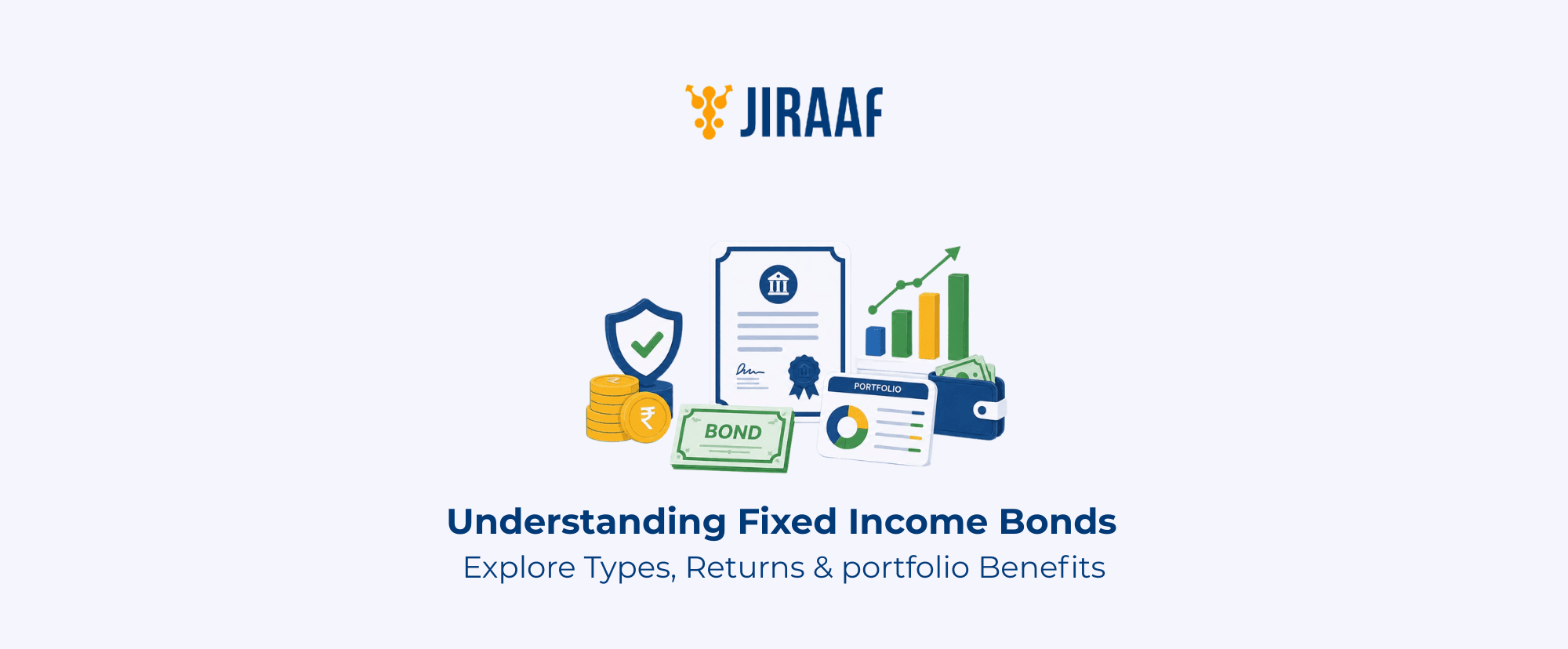
Summary: Fixed-income bonds are debt instruments through which you lend money to a government or corporate issuer in exchange for periodic interest and repayment of principal at maturity. This guide covers how fixed-income bonds work in India, the types available, how returns are calculated, and the risks involved.
Quick Overview
- Fixed-income bonds are debt instruments where you lend money to an issuer in return for periodic interest and principal repayment at maturity.
- In India, they include government bonds, corporate bonds, and other fixed-income instruments.
- Returns come from coupon income, yield, and possible price movements in the secondary market.
- They can contribute to stability, income visibility, and portfolio diversification.
- Fixed-income investments are attracting more attention in 2026 as the range of accessible instruments expands.
When you think about investing in India, your mind likely jumps straight to stocks, mutual funds, or real estate. Historically, retail investors have left debt instruments in the background, only checking in on them when the stock market turns volatile or interest rates take a sudden turn.
However, this traditional viewpoint is undergoing a massive shift. In 2026, the intersection of digital innovation, regulatory overhauls by SEBI, and a stabilizing interest rate cycle has thrust fixed-income products into the mainstream. Bonds are no longer viewed merely as a fallback during equity market uncertainty, but as a core, strategic pillar for smarter asset allocation. For an Indian investor seeking to outpace inflation without absorbing excessive stock market volatility, understanding the mechanics of debt is no longer optional—it is essential.
Digital platforms and user-friendly apps have completely democratized this space, opening access far beyond institutional buyers. Today, navigating fixed-income is no longer just about picking a product; it is about understanding how these different instruments behave under changing economic conditions.
India’s debt market is broader than it appears. Government securities, corporate debt, municipal bonds, and structured instruments all sit within it, and each responds uniquely to shifts in inflation, credit quality, and market sentiment. fixed-income bonds in India require a closer look, precisely because they were never as static or straightforward as the name suggests.
What Are Fixed-Income Bonds?
At its core, a bond is simply a loan where you act as the lender.
When you buy a bond, you lend your money to a government or a company. In exchange, the borrower agrees to pay you regular interest over time and return your initial principal on a specific date, known as maturity.
While that forms the basic blueprint, you need to understand a few critical layers to see how a bond actually behaves in the real world:
- The face value: The principal amount of the bond as stated by the issuer.
- The coupon rate: The fixed interest rate paid on the face value. For example, if you hold a bond with a face value of ₹10,000 and an 8% coupon, your annual payout is exactly ₹800.
- The market price: The actual cost to buy the bond in the secondary market after it has been issued.
Because bonds actively trade between investors, their market prices fluctuate daily based on supply, demand, and economic cycles. Consequently, if you buy or sell a bond in the secondary market, the actual return you earn will rarely match the baseline coupon rate. This brings you to Yield to Maturity (YTM).
YTM captures your complete return picture. It calculates not just the regular coupon payments you receive, but also factors in what you paid for the bond relative to the face value you will get back at maturity. If you and another investor hold the exact same bond but paid different prices for it on an exchange, your final returns will be completely different. Ultimately, the label ‘fixed-income’ describes the locked-in payment structure, not a frozen market price
Types of Fixed-Income Bonds in India
The Indian bond market is a diverse ecosystem. The instruments available to you vary significantly based on who is borrowing your money and how they structure the repayment.
Government Bonds
Issued to fund national infrastructure and public spending, these instruments are backed by the sovereign guarantee of the government, making them the most stable layer of a debt portfolio.
- Government Securities (G-Secs): Long-term bonds issued by the central government, often spanning several decades
- State Development Loans (SDLs): Bonds issued by individual state governments to fund regional development
- Treasury Bills (T-Bills): Short-term debt instruments with maturities under one year (typically 91, 182, or 364 days)
- Floating-rate bonds: Bonds where your interest payouts are not fixed, but instead reset periodically based on a benchmark market rate
Because the risk of default is virtually non-existent here, the trade-off is lower returns. Government yields typically serve as the baseline floor for the rest of the market.
Corporate Bonds
When companies need to raise capital for expansion, they issue corporate bonds. This category offers higher yields than government debt to compensate you for taking on corporate risk.
- Secured bonds: Backed by specific physical assets of the company. If the issuer faces financial distress, those assets can be liquidated to repay you
- Unsecured bonds: Backed solely by the overall financial health and creditworthiness of the company, offering no specific collateral
- Convertible bonds: Debt instruments that give you the option to exchange your bonds for equity shares of the company under predefined conditions
- Callable and puttable bonds: Structural features that alter maturity. A callable bond allows the company to pay you back early, while a puttable bond allows you to demand early repayment if you need to exit
To navigate this landscape, you must rely on credit rating agencies. High-quality companies carry top-tier ratings (like AAA), while lower-rated companies (like B), might offer much higher interest rates (often referred to as high-yield or junk bonds) to balance out their significantly elevated risk profile.
Specialized Instruments
Beyond standard government and corporate issues, you can access specialized debt vehicles designed for specific financial goals:
- Tax-free bonds: Typically issued by government housing or infrastructure public sector undertakings (PSUs), where the interest you earn is entirely exempt from income tax
- Zero-coupon bonds: Bonds that pay no regular interest. Instead, you buy them at a deep discount to their face value and receive the full face value at maturity
- Commercial paper: Unsecured, short-term debt issued by corporations to meet immediate working capital needs
- Inflation-Indexed bonds: Instruments where your principal and interest payments are adjusted dynamically to preserve your purchasing power against rising inflation
- Municipal bonds: Debt issued by local urban bodies or civic corporations to fund local projects like highways or water systems, a market that is steadily developing in India
How Returns Work in Fixed-Income Bonds
To understand how your investment gains value, you must look at how the secondary market reprices these cash flows.
Suppose you want to invest in a bond with a face value of ₹10,000 and an 8% annual coupon (₹800 a year). If you purchase it at its par value of ₹10,000, your return matches the coupon perfectly. However, if the bond trades at a discount in the market and you buy it for ₹9,500, your effective return jumps because you paid less for that exact same ₹800 income stream. Conversely, if you pay a premium price of ₹10,500, your yield drops.
This variance is entirely driven by a fundamental rule of finance: the inverse relationship between interest rates and bond prices.
When Economy-wide Interest Rates RISE ──► Existing Bond Prices FALL
When Economy-wide Interest Rates FALL ──► Existing Bond Prices RISE
Think of it this way: if the Reserve Bank of India (RBI) hikes interest rates, newly issued bonds will start offering higher coupons. Your older bond, locked into a lower interest rate, suddenly looks less attractive to buyers. To sell it on an exchange, you have to lower your price. If interest rates drop, your older bond with its higher, locked-in rate becomes highly valuable, driving its market price up.
Benefits of Fixed-Income Bonds
When you incorporate bonds into your financial plan, you unlock clear structural advantages that differ fundamentally from equity investing:
- Predictable income visibility: Because most bonds operate on a rigid, contractual payment schedule, you know exactly when and how much interest you will receive, making them an excellent tool for structured cash flows or passive income.
- True portfolio diversification: Because bonds and equities rarely move in perfect lockstep, a blended portfolio maintains a steadier path, absorbing shocks when the stock market experiences sudden downturns.
- Lower price volatility: High-quality, highly rated bonds experience far softer price swings than equities, giving your capital a smoother, more secure environment to grow.
- Customized horizon matching: With maturities ranging from a few days to several decades, you can precisely align your bond investments with your specific life goals, whether you are saving for a short-term expense or planning long-term retirement income.
Risks to Understand Before Investing
While bonds provide a vital layer of safety, they are not risk-free. True financial clarity requires you to understand the specific trade-offs involved before allocating your capital:
- Credit (default) risk: The danger that a corporate issuer hits financial distress and delays or fails to pay your interest or principal
- Interest rate risk: The hazard that rising interest rates will suppress the market value of your existing bonds, a risk that intensifies the longer the bond’s duration
- Liquidity risk: The reality that many corporate bonds in India trade infrequently. If you need to sell your bond urgently before maturity, you might struggle to find a buyer without lowering your price
- Inflation risk: The risk that persistent inflation will erode the real purchasing power of your fixed interest payments over time
- Structural risk: The unique vulnerability found in complex debt instruments like Additional Tier-1 (AT1) bonds. These instruments carry specific triggers that allow distressed banks to write down the principal or skip interest payments entirely during a crisis, making them far more complicated to evaluate
Fixed-Income Bonds vs Other Investment Options
To position your capital accurately, you need to see exactly where direct bonds sit in contrast to traditional fixed deposits and debt mutual funds:
| Attribute | Fixed Deposits (FDs) | Debt Mutual Funds | Direct Bonds |
| Returns | Rigid, locked-in interest rate | Dynamic market returns | Clear, visible yield locked at purchase |
| Liquidity | Premature withdrawal penalty; no trading | Redeemable with fund house; potential exit loads | Secondary market exchange trading |
| Taxation (2026) | Taxed at your regular income tax slab rate | Taxed at your regular income tax slab rate (No indexation) | Interest taxed at slab; capital gains taxed on holding period |
| Management | Self-managed passive account | Actively managed by professional fund managers | Direct, targeted exposure to a specific issuer |
| Safety Net | DICGC Insurance up to ₹5 Lakh | No insurance; subject to market portfolio risks | Sovereign backing (G-Secs) or corporate asset backing |
While debt mutual funds provide excellent instant diversification under professional care, direct bond investing grants you absolute transparency. You know the exact issuer, the exact risk profile, and the precise yield you are locking in from day one, all while bypassing active mutual fund management fees.
Where Fixed-Income Bonds Fit in Your Portfolio
Understanding this market movement is exactly how you build a resilient investment portfolio. While your equities respond to corporate growth and economic optimism, your bonds respond to interest rate cycles and credit health. Combining both forces balances out your portfolio’s performance over time.
You can use different debt instruments to play specific roles:
- Sovereign G-Secs act as your ultimate capital preservation layer during volatile market cycles.
- Corporate bonds allow you to tactically inject higher yields into your fixed-income allocation.
- Short-term instruments (like T-Bills) protect you from interest rate fluctuations because they mature quickly.
- Long-term bonds offer maximum reward when interest rates are falling, but expose you to sharper price drops if rates rise.
In 2026, asset allocation is no longer about blindly chasing the highest return. Instead, it is about understanding how these moving parts interact to shield your wealth while maintaining reliable growth.
How You Can Access Fixed-Income Bonds Today
Investing in debt has never been simpler. Depending on your financial goals, you can acquire bonds through several modern avenues:
- RBI Retail Direct: The central bank’s dedicated portal, designed specifically to let you buy primary central government securities, treasury bills, state development loans, and Sovereign Gold Bonds directly, with zero platform fees. (Note: This specific portal does not host or trade private corporate bonds.)
- Online bond platforms: Regulated digital providers that curate secondary market corporate and government debt into accessible, easy-to-browse interfaces.
- Stock exchanges: Direct trading of listed corporate debentures and government bonds via your standard trading account.
- Primary public issuances (Bond IPOs): Subscribing directly to new debt offerings launched by corporations or financial institutions.
Investing Through Jiraaf
If you want to maximize your direct exposure to curated corporate fixed-income opportunities, online platforms like Jiraaf streamline the digital workflow into a few simple steps:
- Complete your paperless, digital KYC online on the app or the website
- Browse a transparent, curated marketplace of high-yield and secured debt opportunities
- Execute your payment securely
- Receive the credit-rated securities directly into your standard demat account, where you can track your interest payouts seamlessly
Conclusion
As you navigate the financial landscape of 2026, fixed-income bonds have firmly transcended their historical status as a niche, institutional sandbox. Driven by tech-enabled retail democratization and sharp regulatory oversight from SEBI, they now give you the power to build a truly resilient, multi-layered portfolio.
Whether you choose to anchor your core capital in sovereign-backed G-Secs, tactically boost your yields with secured corporate debt, or align your upcoming cash flows through modern platforms like Jiraaf, bonds are an active, strategic tool. By mastering the delicate balance between market yields, interest rate movements, and credit quality, you can transition away from being a passive saver and become a precise, confident wealth creator.