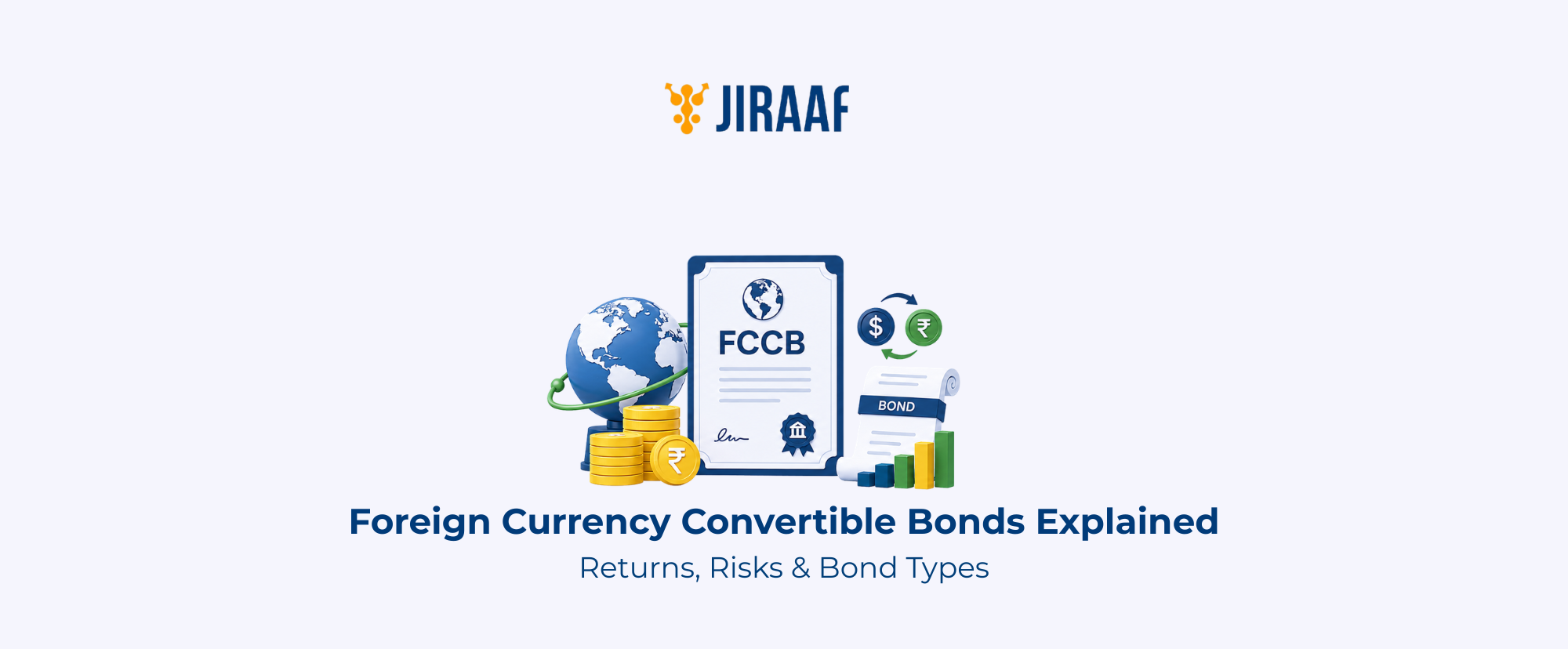
Summary: Foreign Currency Convertible Bonds (FCCBs) are hybrid instruments that combine fixed-income debt with the option to convert into equity, issued by companies in a foreign currency to access overseas capital. This guide covers how FCCBs work, their benefits and risks for both issuers and bondholders, how they compare with traditional bonds, and the regulatory framework governing them in India.
Quick Overview
- FCCBs are bonds issued in a foreign currency by companies to raise overseas capital
- As a bondholder, you earn coupon payments in that foreign currency during the tenure
- You also have the option to convert the bond into equity shares at a pre-decided price
- FCCBs combine fixed-income features with equity participation, making them hybrid instruments
- They carry currency, equity market, and refinancing risks alongside their benefits
When Indian companies look beyond domestic capital markets for funding, the instruments they choose shape both their balance sheet and the returns available to global investors. Foreign currency convertible bonds sit at an interesting intersection. They carry the repayment structure of debt, the currency exposure of a cross-border transaction, and an embedded option that could convert that debt into equity.
FCCBs first gained significant attention in India during periods of strong global liquidity, when companies could raise overseas capital at costs below what domestic debt markets offered.
This guide covers how they work and what they require of both the issuer and the bondholder.
What Are Foreign Currency Convertible Bonds
An FCCB is a convertible bond that an Indian company issues in a foreign currency, typically US dollars, euros, or Japanese yen, to raise capital from overseas investors. You, as the bondholder, receive fixed coupon payments in that foreign currency throughout the tenure. At maturity, the principal is repaid in the same foreign currency(unless converted into equity or issued with a premium on a redemption structure, where the final payout includes a pre-determined premium to compensate for a low coupon).
What makes FCCBs different from a regular bond is the conversion option. At a pre-agreed conversion price and within a defined conversion window, you can choose to exchange your bond for equity shares of the issuing company. If you exercise this option, the company issues shares to you instead of repaying the principal in cash.
The typical FCCB structure usually contains:
- Coupon rate: The fixed interest rate paid to bondholders (which can sometimes be set at 0% for zero-coupon FCCBs, where the return is entirely derived from the redemption premium if conversion doesn’t happen)
- Conversion price: The price at which investors can convert bonds into shares
- A conversion ratio: The number of shares investors receive after conversion
- A fixed maturity date: The date when the company must repay the bond if conversion does not happen
- YTM/redemption premium: The guaranteed return offered at maturity if the investor chooses not to convert, usually structured as a premium over the principal amount to make up for the low nominal coupon
These terms determine when equity conversion applies and help you evaluate FCCBs against plain bonds or direct equity investments.
How Foreign Currency Convertible Bonds Function
When we break down the convertible bond mechanism, the actual structure is less complex than it seems.
Step 1: Your company first issues FCCBs in foreign currency and raises funds from overseas investors.
Step 2: You receive periodic coupon payments, usually semi-annual, typically lower than fixed rate bonds due to the potential equity participation (or you accumulate returns via a redemption premium if it is a zero-coupon FCCB).
Step 3: Once the conversion window opens, you may assess whether converting your bond into equity makes financial sense. If the company’s share price has risen above the conversion price, conversion gives you equity at below-market cost. If it has not, you may hold the bond.
Step 4: At maturity, if no FCCB conversion has occurred, the company repays the full principal along with any applicable redemption premium in foreign currency. This is where FCCBs can become less favorable if the issuer has not provisioned cash for the repayment, assuming conversion would happen automatically.
Foreign Currency Convertible Bonds Example
Here is a simplified FCCB example to illustrate how it works in practice.
An Indian company raises $100 million through FCCBs with the following terms:
Coupon rate: 3% per annum
Tenure: 5 years
Conversion price: ₹1,000 per share
Current share price at issuance: ₹800
Redemption value: 110% of principal amount at maturity if not converted (adding a 2% annualized premium to the yield)
Scenario 1: Stock Price Increases
Share price rises to ₹1,400 by year 3.
The conversion price of ₹1,000 is now below the market price. You convert your bonds into shares, acquiring equity at ₹1,000 per share when the market values them at ₹1,400. The company issues equity instead of repaying cash at maturity.
Scenario 2: Stock Price Weakness
Share price stays below ₹1,000 through maturity.
Conversion does not make economic sense. You hold the bond to maturity, collect the 3% coupon each year, and receive the $110 million (representing the principal plus the 10% redemption premium) in US dollars at the end of the five-year tenure.
This example shows that an FCCB can end up as debt or equity, depending on market performance, exchange rates, and your conversion decision.
Benefits of Foreign Currency Convertible Bonds
FCCBs gained traction because, as an investor, you earn fixed-income returns with the option to participate in share price gains, while issuers benefit from lower borrowing costs.
Benefits for Investors
FCCBs offer a structured income stream through regular coupon payments in foreign currency for the duration of the tenure (or a guaranteed capital gain at maturity via redemption premium). Unlike equity, which carries no guaranteed payout, this income is contractual – one of the key benefits of FCCBs.
Beyond the coupon, you hold an embedded option: the right, but not the obligation, to convert your bond into equity. If the issuer’s share price rises above the conversion price, you participate in that appreciation without taking on pure equity risk from the outset. This combination, fixed income with equity-linked participation, is one of the core FCCB advantages compared to plain corporate bonds.
FCCBs also provide exposure to international corporate issuances, adding global diversification to a fixed-income portfolio otherwise limited to domestic instruments, another important convertible bond benefit.
Benefits for Issuers
For the issuer, lower coupon costs are the headline benefit. By embedding an equity option, the company reduces its borrowing rate relative to a plain bond. Over a five-year tenure, even a 200–300 basis point reduction can result in meaningful cost savings.
Access to global capital markets allows the company to tap a broader pool of institutional capital, sovereign funds, pension funds, and hedge funds that may not participate in domestic markets.
Finally, conditional dilution gives the company flexibility over equity issuance. If the share price does not cross the conversion threshold, the company repays the debt in cash without issuing new shares (though it must account for the higher cash outflow due to the redemption premium).
Risks Investors and Companies Should Understand
FCCBs gained attention after the financial crisis, as many companies treated them like low-cost debt despite their complexity.
- Currency risk: Since repayment is in foreign currency, a weakening rupee can increase repayment costs for companies earning mainly in rupees.
- Equity market risk: FCCBs depend on share price movement. If the stock stays below the conversion price, conversion does not take place and companies may need to repay the bonds in cash.
- Refinancing risk: Some issuers expected conversion to occur. When markets weakened, refinancing and repayment became more challenging. If an issuer’s credit profile deteriorates, refinancing the massive bullet repayment at maturity through fresh debt becomes incredibly difficult.
- Dilution risk: If investors convert into shares, existing shareholders may face dilution as the number of outstanding shares increases.
This mix of currency, equity, and refinancing risk differentiates FCCBs from traditional bonds.
Foreign Currency Convertible Bonds vs Traditional Bonds
FCCBs and traditional bonds are both debt instruments, but they serve different purposes and carry different structures. The table below sets out the key differences between convertible bonds vs traditional bonds.
| Feature | FCCBs | Traditional Bonds |
| Currency | Foreign currency | Usually domestic currency |
| Conversion option | Yes | No |
| Coupon rate | Usually lower (or 0%) | Usually higher |
| Equity participation | Possible via conversion | Not available |
| Currency risk | Higher | Lower |
| Dilution possibility | Yes (on conversion) | No |
| Return potential | Fixed income with equity-linked participation | Primarily fixed income |
| Redemption structure | Often includes a premium on redemption to enhance yield if unconverted | Typically redeemed at par (face value) |
The core distinction is the conversion option. Everything else, the lower coupon, the currency risk, the dilution possibility, flows from that single structural feature.
Regulatory Framework for FCCBs in India
In India, FCCBs fall under the broader framework of External Commercial Borrowings (ECBs), governed by applicable ECB guidelines issued by the Reserve Bank of India (RBI) and regulations prescribed under the Foreign Exchange Management Act (FEMA).
The Reserve Bank of India regulates these issuances through rules covering:
- Borrowing limits (such as the automatic route limit of up to $750 million per financial year for eligible borrowers)
- Repayment conditions
- Maturity requirements (minimum average maturity period of 3 or 5 years, depending on the ECB category/end-use)
- Disclosure standards (including submitting Form ECB to the RBI through an AD Category-I bank before obtaining a Loan Registration Number)
- FEMA compliance and adherence to end-use restrictions (e.g., real estate or capital market investments are generally prohibited)
These Reserve Bank of India FCCB guidelines ensure that overseas borrowing remains within a structured regulatory framework. Since FCCBs involve foreign currency exposure, they are closely monitored. The FCCB regulations in India have evolved over time, with earlier cycles highlighting risks during weak equity markets.
Where FCCBs Fit in Modern Capital Markets
Hybrid instruments like FCCBs exist because neither pure debt nor pure equity always meets a company’s funding needs or an investor’s return objectives. FCCBs compress both into a single structure, which creates flexibility and complexity for both sides.
For companies, FCCBs sit in a specific strategic window. They make most sense when share prices are expected to appreciate over the tenure, borrowing costs in foreign currency are lower than domestic alternatives, and the company can manage the currency exposure through hedging or natural income in foreign currency.
For bondholders, FCCBs are not a substitute for plain fixed-income instruments. Equity is not a fixed-income investment, and the embedded conversion option means the actual return on an FCCB depends on factors beyond the coupon – share price performance, exchange rate movements, and the issuer’s ability to refinance or repay. Understanding those layers is what separates an informed evaluation from one based on the headline yield alone.
Conclusion
FCCBs show that lower borrowing costs do not always mean lower risk. If the share price performs well and currency markets stay stable, they can be an efficient way to raise overseas capital. However, changes in either factor can increase repayment obligations.
This balance between potential benefits and risks is what makes FCCBs a distinct type of hybrid instrument in corporate finance. As you explore fixed-income opportunities, platforms like Jiraaf can help you better understand how such instruments fit within the broader debt landscape.