Summary: Face value serves as the foundation for bond cash flows, coupon payments, and maturity proceeds, but it does not determine what you pay for a bond in the market. This guide explains how face value interacts with bond prices and yields, and why a fixed number continues to influence investment returns long after a bond is issued.
Quick Overview:
- Face value is the amount repaid at maturity
- It is also called par value
- It does not change after a bond is issued
- Face value determines coupon payments
- Bonds may trade above or below face value in the market
- Face value also serves as the foundation for many yield and valuation calculations
Bonds can trade at different prices over time, and the returns you earn may also change as market conditions evolve. Yet one number remains fixed throughout the life of the bond: its face value.
To understand how bonds work, you need to become familiar with a few foundational concepts. One of the most important is face value; a term you will encounter repeatedly as you learn about bonds and evaluate fixed-income investments.
Face value is more than just a number printed on a bond. It determines the amount repaid at maturity, serves as the basis for coupon payments, and plays an important role in yield calculations. Even market prices become relevant only when viewed in relation to a bond’s face value. Understanding this relationship is central to evaluating any fixed-income instrument.
So, what exactly is face value, and why does it continue to matter even after a bond begins trading in the market? Let’s take a closer look.
What is Face Value in Bonds?
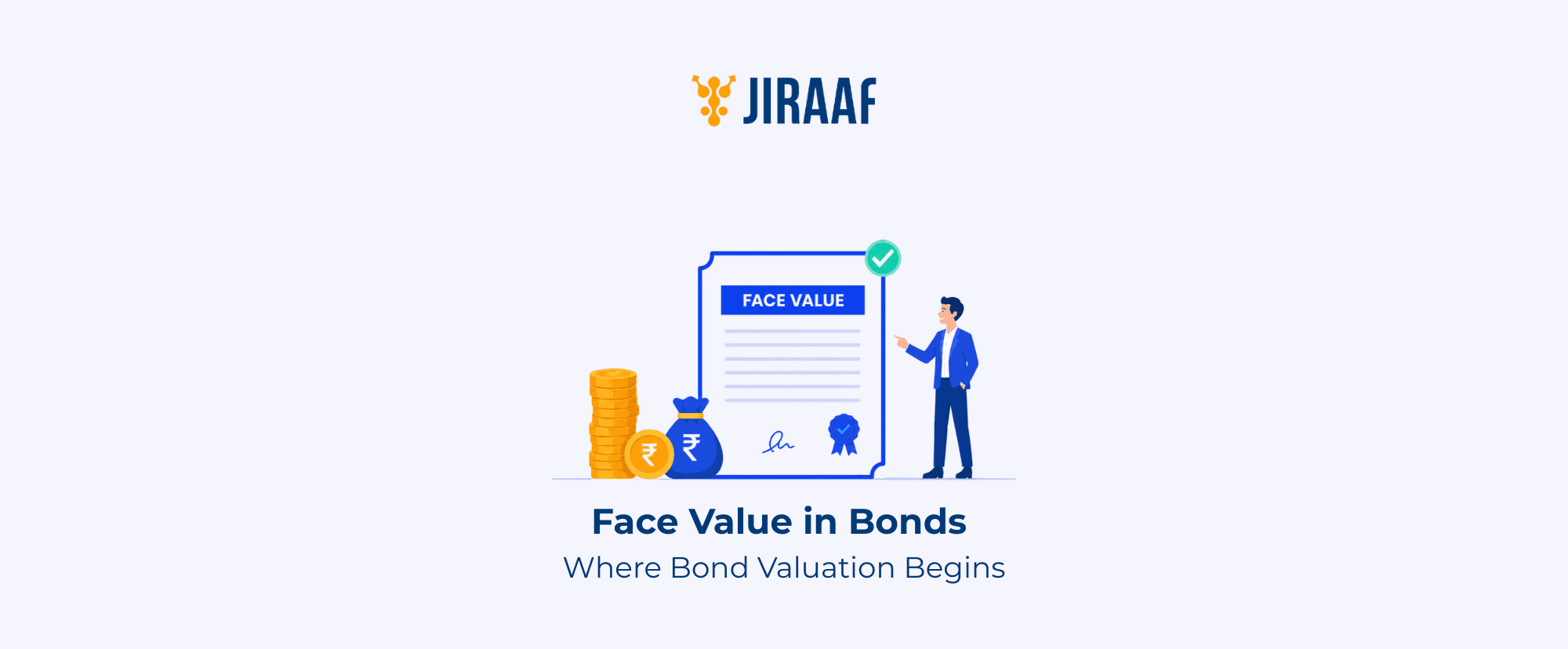
Face value, also known as par value, is the amount the bond issuer agrees to repay at maturity. When a bond is issued, this amount is fixed upfront. Face value defines the issuer’s repayment obligation at maturity, and it sets the base for coupon calculations.
For example, if a bond has a face value of ₹1,000 and a coupon rate of 8%, the issuer pays a fixed coupon of ₹80 (8% of ₹1,000) annually as interest. At maturity, the issuer repays the ₹1,000 face value along with the final coupon payment. The market price may have moved significantly between issuance and maturity. The cash flows do not change because the coupon is fixed to the face value.
That distinction matters more once a bond enters the secondary market. The price you pay to acquire a bond may differ from its face value, but the income it generates and the amount repaid at maturity are both anchored to the face value.
Face Value vs Principal Amount vs Market Price
Face value, principal amount, and market price describe different aspects of the same bond.
For a single bond unit, the face value and principal amount refer to the same number: the amount the issuer is obligated to repay. When you hold multiple bond units, your principal amount is the face value of the bond multiplied by the number of bond units.
Market price is different in nature. It reflects what you would pay to acquire a bond at a given point in time, and it shifts continuously based on interest rates, credit conditions, and liquidity.
| Aspect | Face Value in Bonds | Principal Amount | Market Price |
| Meaning | The fixed reference value of the bond used for coupon and maturity calculations | The amount of money originally borrowed by the issuer that must be repaid at maturity | The price you pay to buy the bond in the market |
| Also called | Par value, nominal value | Principal, original amount, borrowed capital | Trading price, secondary market price |
| What it determines | Coupon payments, maturity repayment, and many yield calculations | The repayment obligation of the issuer | Whether the bond is bought at a premium, discount, or par |
| Changes over time? | No, it stays fixed through the bond’s life | Fixed for a standard bond | Yes, it changes with interest rates, demand, credit risk, and time to maturity |
| Relationship to each other | In most bonds, face value and principal amount are used interchangeably | Often equals face value in standard bonds | Can be above, below, or equal to the face value and principal |
| Example | If the face value is ₹1,000, coupons are calculated on ₹1,000 | If the bond was issued at ₹1,000, that is the principal to be repaid | The bond may trade at ₹980, ₹1,020, or ₹1,000 in the market |
Why do Bonds Trade Above or Below Face Value?
A bond’s coupon is calculated on face value and does not change. When interest rates in the market rise above a bond’s coupon rate, newer bonds offer better returns. This makes existing bonds less attractive, so their price falls until the return matches market levels. When interest rates fall below a bond’s coupon rate, existing bonds offer better returns than new ones. This increases demand for those bonds, pushing their price above face value until returns align with the market again.
Depending on where they trade relative to face value, bonds are generally categorized as:
- Premium bonds: These bonds trade above face value. Their coupon rate exceeds current market yields, so you pay more for that income advantage. Since the issuer still repays only face value at maturity, the premium paid reduces the overall yield.
- Discount bonds: These bonds trade below face value. Their coupon rate is below current market yields, so you pay less than face value to compensate. At maturity, they receive face value, which is higher than the purchase price. That difference supplements the coupon income and is already reflected in the yield.
- Par bonds: These bonds trade at face value when their coupon rate broadly matches prevailing market yields. The return comes from coupon income alone, with no price gain or loss at maturity.
Credit quality and time to maturity also influence where a bond trades relative to face value. A deteriorating credit rating can push a bond to a discount independently of interest-rate movements, while longer-dated bonds tend to experience larger price changes for a given shift in yields. However, for investment-grade bonds, interest rates remain the primary driver under normal market conditions.
The price paid relative to the face value directly affects total return. A discount bond offers a lower coupon but delivers a higher yield when you factor in the gain at maturity. A premium bond may offer a higher coupon but a lower yield because of the premium paid upfront.
How does Face Value Influence Bond Returns?
Face value plays an important role in how bond returns are calculated.
Coupon Payments and Face Value
When you hold a bond with a face value of ₹1,000 offering an 8% coupon rate, you receive ₹80 annually regardless of whether you paid ₹950 or ₹1,050 for it. The coupon does not adjust when the market price moves. What changes is how that fixed ₹80 translates into yield, depending on what you paid. Your coupon payments are always proportionate to the face value.
Yield Calculations and Face Value
Current yield divides the annual coupon by the market price. If you paid ₹950 for a bond paying ₹80 annually, your current yield is 8.42%, not 8%. That difference arises from the gap between your purchase price and face value.
Yield to maturity (YTM) includes all parts of a bond’s return: the interest you receive every year, the price you paid to buy the bond, how long you hold it until maturity, and the face value you get back at the end.
If you bought at ₹950, the ₹50 you gain at maturity is built into your YTM. If you bought at ₹1,050, that ₹50 loss at maturity pulls your YTM below the coupon rate. YTM is effectively the rate that equates all future cash flows, including coupons plus face value repayment, back to your purchase price. This is why two bonds with identical coupon rates can offer very different returns depending on what you pay for them.
What Investors Receive at Maturity
At maturity, the issuer repays face value, not what you paid for the bond in the secondary market. If you bought at a discount, you receive more than your purchase price. If you bought at a premium, you receive less. Neither outcome affects the issuer’s obligation; both directly affect your realized return. The price you pay relative to face value shapes your total return, not just the coupon rate.
How Should Investors Use Face Value when Evaluating Bonds?
Face value gives you the contractual baseline of what the issuer promises to pay. The investment decision starts there, but the following factors also shape the decision:
Understanding Bond Cash Flows
Before comparing yields or credit profiles, use face value to understand what the bond actually pays over its life. Both coupons and face value tell you how much you receive periodically, and what comes back at the end. For investors like you, managing liquidity or planning around specific time horizons, the cash flow map often matters more than where the bond is trading on any given day.
Evaluating Yield Against Purchase Price
Two investors can hold the same bond and earn different returns if they paid different prices. The coupon and maturity repayment are identical. What differs is the entry price relative to face value, and that gap is what yield to maturity captures. If you pay ₹950 for a ₹1,000 face value bond, your YTM is higher than the coupon rate because the ₹50 maturity gain supplements your income. If you pay ₹1,050, your YTM falls below the coupon rate because the ₹50 loss at maturity offsets part of it. The more useful question is what return you are likely to earn from the price you are paying today.
Looking Beyond Face Value
Face value and coupon rate explain the contractual cash flows of a bond, but they do not fully explain investment outcomes. Credit quality, maturity profile, and interest-rate sensitivity can differ significantly across bonds and influence both risk and return.
One issuer may carry a stronger credit rating. One bond may mature in three years while another matures in ten. Longer-dated bonds generally experience greater price movements when interest rates change, which means they can carry higher interest-rate risk even when face value and coupon rates are identical.
Face value tells you what the issuer has promised to repay. Credit quality indicates the issuer’s ability to meet that promise, and maturity profile influences how long your capital remains invested and how sensitive the bond is to changing market conditions. Evaluating all three together provides you a more informed basis for comparison.
Conclusion
Face value anchors a bond’s structure, but returns depend on how it interacts with market price and time. The entry price and the yield it implies play a more direct role in determining outcomes over the holding period.
When you evaluate bonds, you may consider looking beyond coupons and face value. Interest rates, credit quality, and time to maturity can influence how a bond performs after purchase.
This helps you move from simply understanding what a bond is to assessing what it can deliver for you in current market conditions.