Summary: Bonds are fixed-income instruments through which investors lend money to governments or companies in exchange for regular interest payments. This guide explains what bonds are, how they work, the different types available in India, their benefits, risks, and how investors can start investing in bonds through regulated platforms.
Quick Overview
- Bonds are like loans, where investors lend capital to corporations or governments that issue them in exchange for regular interest payments
- These are fixed-income instruments through which you can typically gain fixed returns with relatively lower risk compared to equity.
- Regulated platforms in the Indian debt market help retail investors gain access to investment-grade corporate bonds
- Authorized agencies provide credit ratings, which assess the credit profile of issuers.
When investors buy bonds, they lend money directly to an organization in exchange for fixed interest payments and repayment on a predetermined date. As India’s bond market becomes more accessible through regulated online platforms, understanding how bonds work, the risks involved, and how returns are generated has become increasingly important for investors. This guide explains what bonds are in detail.
Defining Bonds in Simple Terms
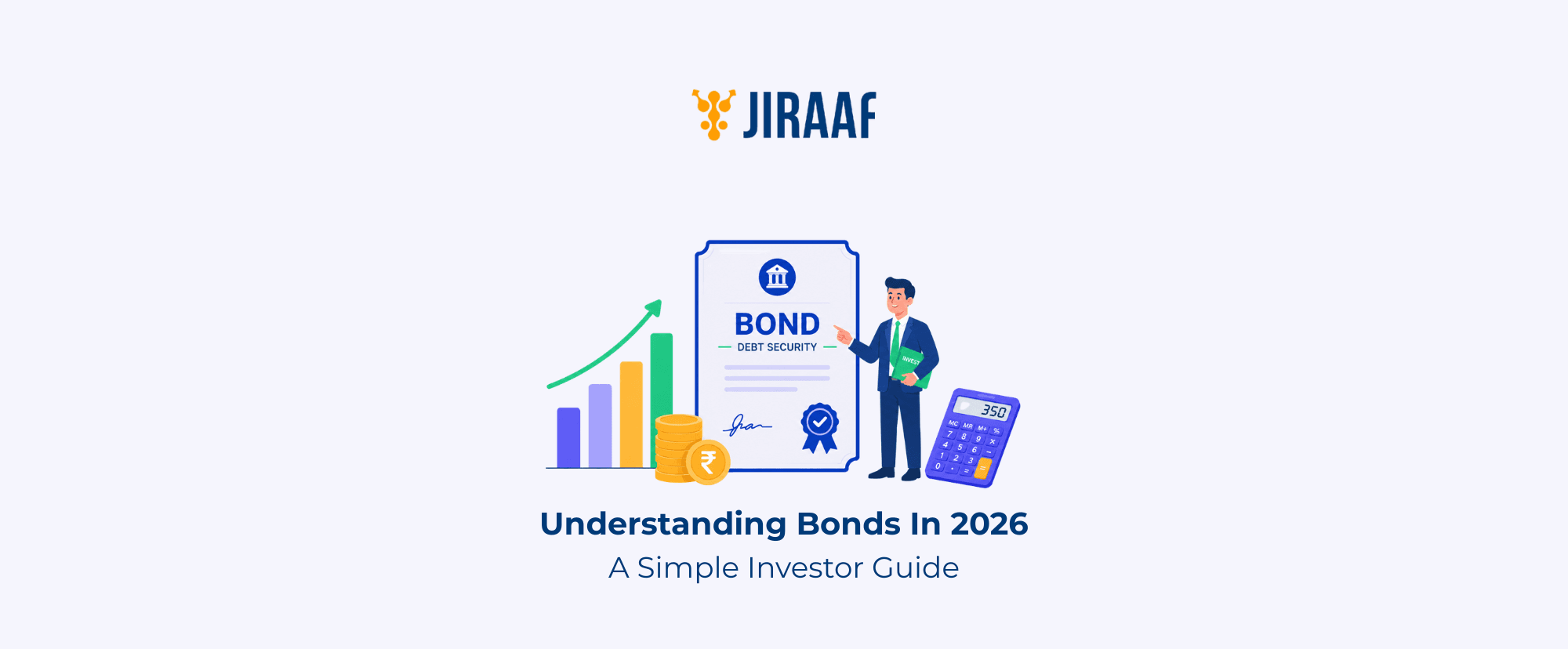
A bond is a fixed-income instrument that represents a loan made by an investor (principal amount) to a borrower/issuer of the bond, usually a company or government, for a defined period at a fixed interest rate. It bridges the gap between issuers looking to raise capital and investors seeking fixed-income returns.
The fixed periodic interest payment is called the coupon. The original amount that an issuer agrees to repay is called the face value and the date on which the agreement ends is the maturity date.
Core Components of a Bond
Three terms come up consistently when evaluating bonds.
| Term | What It Means |
|---|---|
| Face value | The principal amount the issuer agrees to repay when the bond matures. This is also the base figure used to calculate yield on a bond. |
| Coupon rate | The annual interest rate paid by the issuer, expressed as a percentage of face value. Coupon payments are usually made as mentioned in a bond indenture. Typically, they are paid monthly, quarterly, semi-annually, or annually |
| Maturity date | The specific date the bond term ends, and the issuer returns the face value |
A few other terms come up regularly once investors start looking at actual listings. Such as:
- Yield: It refers to the effective return on a bond, which can differ from the coupon rate depending on the price paid at purchase.
- Credit rating: Credit rating is the grade assigned by an independent agency, reflecting the issuer’s assessed ability to meet payment obligations.
- Market price: It is the price at which the bond trades in the secondary market. Market price moves with changes in interest rates and shifts in the issuer’s credit standing.
How do Bonds Work and Generate Returns?
Bonds earn returns for investors through two channels.
The first is interest income. The issuer pays a fixed coupon on a set schedule throughout the life of the bond. The dates are known, the amounts are known, and barring a default, those payments are generally made according to the bond terms unless a default occurs.
The second channel is capital gains. Bonds can be bought and sold in the secondary market before maturity. If interest rates fall after an investor buys a bond, its market price tends to rise. Selling at that point means earning the difference between the purchase price and the sale price.
The reverse is also true. If rates rise, the market value of the bond drops. Selling before maturity in that environment could result in a loss.
Here is a practical example. Assume an investor buys a bond with a face value of ₹10,000 and a 10% annual coupon rate. Every year, they receive ₹1,000 in interest. When the bond matures after five years, the original ₹10,000 is returned. The total interest earned over the full tenure is ₹5,000. If they sell the bond in the secondary market before maturity, overall returns may reflect either a gain or a loss, depending on market conditions.
If the investor plans to hold the bond until maturity, the coupon rate is the figure that is often used to estimate expected cash flows. The bond’s yield may differ from the coupon rate if the purchase price was above or below face value.
Common Types of Bonds in the Indian Market
India’s bond market has several categories of instruments, each built for a different purpose and serving investors with different risk profiles. Here are the two main categories of bonds, based on who issues them:
Corporate Bonds
Private or public companies issue corporate bonds when they need funds for various business operations or expansions. They may also issue bonds to raise working capital. The yields for corporate bonds are higher compared to G-secs, as they carry credit risk linked to the issuer’s financial health. Investment-grade corporate bonds with credit ratings of AAA to BBB- generally carry lower credit risk.
Government Securities (G-secs)
The Reserve Bank of India (RBI) issues government securities on behalf of the central government. The risk of default is the lowest for G-Secs among all bond categories in India, as they carry sovereign backing.
Short-term G-secs are called treasury bills (T-bills), with a maturity of less than one year. T-bills are available with maturities of 91, 182, or 364 days.
Government bonds are long-term dated securities with maturities ranging from 1 to 40 years.
Compared to corporate bonds, yields on G-secs are lower. However, they carry one of the highest safety profiles among Indian debt instruments.
Understanding Credit Ratings and Risk
There is one point worth understanding about bonds. The return on a ₹10,000 bond from an established large-cap company and a ₹10,000 bond from a mid-sized NBFC are not the same. The face value might match, the tenure could be similar, but the underlying return can differ because of the creditworthiness of both issuers.
In India, agencies like Credit Rating Information Services of India Limited (CRISIL) and Investment Information and Credit Rating Agency (ICRA) evaluate an issuer and assign a grade. They assess:
- How much debt the company carries
- How steady its cash flows have been
- What its profit margins look like
- How it has performed during difficult economic periods
The rating that comes out of that process gives you a simplified way to compare one issuer against another.
Investment-grade bonds range from AAA to BBB-. Within that band, risk and yield both shift as you move down the scale.
| Rating | Risk Profile | Yield Range |
| AAA/AA+ | Lowest | 7.20% – 8.00% |
| AA/AA- | Low | 8.00% – 9.5% |
| A+/A/A- | Low to Medium | 9.5% – 11.00% |
| BBB+/BBB/BBB- | Medium to High Risk | 11% – 14% |
Note: Yields as of May 2026. Ratings below BBB- are considered junk bonds and carry significantly higher credit risk.
These numbers are indicative. The actual yield on any bond depends on:
- The financial position of the issuer
- How long the tenure runs
- What credit spreads look like at the time of purchase
- The broader interest rate environment
A higher yield is compensation for higher credit risk. It is not, on its own, an indicator that the bond is a better fit.
Bonds rated BB+ or below fall into speculative-grade territory. These instruments carry significantly higher credit risk and are distinct from investment-grade bonds.
Comparing Bonds with Other Fixed-Income Options
While bonds are among the more widely known debt investment options, they can be compared with other fixed-income options as well for better understanding. Fixed-income alternatives most Indians are already familiar with are:
Fixed deposits (FDs)
Traditional Bank FDs come with deposit insurance up to ₹5 lakh through the Deposit Insurance and Credit Guarantee Corporation (DICGC), which provides limited deposit protection. Generally, investment-grade corporate bonds provide better yields than traditional FDs.
Savings accounts
Savings accounts are suitable for money needed in the short term. Returns, though, are modest. Most accounts pay somewhere between 2.5% and 4%. If an investor’s money can stay invested for a year or longer, even a modest difference between the interest earned on a savings account and the yield offered by a bond can lead to a noticeably different income outcome over time due to the effect of compounding and higher fixed returns.
Debentures
Private companies issue debentures, which may be secured or unsecured. Non-Convertible Debenture, or NCD, is easily accessible by retail investors. Unlike convertible debentures, which can be exchanged for equity shares of the issuing company after a fixed period, NCDs cannot be converted. They pay a fixed interest rate and return the principal at maturity. Listed NCDs can be bought and sold on stock exchanges before maturity, similar to bonds. NCDs typically offer higher yields than FDs and government bonds, but they carry issuer-specific credit risk.
How to Start Investing in Bonds in India
In the past, the process of investing in corporate bonds in India was more complex than it is today. That has changed considerably, largely thanks to Online Bond Platform Providers (OBPPs) that have streamlined the experience.
Here are the general steps to invest in bonds in India.
- Open a demat account. This is where bond holdings are stored electronically.
- Complete Know Your Customer (KYC) verification with identity proof, address proof, and PAN details.
- Browse bond listings on an OBPP. These listings typically show the credit rating, coupon rate, tenure, yield, and issuer background.
- Select an instrument that aligns with your return expectations, risk comfort, and investment horizon.
- Complete the transaction digitally through the platform.
Jiraaf is one such OBPP, regulated by the Securities and Exchange Board of India (SEBI). The platform researches and lists investment-grade corporate bonds and offers access to relationship managers and transparent updates on repayment schedules throughout the holding period.
Conclusion
Bonds are one of the simpler ways to build a predictable income component in a portfolio. The key variables are who the investor is lending to, for how long, and how much credit risk they are taking on relative to the yield they receive.
India’s debt market in 2026 offers wider access and more variety than it did even a few years ago.