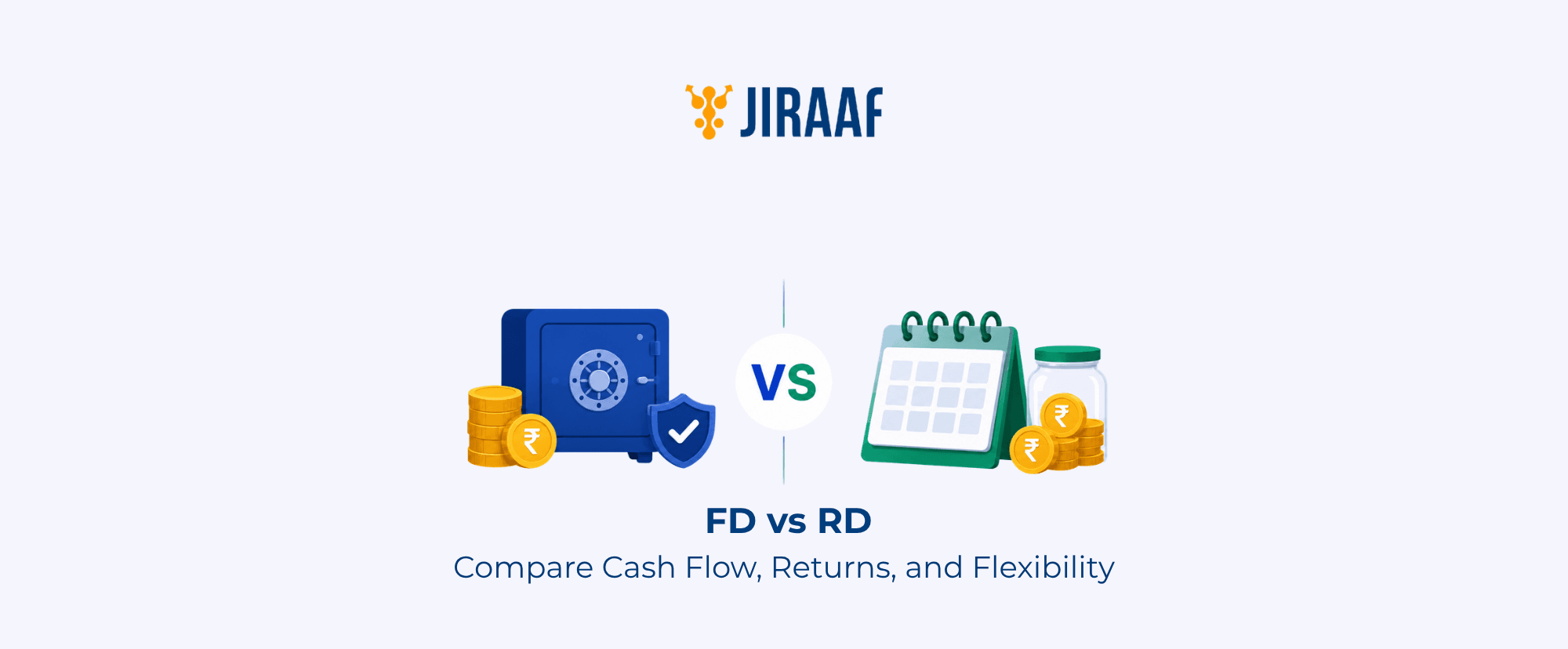
Summary: A fixed deposit (FD) and a recurring deposit (RD) are fixed-income investment options that offer predictable returns but differ in how the timing of your investment affects compounding over time. This guide covers the difference between FDs and RDs, how their investment mechanics affect returns, when each is the better choice, and how they fit into a disciplined fixed-income strategy.
Quick Overview
- FDs and RDs are not interchangeable terms or assets
- An FD helps you put an existing lump sum to work immediately, while an RD helps you build wealth gradually through regular savings
- The same interest rate doesn’t mean the same return from FD and RD
- Choose between an FD and an RD based on your cash flow
- Check liquidity, tax, tenure, and your actual goal before you lock money in
- Once your savings grow, it’s worth asking if your FD/RD split still makes sense
The choice between a Fixed Deposit (FD) and a Recurring Deposit (RD) isn’t really about which investment is better. It’s about which one matches the way money is available. For someone with a lump sum, the answer may be straightforward. For someone investing from a monthly income, it isn’t. This comparison breaks down the differences that actually influence that decision, from returns and flexibility to liquidity, tenure, and who each option is best suited for.
What are a Fixed Deposit (FD) and a Recurring Deposit (RD)?
An FD is a one-time lump-sum investment and one of the most popular fixed-income options. Your money starts earning returns from the day you invest and remains invested for a fixed tenure. It may be suitable for you if you already have surplus funds and want stable returns. If you withdraw the deposit before maturity, the institution may levy a penalty. Banks and NBFCs offer different types of FDs for Indian residents and NRIs at varying interest rates.
An RD is also a fixed-income investment, but instead of a lump sum, you contribute a fixed amount every month. Similar to an FD, an RD runs for a fixed tenure and offers fixed returns based on your monthly investment amount. With each monthly contribution, your principal grows, and the returns you earn depend on how long each installment stays invested. At the end of the tenure, you receive the entire invested amount along with the compounded returns. Like FDs, RDs also offer capital preservation. They are generally suitable for you if you want to build a corpus gradually through regular monthly savings.
Difference Between Fixed Deposit and Recurring Deposit
The interest you earn on a lump sum works differently from the interest you earn on monthly contributions. Understanding these mechanics can help you decide which product fits your situation.
How Your Capital Starts Earning Returns
Since an FD deploys your entire investment from day one, the full principal starts earning interest immediately. For cumulative FDs, banks generally calculate and compound interest quarterly, allowing your investment to earn interest on both the principal and previously accumulated interest. That means your FD investment starts earning interest on interest.
Banks also offer non-cumulative FDs, where the interest stays separate from the principal. Depending on the payout schedule you choose (monthly, quarterly, half-yearly, or annual), the bank pays out the interest separately. Since the interest doesn’t compound into the principal, you get fixed returns at your chosen interval for the entire tenure, without compounding.
With an RD, you earn interest only on the amount you’ve already deposited. Even if your total investment amount and interest rate stay the same across FD and RD, the duration each rupee stays invested varies.
For example, in a 12-month RD, your first monthly installment remains invested for the full year, while your last installment stays invested for only one month. As a result, they earn different amounts of interest.
This affects compounding and your final maturity value. RDs are strictly cumulative, so your interest continues to earn interest throughout the tenure. You receive the principal along with the total interest earned only when the RD matures.
How Cash Flow Influences Your Choice
An FD is generally suitable if you already have surplus funds available for investment. If you are building savings gradually from your monthly income, an RD may be a more practical option. If you don’t need the capital right away and can wait until the end of the tenure, an FD earns a higher return than a savings account. But not everyone has surplus cash available. Opening an RD can help you build a savings habit and grow the amount you invest over time.
Cash flow is the primary criterion for choosing between an FD and an RD. If your surplus funds are irregular, you may find FD more suitable than committing to the fixed monthly payments that an RD requires.
Liquidity and Investment Commitment
Once you invest the capital, FD needs no further management or contributions. Your principal stays invested throughout the entire tenure. On the other hand, RD spreads your commitment across monthly deposits throughout the tenure, so while you can start with a smaller amount, you must maintain your monthly deposits.
Premature withdrawal is generally permitted for both FDs and RDs, subject to the institution’s terms and applicable penalties, which may reduce your effective returns.
Why FD and RD Returns Differ
Interest rate, invested amount, and length of investment determine your returns from an FD or RD. Because FD deploys your full principal from day one, it can generate higher returns than RD for the same total investment. You would choose RD for disciplined savings rather than to maximize returns on capital you already have.
Suppose you invest a total of ₹1.2 lakh at the same interest rate. An FD starts earning interest on the full ₹1.2 lakh immediately, while an RD earns interest only on the installments already deposited. As a result, the FD generally generates a higher maturity value.
Taxation and TDS
Your FD and RD returns count as part of your total income, and you pay tax on them at your income tax slab rate. For both, TDS applies at 10% if you’ve submitted your PAN, or 20% if you haven’t, once your total interest income from FDs and RDs in a financial year crosses ₹50,000 (₹1,00,000 if you are a senior citizen). The bank deducts TDS when the interest is credited or paid, whichever is earlier. In practice, banks usually deduct it when the interest is credited, even if the deposit matures later
Under Section 393 of the Income-tax Act, 2025 (the provision previously known as Section 194A of the Income-tax Act, 1961), banks club together your interest income from FDs and RDs held with them and calculate TDS on the combined amount.
For example, if you earn ₹40,000 in annual interest from an FD and another ₹40,000 from an RD at the same bank, the bank deducts 10% TDS on the combined ₹80,000. But if you hold the FD at one bank and the RD at another, the ₹40,000 credited by each bank stays below the ₹50,000 limit, so neither bank deducts TDS.
Whether or not TDS gets deducted, you remain liable to pay tax on your total annual income at your applicable slab rate. You then adjust your final tax liability against any TDS already paid.
| Parameter | Fixed Deposit (FD) | Recurring Deposit (RD) |
|---|---|---|
| Typical tenure | 7 days to 10 years | 6 months to 10 years |
| Minimum investment | Varies by bank | Fixed monthly installment, as specified by the bank |
| Interest payout | Cumulative or periodic payout options | Interest paid with the maturity amount |
| Premature withdrawal | Usually allowed with applicable penalties | Usually allowed with applicable penalties |
| Loan facility | Commonly available against the deposit | Available at some banks, subject to terms |
| Tax-saving option | 5-year tax-saving FD available | No tax-saving variant |
| Best suited for | Parking an existing lump sum | Building a corpus through regular savings |
Why the Same Interest Rate Doesn’t Mean the Same Return
One common mistake when choosing between FD and RD is comparing only the interest rates. Identical interest rates do not generate identical returns. FD earns interest on the full principal from day one, while RD earns interest only on the amount already deposited. The timing of your investment, not just the interest rate, influences your final return.
For example, say you have ₹1,20,000 in surplus cash that you won’t need for a year. You could invest it in a 6.5% FD with a one-year tenure, or a 6.5% RD for 12 months, staggering your investment through monthly deposits.
Here’s how your investment earns returns from the FD:
● Total Principal Invested: ₹1,20,000
● Total Interest Earned: ₹7,992
● Final Maturity Value: ₹1,27,992
Returns from the RD are:
● Total Principal Invested: ₹1,20,000
● Total Interest Earned: ₹4,286
● Final Maturity Value: ₹1,24,286
With the RD, your money goes to work slowly. Your first ₹10,000 deposit earns interest for a full year, but your final ₹10,000 deposit earns interest for only a single month. Because a large portion of your cash sits outside the bank waiting to be deposited, the RD’s final maturity value ends up ₹3,706 lower than the FD’s.
If you have surplus cash, investing the entire amount in an FD in one go earns higher returns than using an RD. An RD suits you if you don’t have surplus cash on hand but want to build a savings habit and grow your wealth gradually.
Choosing Between an FD and an RD
Your cash flow should determine your choice, not the other way around. Matching the product to your income pattern often leads to better financial outcomes.
If you expect interest rates to fall, locking into an FD now can help you preserve today’s rate for your chosen tenure. If you are still building your savings, RD lets you invest gradually while keeping your savings habit disciplined.
You can choose an FD if:
- You already have a lump sum
- You receive a bonus or windfall
- You want to maximize returns on idle cash
- You are building an emergency fund
- You want predictable returns without making monthly contributions
You can choose an RD if:
- You want to develop disciplined saving habits
- You are saving for a planned expense
- You cannot invest a large amount up front
If you’re comparing fixed-income options beyond traditional bank deposits, platforms such as Jiraaf can help you evaluate high-yield FDs and other fixed-income instruments based on returns, tenure, and issuer profile.