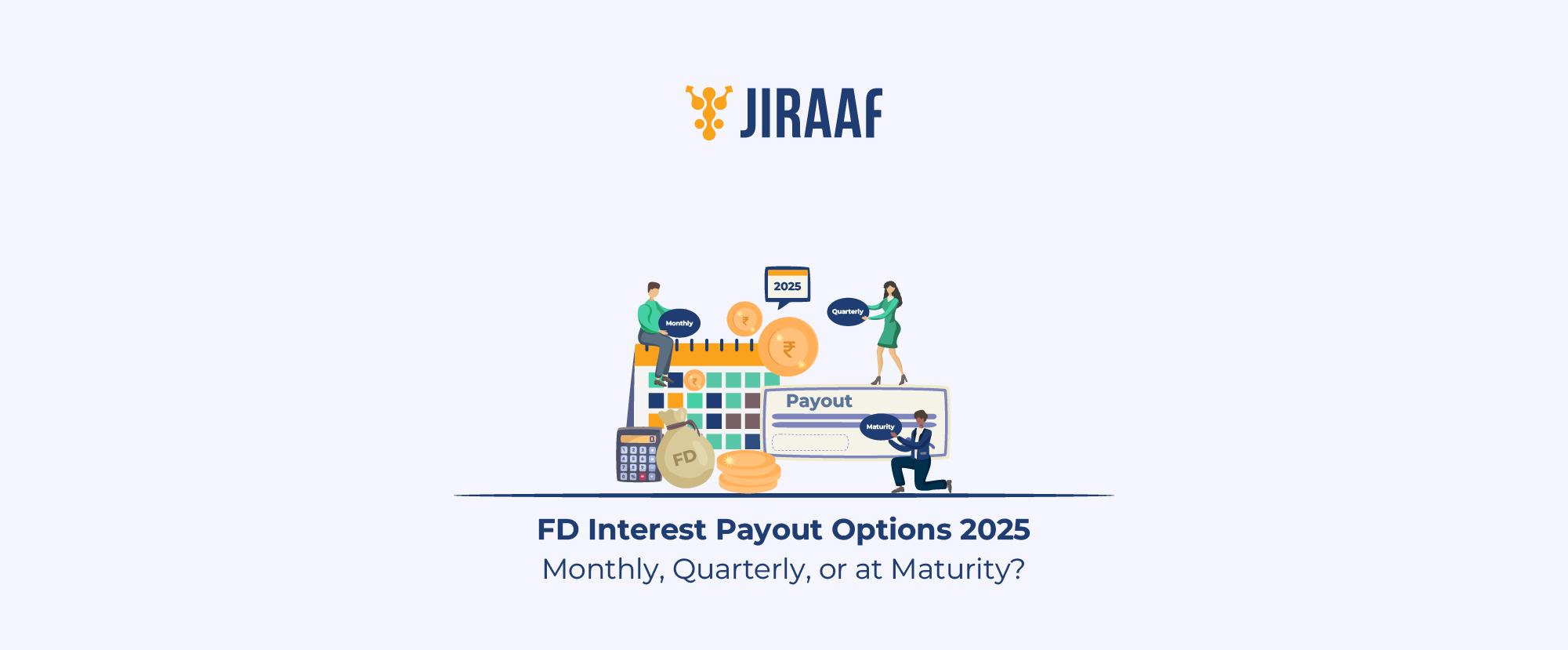
Understand FD interest payout options like monthly, quarterly, and maturity payouts, and learn how each impacts your returns, taxes, and cash flow.
When you invest in a fixed deposit, the interest rate is usually the first thing you look at. But an equally important decision to consider is when that interest is paid to you. The payout structure you choose can shape your cash flow, affect how efficiently your money compounds, and even influence how you plan for short-term expenses or long-term goals.
In the next sections, we will break down what an interest payout in an FD is, types of payouts available, taxation on FDs, and much more.
What is Interest Payout in FD?
An interest payout refers to the frequency at which you receive interest on your investment. Within FD’s context, two types emerge.
- Cumulative FDs, that pay all the interest along with the principal at maturity
- Non-cumulative FDs, that distribute interest regularly, similar to a bond
Depending on your cash flow requirements, you can select between monthly, quarterly, semi-annual, or annual payout choices. Let’s break down each type of payout option in FDs for better understanding.
Types of Payouts in FDs
The following are the most common types of payout options available in FDs.
Monthly Payout FD
The interest is paid out every month, similar to a salary. This type of FD is ideal if you are seeking a steady, recurring income, especially during times like retirement.
Quarterly Payout FD
A quarterly FD pays out interest every 3 months. It is ideal for you if you are a salaried individual and do not need a steady source of income every month, but want to meet miscellaneous expenses occasionally, like a vacation.
Half-yearly Payout FD
Here, the interest on the FD is paid out every 6 months. This is the ideal solution for individuals seeking to reinvest or align with their semi-annual expenses.
Yearly Payout FD
Yearly payout FD pays interest at the end of each year. This option is appealing if you want a decent sum at the end of every year to reinvest or manage your tax planning.
Payout at Maturity FD
A payout at maturity FD or a cumulative FD locks in your interest payments till it matures. If you choose this option, you receive interest along with the principal in a lump sum at maturity.
Now that the different payout options are clear, let’s understand how each one plays out with simple examples.
Impact of Payout Frequency on Effective Returns
The frequency at which you receive returns impacts your overall utilization of the interest as well as your financial goals. Let us understand the impact of payout frequency by taking the case of 4 friends.
Mr. A, Mr. B, Mr. C, and Mr. D each invest ₹5,00,000 in a 3-year FD at 8% interest. Everything else is the same; the only difference is their payout choice.
- Mr. A chooses a monthly payout
- Mr. B chooses a quarterly payout
- Mr. C chooses a half-yearly payout
- Mr. D chooses payout at maturity
With each friend receiving ₹1,20,000 as the total interest, here is how their payout differs:
- Mr. A (Monthly payout): ₹3,333 per month
- Mr. B (Quarterly payout): ₹10,000 per quarter
- Mr. C (Half-yearly payout): ₹20,000 every 6 months
- Mr. D (Yearly payout): ₹40,000
All payout modes yield the same total interest because interest is withdrawn rather than reinvested. However, Mr. D, who opted for maturity as the payout option, also chose to have interest reinvested, as he isn’t claiming it. So, interest gets reinvested every quarter, and the maturity value becomes ₹6,34,121, with a total interest of ₹1,34,121 on Mr. D’s yearly payout FD.
This is ₹14,121 higher than payout FDs, thanks to the “interest on interest” effect of compounding.
Tax Implications of FD Interest Payout Options
The tax implications of FD interest payout options in India are as follows:
- Interest earned on FDs is fully taxable as per the investor’s income tax slab under “Income from Other Sources.” This applies regardless of the payout frequency, which can be monthly, quarterly, semi-annually, annually, or at maturity. The interest income must be reported on the income tax return.
- Tax Deducted at Source (TDS) is deducted by banks when the interest income from FDs exceeds ₹50,000 per financial year for regular citizens and ₹1,00,000 for senior citizens (FY 2025-26). The TDS rate is 10% if PAN details are provided, and 20% if not.
- TDS on FD interest is deducted when interest is credited or accrued (quarterly/annually). Monthly payout FDs deduct TDS monthly; cumulative FDs deduct TDS annually when interest is internally credited—not at maturity
- Investors can avoid TDS deduction by submitting Form 15G (for individuals below 60 years) or Form 15H (for senior citizens) if their total income is below the taxable limit.
- Interest on tax-saving FDs (lock-in period of 5 years) qualifies for deduction under Section 80C up to ₹1.5 lakh, but the interest earned is still taxable.
Regardless of the interest payout option chosen, FD interest income is taxable according to the income slabs, and TDS is deducted when the interest exceeds the threshold limits, with provisions in place to avoid or claim refunds depending on the investor’s tax status.
Once you know how FDs are taxed, the next step is to decide on the best FD interest payout option.
How to Choose the Best FD Interest Payout Option?
The best FD payout option depends entirely on your financial goals, income needs, and risk appetite:
- Assess your cash flow needs: Do you require a safe, recurring monthly income? Go for a monthly payout. Comfortable without a regular income? Choose cumulative
- Match with financial goals: A yearly payout FD works for annual expenses like fees, insurance, etc. And for long-term wealth building, maturity payout is best
- Consider the returns: Cumulative FDs give the highest effective return due to compounding. Non-cumulative FDs trade return for liquidity
- Look at your tax bracket: Frequent payouts may push you into higher TDS deductions in the year; cumulative may defer it until maturity
- Check flexibility with the bank: Not all banks offer all payout modes (monthly is less common), so confirm before investing
Use online FD calculators before investing to compare effective yields under different payout structures. The small differences can add up significantly over 3 to 5 years, and aligning your choice with your financial plan can maximize returns without compromising on liquidity.
Final Thoughts
The type of payout you choose in an FD can be decided by your current financial situation, the kind of output you want to derive from your investment, and your ultimate financial goal. Beyond interest rates, the payout structure decides how useful your FD is in real life, whether it supports regular expenses, times your cash flows better, or quietly maximizes value through compounding.
Ultimately, customizing your FD payout frequency as per your needs makes it a deliberate part of your overall financial plan.