Tax season has a way of sneaking up on you. One day, you’re going about your routine, and the next, there’s an email from HR with a subject line that reads something like “Final Investment Declaration: Action Required”. Suddenly, you’re scrambling to find insurance certificates, digging through old receipts, and trying to remember every financial decision you made over the past year.
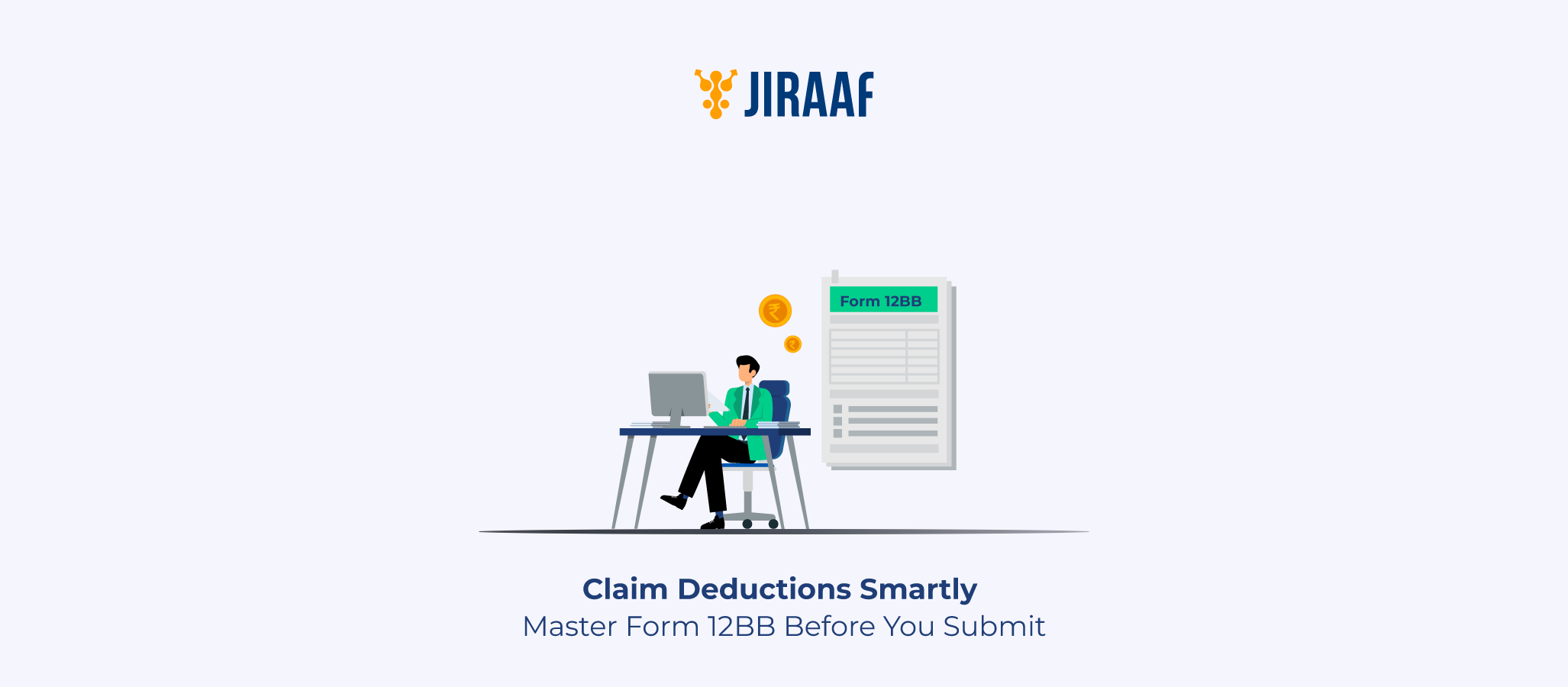
This is exactly the chaotic situation Form 12BB is designed to bring order to. It’s the official document that tells your employer which tax-saving investments and expenses you’ve made during the year, so they can calculate the right amount of tax to deduct from your salary every month. Get it right, and you keep more of your paycheck. Ignore it or rush through it, and you could end up paying more tax than you need to and wait months for a refund.
Here’s everything you need to know about Form 12BB.
What Is Form 12BB?
Form 12BB is an official declaration form submitted by a salaried employee to their employer. It lists all the investments made and expenses incurred during the financial year that qualify for tax benefits.
Introduced under Rule 26C of the Income Tax Rules, Form 12BB serves as a formal statement of claims under Section 192 of the Income Tax Act. In simpler terms, it tells your employer: “Here’s what I’ve invested this year. Please factor this in while calculating how much tax to deduct from my salary.”
Here’s how the timeline typically works: at the beginning of the financial year (around April), you submit an informal or estimated declaration to your employer. This helps them calculate a rough amount of TDS to deduct each month. Then, toward the end of the year (usually in January or February), you submit Form 12BB as the final, definitive declaration with actual proof of investments. Your employer then uses this to correct any excess or shortfall in TDS before the financial year closes on March 31.
Why Does Form 12BB Matter?
The primary purpose of Form 12BB is to bridge the gap between your gross salary and your actual taxable income.
Without it, your employer has no legal basis to factor in your deductions. They’d have to deduct tax on your full salary, which could mean a significantly higher TDS every month and a noticeably smaller take-home pay. You’d eventually get a refund when filing your annual return, but that means waiting months for money that was rightfully yours all along.
By submitting Form 12BB on time:
- You receive the tax benefits you’re entitled to, ensuring your monthly in-hand salary reflects your real tax liability.
- Your employer gets the documentation they legally need to deduct the correct amount of TDS.
It benefits both sides, and yet many employees treat it as an afterthought. Submitting it accurately and on time can make a real difference to your monthly cash flow.
What Does Form 12BB Look Like?
The form is divided into clear sections, each covering a different category of tax-saving claim. Here’s a quick overview of its structure:
- Personal details: Your name, address, PAN, the financial year, and the assessment year
- House Rent Allowance (HRA): Details of rent paid to your landlord
- Leave Travel Concession (LTC/LTA): Evidence of domestic travel expenses
- Interest on home loan: Interest paid on a housing loan under Section 24
How to Fill Form 12BB: A Step-by-Step Guide
Step 1: Fill in your personal information
Start with the basics: your full name, residential address, and Permanent Account Number (PAN). Make sure you enter the correct financial year (for example, 2025–26) and assessment year (2026–27). A small error here can cause unnecessary confusion later.
Step 2: Declare House Rent Allowance (HRA)
If you live in a rented home, this section is for you. Enter the total rent you paid during the financial year.
One important rule to keep in mind here is that if your total annual rent exceeds ₹1,00,000, you’re required to provide your landlord’s name, address, and PAN or Aadhaar number. This is a mandatory requirement, so make sure you have this information ready before submitting.
Step 3: Claim Leave Travel Concession (LTA/LTC)
If you traveled domestically with your family during the year and your employer offers LTA as part of your pay structure, declare the amount spent on travel here. Keep in mind that LTA only covers the actual cost of travel (airfare, train tickets, or bus fares). It does not cover hotel stays, meals, or local sightseeing expenses.
Step 4: Report interest paid on a home loan
If you’re repaying a home loan, enter the total interest paid or payable for the year in this section. You’ll need to provide your lender’s name, address, and PAN to support this claim. Under Section 24(b), the deduction on interest for a self-occupied property is generally capped at ₹2,00,000 per year.
Step 5: List your chapter VI-A deductions
This is often the most detailed section, covering the investments most salaried individuals make. Here are the key sub-sections:
- Section 80C: Covers life insurance premiums, Public Provident Fund (PPF), Equity Linked Savings Schemes (ELSS), home loan principal repayment, and children’s tuition fees. The total cap under 80C is ₹1,50,000.
- Section 80D: Covers medical insurance premiums paid for yourself, your spouse, children, and parents. The limit ranges from ₹25,000 to ₹1,00,000 depending on the age of the insured.
- Section 80CCD(1B): Covers additional contributions to the National Pension System (NPS) beyond the 80C limit, up to ₹50,000.
What Deductions Can You Declare?
Here’s a quick reference table of the most common claims made through Form 12BB under the old tax regime:
| Section | Nature of Claim | Standard Limit |
| 80C | Life insurance, PPF, ELSS, home loan principal | ₹1,50,000 |
| 80D | Medical insurance premiums | ₹25,000 to ₹1,00,000 |
| 24(b) | Interest on home loan (self-occupied) | ₹2,00,000 |
| 80E | Interest on education loan | No upper limit |
| 80TTA | Savings bank interest | ₹10,000 |
It’s worth noting that Form 12BB is relevant under the old tax regime only. If you’ve opted for the new tax regime, most of these deductions don’t apply, and this form may not be necessary for your situation.
Who Should Submit Form 12BB, and When?
Who: Every salaried employee who wants to claim tax exemptions or deductions should submit Form 12BB. This includes pensioners as well, since pension income is treated as deferred salary under the Income Tax Act.
When: Most employers open the final declaration window between January and March. This gives them enough time to adjust TDS deductions for the remaining months of the financial year before it ends on March 31.
How to Download Form 12BB
You can download the standard format of Form 12BB from the Income Tax Department’s official website (incometax.gov.in).
Many companies also provide their own version through the HR or payroll portal, which may come pre-filled with your personal details. Once you’ve filled it out, attach the relevant proofs of investment and submit everything to your payroll or HR department as instructed.
Conclusion
Think of Form 12BB as your year-end financial report card, except this one actually puts money back in your pocket. When you take the time to fill it out carefully, gather your proofs, and submit it before the deadline, you’re not just completing a formality. You’re making sure every rupee you saved counts, every deduction lands where it should, and your employer withholds exactly the right amount of tax, not a paisa more.
The employees who benefit most from Form 12BB aren’t necessarily the ones who invest the most. They’re the ones who stay organized, submit on time, and don’t leave their tax savings to chance. Start collecting your investment proofs early, keep them in one place throughout the year, and when HR sends that email, you’ll be ready, not scrambling.