Your salary might have increased over the years, but so have your expenses, and often at a faster pace. This noticeable rise in your rent, groceries, travel, and other lifestyle costs often leaves you with little room to save or invest in the same proportion as your salary increase. In such an environment, relying on a single source of income can feel limiting.
This is why it becomes important to look beyond your primary source of income and start building a second source of income, either through active efforts or passive income streams.
In this blog, we break down what a second income means, why it matters today, and how you can start building one.
What is a Second Income?
A second income refers to any additional source of earnings beyond your primary job or main business. Much like your salary, it does not run on autopilot. It requires you to consistently show up, whether through a skill, a service, or expertise in a particular field. In that sense, it functions more like a second job or a structured side endeavor than a one-time setup.
The primary role of a second income is to strengthen your financial foundation. It acts as a cushion, reducing your dependence on a single source of income and giving you greater stability and flexibility in managing expenses, savings, and future goals.
An individual can have an active second income as well as a passive second income through activities like freelance work, content creation, tutoring, running a small online business, or dividends earned from a stock.
Note: While passive income sources like dividends or rental income also supplement your primary earnings, they operate on a different model altogether, one that is driven by capital investment rather than active effort.
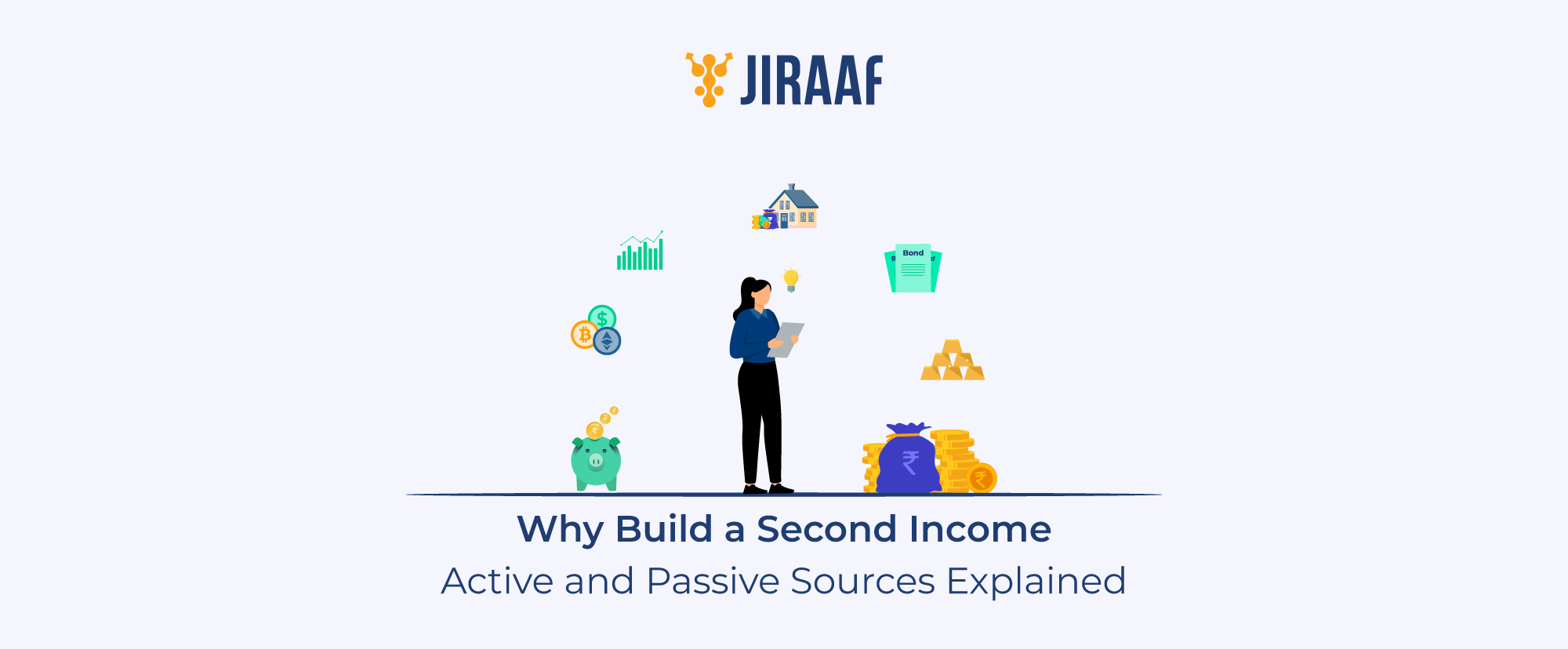
Types of Second Income: Active vs Passive
Not all second income sources function the same way. Broadly, they can be classified into active income and passive income, based on the level of effort required to generate earnings.
| Parameter | Active Second Income | Passive Income |
| Effort required | Requires continuous time, skill, and involvement | Requires minimal ongoing effort after initial investment |
| Income dependency | Directly linked to the amount of work done | Not directly dependent on time once established |
| Scalability | Limited by time and capacity | Can scale with capital or systems in place |
| Income stability | Can fluctuate based on demand and consistency | Relatively stable if the underlying source is reliable |
| Examples | Freelancing, tutoring, content creation | Bond coupons, dividends from stocks, rental income generated from a property |
Now that you have understood the concept of second income, the next step is to see why it has become increasingly important in today’s economic environment.
Importance of Second Income in Today’s Economy
Recent data reflects how household budgets are evolving. Urban quarterly expenses have moved from ₹52,711 in 2022 to ₹73,579 by March 2025, significantly increasing the baseline cost of maintaining a lifestyle.
This makes income diversification a more relevant consideration than before. Additionally, building a second income helps in:
- Creating a buffer during uncertain times
Events like COVID-19 showed how quickly income streams can be disrupted. A second income provides an additional layer of security; not just when your primary income is affected, but also when expenses exceed your regular earnings, helping you manage financial gaps without disrupting your plans.
- Helps you keep pace with rising expenses
As inflation pushes up everyday costs, an additional income stream helps maintain your lifestyle without putting pressure on your primary earnings.
- Accelerates emergency fund creation
Instead of relying solely on your salary, a second income allows you to build a contingency fund faster and more comfortably.
- Supports lifestyle goals without financial strain
Whether it’s a vacation, gadget upgrade, or an occasional big purchase, a second income lets you plan these expenses without disturbing your core budget.
- Strengthens long-term financial preparedness
Additional income can be channeled towards investments, helping you build a retirement corpus or achieve long-term financial goals more efficiently.
In essence, a second income strengthens your ability to manage both expected and unexpected financial needs more effectively.
Types of Additional Income Sources to Explore
Once you understand the difference between active and passive income, the next step is to explore where these income streams can actually come from.
Active Second Income
This type of income requires you to put in active time by doing activities like:
- Content Creation
Creating videos, reels, or posts on platforms like YouTube or Instagram and monetizing through ads, sponsorships, or subscriptions.
- Selling Digital Products
Designing and selling e-books, courses, templates, or digital tools that solve a specific problem.
- Freelancing
Offering services such as editing videos, social media management, website development, marketing, or consulting on a project basis to clients.
- Blogging
Writing blogs around a niche (finance, travel, tech, etc.) and earning through ads, affiliate marketing, or brand collaborations.
These options help you build earning capacity, but they require consistency and effort to sustain. While active income sources help you increase your earning potential, passive income sources focus on creating steady earnings with minimal ongoing effort.
Passive Income Sources
Passive income sources generate earnings with little to no daily involvement once the initial setup or investment is made. These sources require you to invest in:
- Corporate and Government Bonds
Investment-grade corporate bonds as well as government bonds can help you earn regular coupon payouts by investing in fixed-income instruments, offering predictable income over time.
- Fixed Deposits (FDs)
Fixed deposits offer a stable way to earn assured returns up to ₹5 lakhs under Deposit Insurance and Credit Guarantee Corporation (DICGC) insurance coverage, making them a simple, low-risk passive income option.
- Real Estate (Rental, Commercial & REITs)
Buying a flat or a shop can help you generate recurring rental income. However, real estate options such as Real Estate Investment Trusts (REITs) allow you to earn dividend income with relatively lower capital compared to buying and renting a property. You can invest in a single unit of a RIET in ~₹400. However, SEBI still mandates a minimum application value of ₹10,000 to 15,000 for initial subscriptions through IPO or FPOs.
- Stock Dividends
You can also invest in dividend-paying companies to receive a portion of profits as regular income.
These income streams focus on making your money work for you, helping you reduce reliance on active effort over time. However, there is one catch you should know about.
Can Active Second Income Become Passive Income Over Time?
While a second income is broadly classified into active and passive, in practice, the line between the two is not always rigid. There is often a natural overlap, where an active income stream can gradually evolve into a passive one over time.
For instance, content creation typically starts as an active effort; you invest time in creating videos, posts, or courses. However, once this content is published and gains traction, it can continue to generate income through ads, royalties, or subscriptions with minimal ongoing effort.
Similarly, digital products, online courses, or even certain service-based businesses can transition from being effort-driven to more system-driven.
That said, this transition takes time and is the exception, not the rule. For most people starting out, a second income is built day by day, through effort, skill, and consistency.
Conclusion
A second income doesn’t have to start big. In most cases, it begins as a small, consistent effort alongside your primary work. As uncertainties always remain in life, having multiple income streams allows you to absorb shocks without disrupting your long-term plans.
At the end, what matters is the shift it creates. When you have multiple sources of income, you no longer rely on one source for everything. And over time, that shift can help you gain freedom, not just from job or business, but from constantly adjusting your life around a single source.