Learn how to classify your income and clearly separate essential expenses from flexible spending.
You earn every month, yet somehow the money always seems to fall short. The problem often isn’t how much you earn, it’s that you don’t know how to structure your income.
Understanding the difference between disposable and discretionary income is the first step to understanding that. These two numbers tell you exactly where your money stands after taxes and essential expenses, and more importantly, how much flexibility you truly have on your spending.
In the sections ahead, we will discuss how your personal income is classified, the difference between disposable and discretionary income, and why understanding both of these metrics is crucial for financial planning.
How Personal Income Is Classified?
Good money management begins with a simple task: assigning every rupee you earn a purpose. If you don’t categorize your income, it often gets spent without direction, leaving little room for savings and long-term planning.
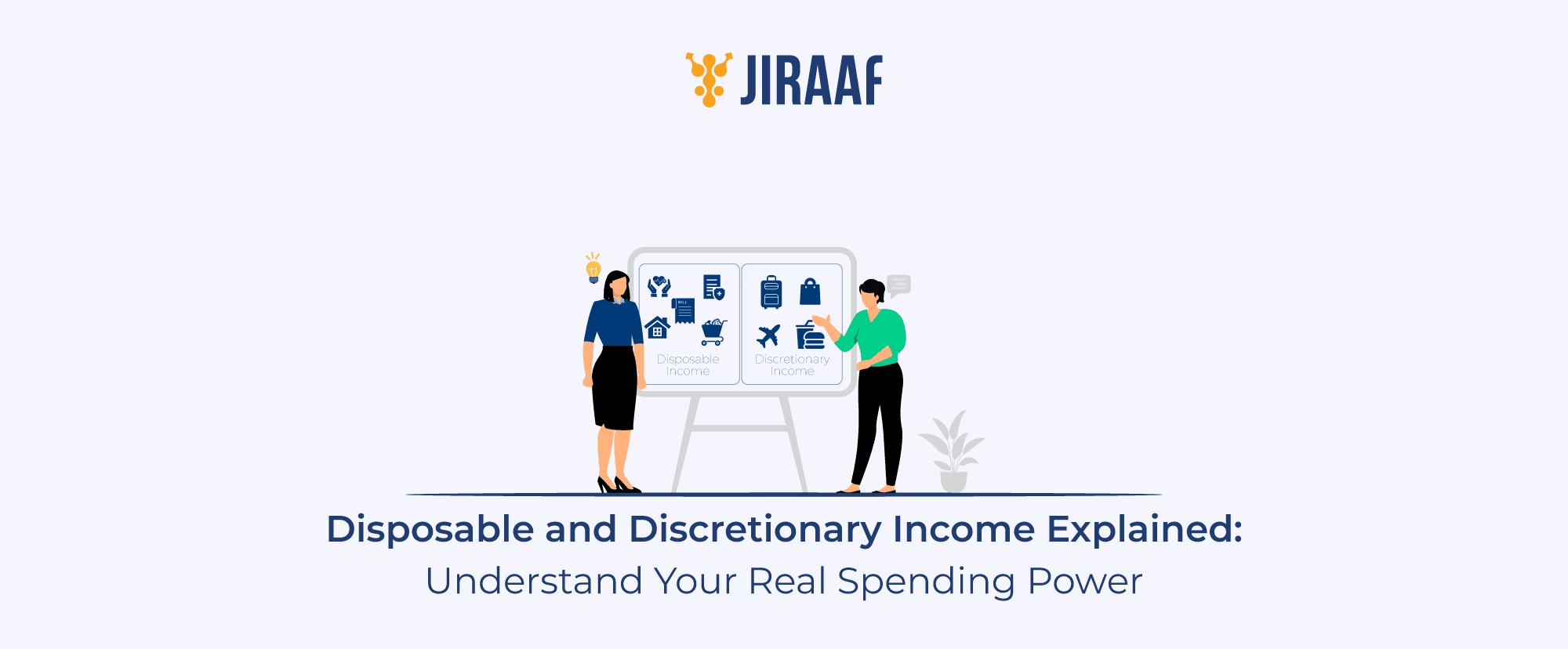
Therefore, the first step to managing money effectively is to break your income into meaningful categories. At a broad level, your personal income can be divided into two key buckets:
- Disposable Income
- Discretionary Income
To build this foundation, the first step is to understand your starting point: your disposable income.
What Is Disposable Income?
Disposable income is the money you have left after paying your taxes. It is the amount you take home and use to manage your overall life.
In simple terms, your disposable income can be calculated using this formula:
Disposable Income = Gross Income − Taxes
Your gross income includes your salary, bonuses, rental income, dividends, coupon payouts, or any other earnings before any deductions. Once taxes are deducted, the remaining amount is your disposable income.
Let’s understand this with a simple example. If you earn ₹60,000 per month and pay ₹9,000 in taxes, your disposable income is ₹51,000. This ₹51,000 is what you have available to cover all your expenses, including both essential and non-essential.
Unlike the common misconception about disposable income, it doesn’t necessarily refer to money you can freely spend. Your disposable income still needs to cover necessities like rent, groceries, utility bills, transportation, and insurance. While many financial planners suggest treating savings as a “fixed cost”, technically, savings and investments are typically funded out of your discretionary pool, not your disposable base.
It also acts as a crucial point of reference for economists and analysts. When disposable income rises, individuals spend more on goods and services, driving demand, business growth, and job creation. Conversely, when an economy has higher inflation, taxes, or weak income growth, people’s disposable income falls, leading to slow economic activity.
Once you understand how much you actually take home, the next step is to see how much of it remains after covering your essential expenses.
What Is Discretionary Income?
Discretionary income is the money you have left after paying taxes and covering all your essential living expenses. This is the portion of your income that you can choose how to spend, save, or invest based on your lifestyle and priorities.
You can calculate your discretionary income using this formula:
Discretionary Income = Disposable Income − Essential Living Expenses
Essential expenses include costs that you cannot avoid, such as rent or home loan EMIs, groceries, electricity and water bills, transportation, insurance premiums, and basic healthcare. These are the expenses required to maintain your standard of living.
Let’s continue with the earlier example. If your disposable income is ₹51,000 and you spend ₹35,000 on rent, food, bills, and other essentials, your discretionary income comes to ₹16,000.
This ₹16,000 is what gives you flexibility. It funds your lifestyle choices, whether that means traveling, dining out, upgrading gadgets, pursuing hobbies, or your savings and investments. In many ways, discretionary income defines how comfortably you can live beyond just meeting your needs.
In simple words, knowing your discretionary income helps you answer an important question: “How much flexibility do I actually have with my money?”
Key Differences Between Disposable and Discretionary Income
| Parameter | Disposable Income | Discretionary Income |
| Definition | Income left after paying taxes | Income left after paying taxes and essential expenses |
| Formula | Gross Income − Taxes | Disposable Income − Essential Expenses |
| Purpose | Forms the base for all financial decisions (spending) | Represents the net flexible money available for lifestyle choices, savings, and investments |
| Includes | Covers both essential and non-essential expenses | Covers only optional spending, extra savings, and investments |
| Flexibility | Limited, as it must cover necessary expenses | High, as it can be allocated based on personal priorities |
Final Thoughts: Why Understanding Disposable and Discretionary Income Matters in Financial Planning?
Understanding how your income is structured gives you control over your day-to-day financial decisions. It shifts your mindset from reacting to expenses to actively planning how your money should be spent.
So, you gain clarity on how much money is committed and available for leisure activities instead of wondering where your salary goes each month. In the end, managing money well involves using what you earn with intention.