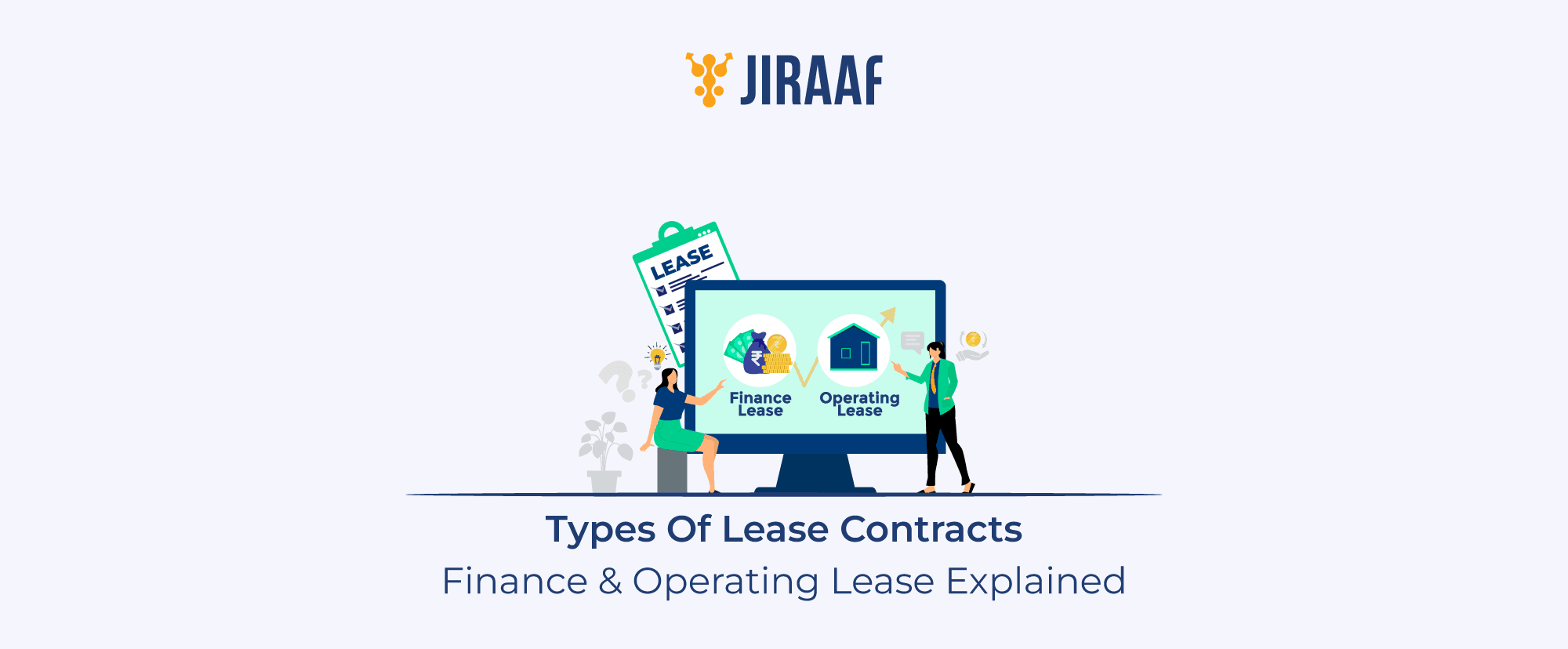
Explore how finance and operating leases differ and how each impacts cash flow, ownership, and business decisions.
Businesses often need high-value assets to operate, but buying them doesn’t always make financial sense. So, instead of committing capital upfront, many companies turn to leasing, an approach that allows them to use the asset while keeping their cash flow intact.
However, simply leasing an asset doesn’t offer a one-size-fits-all solution. Depending on the structure of leasing, a business has to decide whether to own the asset for a definite period or simply rent it for the short-term.
In this blog, we will understand how different types of lease contracts work and what each means in practice under current Indian accounting standards.
What is a Lease Contract?
A lease contract consists of two parties, wherein the lessor (asset owner) buys the underlying asset and grants the lessee (the asset’s user) a right to use the asset for a pre-determined duration in exchange for recurring payments, commonly known as lease rentals.
A lease contract clearly defines the rights, responsibilities, and financial obligations of both parties.
A typical lease agreement includes:
- Lease term: Duration for which the asset can be used
- Payment structure: Fixed or variable lease rentals and payment frequency
- Ownership terms: Whether ownership transfers at the end or remains with the lessor
- Maintenance and insurance: Who is responsible for upkeep and associated costs
- Termination clauses: Conditions under which the lease can be ended early
- Residual value: Expected value of the asset at the end of the lease term
Additionally, there are two types of leases. Let’s have a look at both of them in detail.
What is a Finance Lease?
A finance lease, also known as a capital lease, is a long-term, non-cancellable arrangement where the lessee effectively assumes most of the risks and rewards associated with ownership of the assets.
Although legal ownership may remain with the lessor during the lease term, the structure closely resembles a financed purchase. By the end of the lease, ownership is often transferred to the lessee or can be acquired through a purchase option.
In simple terms, a finance lease allows a business to use and economically “own” an asset without paying the full cost upfront, spreading payments over time. For example, a logistics company in India leases a fleet of trucks for 5 to 7 years under a finance lease. The company pays fixed monthly installments and bears maintenance, fuel, and insurance costs. At the end of the lease term, it has the option to purchase the trucks at a nominal value.
This type of lease is commonly used for high-value, long-life assets such as machinery, commercial vehicles, or industrial equipment.
Features of a Finance Lease
- Long-term tenure: Typically covers a major portion of the asset’s useful life; often interpreted in practice as 75% or more, though no fixed threshold is prescribed under IFRS 16
- Non-cancellable: The lease cannot be easily terminated before expiry
- Risk and reward transfer: Maintenance, insurance, and usage risks shift to the lessee
- Ownership option: Lessee may acquire ownership at the end of the lease term
- Full cost recovery: Lease payments typically cover the asset’s value
- Balance sheet recognition: Treated as a Right of Use (ROU) asset and a corresponding lease liability in financial statements
While finance leases are structured for long-term use and ownership-like benefits, not all situations require such commitment. When flexibility is more important than ownership, an operating lease can offer an alternative solution.
What is an Operating Lease?
An operating lease is a short to medium-term arrangement where the lessee gains the right to use an asset without taking on ownership or long-term financial commitment.
Unlike a finance lease, the ownership, risks, and residual value of the asset remain with the lessor throughout the lease period. The lessee simply pays for usage, making it similar to a rental arrangement.
Operating leases are typically used for assets that:
- Are required for a shorter duration
- May become obsolete quickly
- Need flexibility in usage or upgrades
Common examples include office equipment, vehicles, or rented commercial spaces.
Features of an operating lease
- Shorter duration: Lease term is usually less than the asset’s useful life
- No ownership transfer: Asset remains with the lessor even after lease ends
- Flexibility: Easier to renew, upgrade, or terminate (compared to finance lease)
- Lower risk for lessee: Risks of obsolescence and residual value remain with the lessor
- Maintenance often included: Lessor may provide servicing and support
- Expense treatment: While payments were historically treated only as operating expenses, under Ind AS 116, most operating leases must now appear on the balance sheet, except for short-term (under 12 months) or low-value assets.
Now that we’ve understood how an operating lease works, it becomes easier to compare it with a finance lease across key parameters.
Difference Between Finance Lease and Operating Lease
| Parameter | Finance Lease | Operating Lease |
| Nature of arrangement | Functions like a financed purchase, where the lessee effectively uses the asset as if it were owned | Functions like a rental arrangement, where the lessee only pays for usage |
| Ownership and control | Risks and rewards transfer to the lessee; ownership may transfer at the end | Ownership remains with the lessor throughout; no transfer to the lessee |
| Lease duration | Long-term; typically covers a major portion of the asset’s useful life | Short- to medium-term; does not cover the full economic life of the asset |
| Cost recovery structure | Lease payments generally cover the full cost of the asset over time | Payments cover only the usage period, not the full asset value |
| Accounting treatment | Asset and liability both recorded; depreciation and interest are charged separately | Under Ind AS 116, lease payments are not treated purely as operating expenses for lessees. Instead, leases are recognized as a right-of-use asset and lease liability, with expenses split into depreciation and interest (except for short-term or low-value leases). |
Conclusion
Leasing is ultimately a question of priorities. If your business needs long-term asset utility with a path toward ownership, a finance lease aligns with that goal. If agility, lower commitment, and staying asset-light matter more, an operating lease is a better fit.
However, with the implementation of Ind AS 116 in India, the accounting distinction has narrowed, as both types often require balance sheet recognition. Ultimately, choosing the right structure comes down to how you want to balance control, flexibility, and capital allocation.