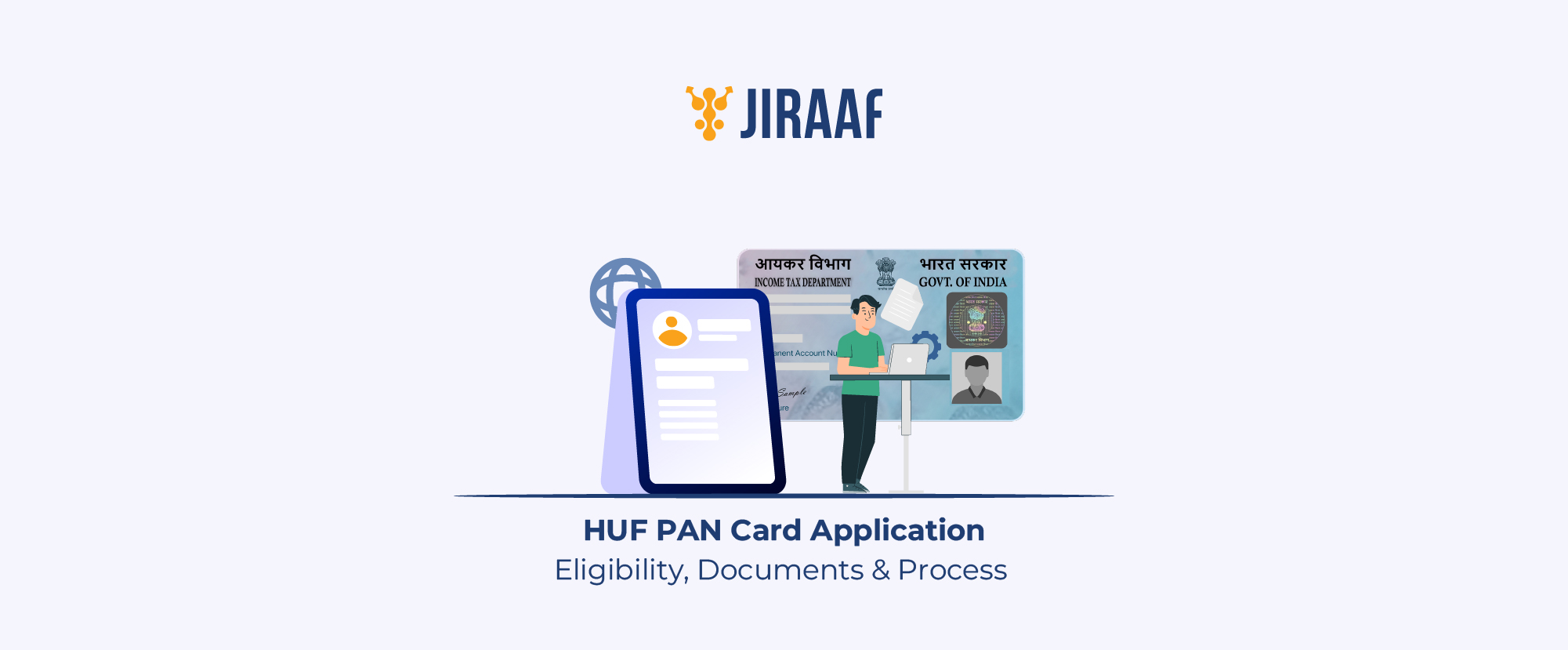
This guide details the legal process of obtaining a HUF PAN card in India, including eligibility requirements and the necessary documentation for the Karta. It provides a step-by-step walkthrough for online and offline applications, including current fee structures and registration steps, and common mistakes to ensure a successful application.
When forming a Hindu Undivided Family (HUF) for tax planning, estate distribution, or family business purposes, obtaining a PAN (Permanent Account Number) card for the HUF is a crucial legal requirement. A PAN card authenticates the HUF as a separate taxable entity under the Income Tax Act and is essential for filing tax returns, opening bank accounts, making investments, or entering into financial contracts in the HUF’s name.
Unlike individual PANs, an HUF PAN card reflects the collective financial identity of a family bound together by lineage and legal succession. As tax optimization and asset segregation become more critical in estate planning, the number of families forming HUFs continues to rise. However, many applicants are unfamiliar with the procedural and documentary formalities associated with applying for an HUF PAN card. This detailed guide explains every step—from eligibility and documentation to application modes, legal declarations, and frequently asked questions.
What is an HUF PAN Card and Who Can Apply For It?
An HUF PAN card is a unique Permanent Account Number allotted to a Hindu Undivided Family by the Income Tax Department. It identifies the HUF as a distinct legal person, separate from its individual members. The HUF is headed by the Karta, who is typically the eldest family member. While traditionally the eldest male, legal rulings now allow the eldest female member to be the Karta.
The Karta oversees all financial matters and represents the HUF for tax and legal purposes.
Who Can Form and Apply for an HUF PAN Card?
- Hindu, Sikh, Jain, or Buddhist families recognized under Hindu Law
- Families with at least two members (Karta and one coparcener)
- A formal declaration/deed establishing the HUF must be available
- The Karta applies for the PAN on behalf of the family
Next, let’s see what documents are required to apply for an HUF PAN card.
Documents Required for HUF PAN Card Application
- Declaration of HUF Formation
- A notarized document declaring formation of HUF
- Contains names of all coparceners and declaration by Karta
- Proof of Identity of Karta
- Aadhaar card, Passport, Voter ID, or Driving License
- Proof of Address of Karta
- Aadhaar, electricity bill, ration card, bank statement, or property registration document
- Photograph
- Passport-size photo of the Karta (to be affixed on the form if applying offline)
- Signature of Karta
- On all submitted documents and declaration
And how can one apply for it? Let’s have a detailed look at that.
Step-by-Step Process to Apply for HUF PAN Card Online
- Visit the PAN application portal
- Navigate to Protean e-Gov or UTIITSL website
- Select Form 49A
- Choose ‘Apply for New PAN for Indian Citizens’ (Form 49A is applicable for HUFs)
- Fill the online form
- Applicant type: Choose ‘Hindu Undivided Family’
- Full name: Mention the HUF name (e.g., “Gupta HUF”)
- Date of birth: Use the date of creation of the HUF
- Father’s name: Leave this section blank, as it is only applicable for individual applicants
- Karta details: Provide full name, mobile number, email ID
- Attach Scanned Documents
- Upload declaration for HUF creation
- Upload Karta’s ID and address proof
- Upload Karta’s photograph
- Payment of Fees
- ₹107 (for communication addresses in India) or ₹1,017 (for addresses outside India)
- Pay via debit card, credit card, net banking, or UPI
- Submit and Track the Application
- After submission, a 15-digit acknowledgment number is issued
- Use this to track your application status
But the online way isn’t the only way to do it. There’s an offline method as well, and we’ll compare both next to see which is more convenient.
HUF PAN Card Application: Online vs Offline Process
| Criteria | Online Application | Offline Application |
| Platform | Protean/UTIITSL website | Protean TIN Facilitation Centers/UTI branches |
| Documentation | Uploaded as scanned copies | Physical submission of documents |
| Payment | Online payment gateway | Cash/DD/Cheque |
| Acknowledgment | Instant digital acknowledgment | Manual receipt |
| Turnaround Time | 7–15 working days | 15–20 working days |
As we can see, most of the process is similar; the only major difference is in the duration it takes to get the PAN card ready and delivered to the applicant. But even though the process is simple, there are a few common mistakes people make while applying.
Common Mistakes to Avoid While Applying for HUF PAN
Here is a list of common mistakes to avoid:
- Using Karta’s name as HUF name: Ensure the PAN application is in the name of the HUF, not an individual.
- Entering the incorrect date of birth: The HUF’s date of formation is used, not the Karta’s birthdate.
- Submitting an incomplete deed: HUF deed must clearly state creation, members, and declaration by Karta.
- Choosing the wrong PAN form: Always use Form 49A (not 49AA, which is for foreign entities).
- Not signing properly: Karta must sign at designated places on the form and supporting documents.
Conclusion
An HUF PAN card is an essential instrument in managing family finances, optimizing taxes, and ensuring lawful asset distribution. It helps the HUF conduct financial transactions, claim tax benefits, and operate business activities while being recognized as an independent entity. Families considering the formation of a Hindu Undivided Family should prioritize this step.
By following the correct application process, whether online or offline, and ensuring accuracy in documentation and declarations, the process becomes smooth and efficient. With this detailed guide, anyone can confidently initiate and complete the PAN application for their HUF and enjoy the financial and tax advantages that come with it.