Mark to market risk shows how your investments are valued daily based on current market prices, even without selling them. Discover how the mechanism behind mark to market risk works.
An investment does not necessarily need to be sold to reflect a gain or loss. Markets reprice assets continuously, whether you act on them or not. This creates a gap between what you paid and what your investment is worth today. Mark-to-market bridges this gap by bringing real-time valuation into both investing and accounting.
In this blog, we explain how MTM works and how it impacts both your portfolio and corporate financial reporting.
What is Mark-to-Market Risk?
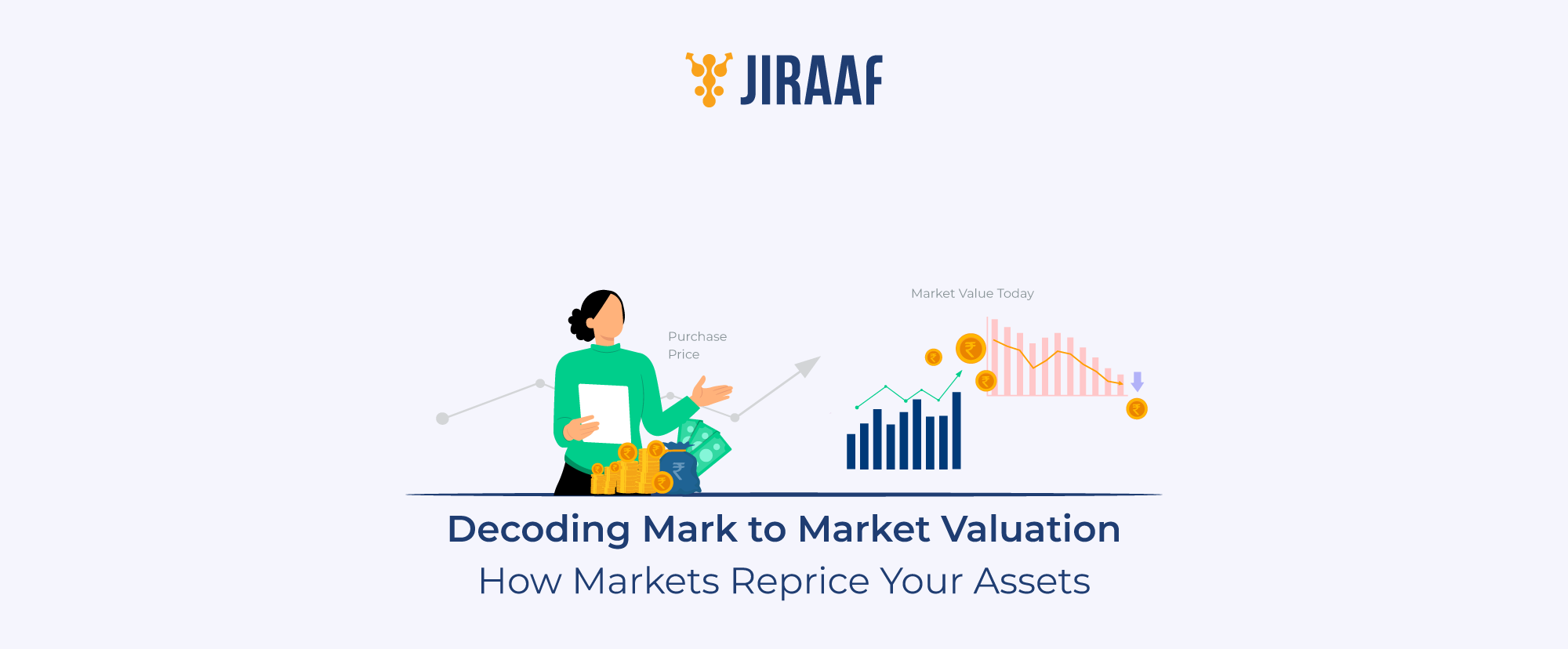
Mark to market (MTM) is a valuation method used to determine an asset’s current market price. In simple terms, it tells you what your investment is worth today if you were to sell it in the market, regardless of the price at which you originally bought it.
This method is widely used across financial markets and corporate accounting systems to reflect the real-time value of assets, rather than their historical cost.
Mark-to-market risk arises from this very principle. Since asset prices fluctuate with market conditions, the value of your investment may also change over time. These fluctuations can lead to gains or losses on paper, even if you have not sold the assets.
For example, suppose you buy a bond for ₹1,000 that offers a 7% return. If market interest rates rise to 8%, newly issued bonds become more attractive. As a result, the market price of your bond may fall to ₹950. This ₹50 decline is a mark to market loss; it reflects the price at which you could sell the bond today.
This risk becomes relevant when you track portfolio value, report financial statements, or exit investments before maturity. Even if the underlying asset remains fundamentally sound, its market value can move against you in the short term due to external factors.
Now that you have understood the mark to market risk in theory, let us discuss what actually causes these fluctuations in the value of assets.
What Causes Mark-to-Market Losses?
A mark-to-market loss occurs when the current market value of an asset falls below its purchase price, even if you have not realized the asset. It is a notional (on paper) loss that arises because assets are continuously valued at prevailing market prices.
This can happen across different types of investments, not just bonds.
1. Price movements in the market
Every financial asset, whether stocks, bonds, or mutual funds, is influenced by demand and supply. If market prices fall due to changing conditions, the value of your holding also declines, leading to an MTM loss.
2. Interest rate changes
Interest rate movements affect a wide range of assets. While bonds are directly impacted, other instruments such as mutual funds also see their Net Asset Value (NAV) fluctuate when underlying market conditions change.
3. Change in credit or risk perception
If the perceived risk of an issuer or asset increases, investors demand higher returns. This leads to a fall in the asset’s price, which reflects an MTM loss.
4. Market sentiment and external Factors
Macroeconomic events, policy decisions, or global developments can influence asset prices across markets, causing temporary declines in valuation.
Let’s understand this with an example. Suppose you have invested in a mutual fund at an NAV of ₹100 and, due to changes in the price of underlying stocks, the NAV falls to ₹97. This ₹3 decline represents a mark-to-market loss.
In essence, MTM losses arise because markets continuously reprice the assets. These losses may remain temporary unless you choose to exit the investment at that lower value.
Additionally, this valuation method is not limited to stocks and bonds; it is formally applied across markets and corporate financial reporting.
Understanding Mark-to-Market Valuation Method
Mark-to-market valuation originated in the 19th century within futures exchanges, where positions began to be revalued daily to reflect current prices. Brokers settle gains and losses each day through margin adjustments, ensuring that risk is continuously accounted for.
Over time, this approach was formally integrated into corporate accounting frameworks to bring the same level of realism to financial reporting.
As per corporate accounting standards, mark-to-market valuation method ensures that certain assets and liabilities are recorded at their current fair value, rather than their original purchase price.
Its role is critical for a few reasons:
- It provides a true and updated picture of a company’s financial position, reflecting realizable values rather than outdated costs.
- It improves transparency in financial reporting, allowing investors and stakeholders to assess risk more accurately.
- It ensures that unrealized gains and losses are recognized, preventing a mismatch between reported value and actual market conditions.
In practice, this means that companies must regularly revalue their holdings based on prevailing market prices. As a result, their balance sheets and income statements reflect the latest market conditions, rather than outdated historical values.
Companies use different types of accounting standards to determine how and when valuation changes within assets are recognized.
Types of Mark-to-Market Accounting Principles
Mark-to-market valuation is governed by global accounting systems that define how assets are valued and reported. These can be understood based on jurisdiction and governing authority:
U.S. Accounting System
1. GAAP (Generally Accepted Accounting Principles)
GAAP is the primary accounting framework used in the United States. It lays down the rules for financial reporting, including how and when mark-to-market valuation is applied.
2. FASB (Financial Accounting Standards Board)
FASB is the authority that develops and updates GAAP. It defines the standards for fair value measurement and ensures consistency in how mark-to-market accounting is implemented across U.S. companies.
Global Accounting System
- IFRS (International Financial Reporting Standards)
IFRS is used across multiple countries, including India (as Ind AS). It focuses on fair value accounting and provides guidelines for valuing assets based on current market conditions.
- IASB (International Accounting Standards Board)
IASB is the global body that develops IFRS. Similar to FASB in the U.S., it sets the rules for fair value measurement and standardizes mark-to-market practices across international markets.
Together, these standards ensure that mark-to-market valuation is applied consistently, making financial reporting more aligned with actual market conditions across different regions and asset classes.
Conclusion
Market movements often force you to confront price changes before you have to make a decision on the investment itself. This is where perspective starts to matter more than the number on the screen.
The key is not to react to every fluctuation, but to understand what is driving that change. In many cases, it is simply the market adjusting to external factors. In others, it may signal a shift worth paying attention to. Over time, the ability to distinguish between the two is what leads to more measured investment decisions and better investment outcomes.