Explore how K-shaped recoveries create unequal growth across industries and income groups during post-recession economic recoveries.
Recessions rarely leave every part of an economy equally affected. Certain sectors recover rapidly once economic activity resumes, while others continue to face prolonged financial stress and economic deterioration.
This uneven recovery pattern recently became especially evident in India during the COVID-19 period, when financial markets and technology-driven sectors rebounded sharply after the initial impact, while labor-intensive industries struggled to recover at the same pace. Economists describe this divergence as a K-shaped recovery.
In this blog, we discuss what a K-shaped recovery means, what causes economies to recover unevenly, and the different types of economic recovery patterns observed after recessions.
What is K-shaped Recovery?
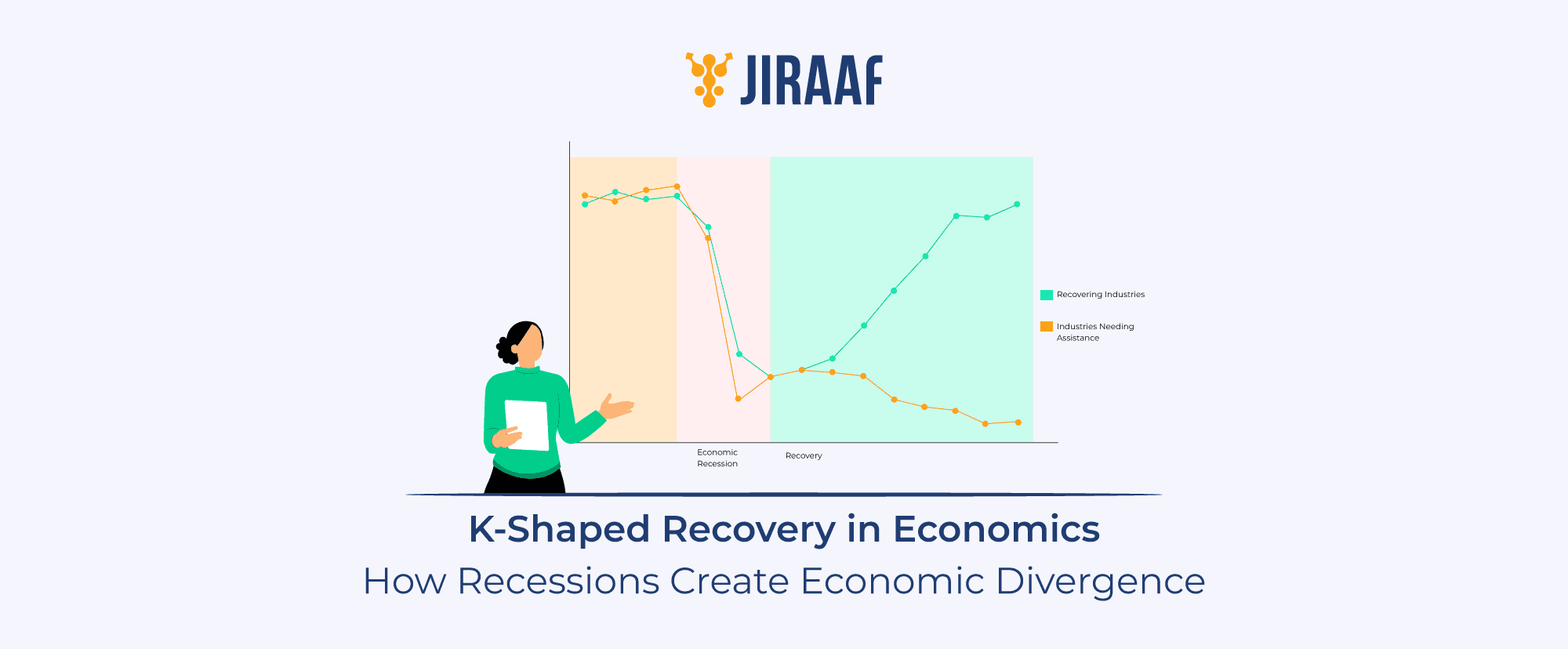
A K-shaped recovery describes a post-recession economic divergence where different sectors and segments of the economy recover at sharply unequal rates and trajectories. The term “K-shaped” originates from the graphical divergence resembling the letter “K”, where one segment of the economy moves upward while another continues deteriorating.
During such recoveries, wealth concentration often accelerates sharply. High-income and asset-owning groups benefit from rising stock markets, appreciating real estate prices, and financial asset inflation. At the same time, lower-income populations continue struggling with unemployment, stagnant wages, weaker purchasing power, and rising living costs.
Example of a K-shaped Recovery in India

Source –Jiraaf
India’s post-COVID economic recovery is widely considered one of the classic examples of a K-shaped recovery. Following the pandemic-led recession, sectors linked to technology, software services, digital platforms, pharmaceuticals, financial markets, and organized retail recovered rapidly due to rising digitization, liquidity expansion, and changing consumer behavior.
At the same time, labor-intensive sectors such as travel, hospitality, restaurants, entertainment, aviation, and small offline businesses continued facing prolonged financial stress, weaker demand, job losses, and cash flow disruptions for a much longer period.
Such uneven recoveries across sectors and income groups are rarely random and are often driven by deeper structural and policy factors.
Causes Behind K-shaped Recovery
K-shaped recoveries are generally driven by a combination of structural economic changes, policy responses, and unequal access to financial resources. Some of the major causes include:
- Creative destruction within the economy
Economic disruptions often accelerate structural shifts where outdated industries weaken while technology-driven and capital-intensive sectors expand rapidly. Businesses that adapt to changing consumer behavior and digital transformation usually recover much faster than traditional industries.
- Uneven impact of monetary and fiscal policies
Expansionary monetary policies, lower interest rates, liquidity injections, and fiscal stimulus measures can disproportionately benefit financial markets, large corporations, and asset-owning groups before broader employment and wage recovery takes place.
- Sector-specific economic disruption
Certain recessions impact industries very differently. Sectors dependent on physical mobility, discretionary spending, or labor-intensive operations may face prolonged financial stress, while digitally enabled industries recover more
quickly in the modern age.
- Unequal access to capital and financial resources
Large businesses and high-income groups generally have greater access to credit, liquidity, and investment opportunities during economic recoveries, allowing them to recover faster compared to smaller businesses and lower-income households.
While K-shaped recoveries reflect one type of post-recession economic divergence, economists classify recoveries into several other patterns depending on how economic activity revives after a downturn.
Different Types of Economic Recovery Patterns
Economists classify post-recession recoveries into different patterns based on the pace, duration, and structural nature of economic revival. Some of the most common recovery patterns include:
- L-shaped recovery
An L-shaped recovery occurs when the economy witnesses a sharp downturn followed by prolonged stagnation with minimal recovery for years. Japan’s “Lost Decade” following the 1990 asset price bubble crash is the most cited modern example of this pattern.
- U-shaped recovery
In a U-shaped recovery, economic activity remains weak for a prolonged period before gradually recovering over time. The U.S. economy experienced a U-shaped recovery between the year 1973 to 1975.
- W-shaped recovery
A W-shaped recovery, also called a double-dip recession, occurs when the economy recovers briefly before slipping back into another downturn and eventually recovering again. Certain economies during the Covid-19 pandemic witnessed temporary W-shaped recovery patterns.
- V-shaped recovery
A V-shaped recovery represents a rapid rebound immediately after a steep economic decline. India’s recovery in certain sectors, such as manufacturing and financial markets, after the initial Covid-19 lockdown phase reflected elements of a V-shaped recovery.
These recovery patterns help economists and policymakers evaluate the depth, sustainability, and distribution of economic recovery after recessions and financial disruptions.
Conclusion
K-shaped recoveries highlight how modern economic recoveries are increasingly influenced by access to technology, capital ownership, financial markets, and policy support. In many cases, sectors linked to digital infrastructure and financial assets recover much faster than labor-driven industries and wage-dependent populations.
As economies become more digitized and capital-intensive, future recessions may continue creating sharper disparities across employment, income growth, and asset ownership. Over time, such recoveries can reshape consumer behavior, labor markets, wealth distribution, and long-term economic mobility within an economy.