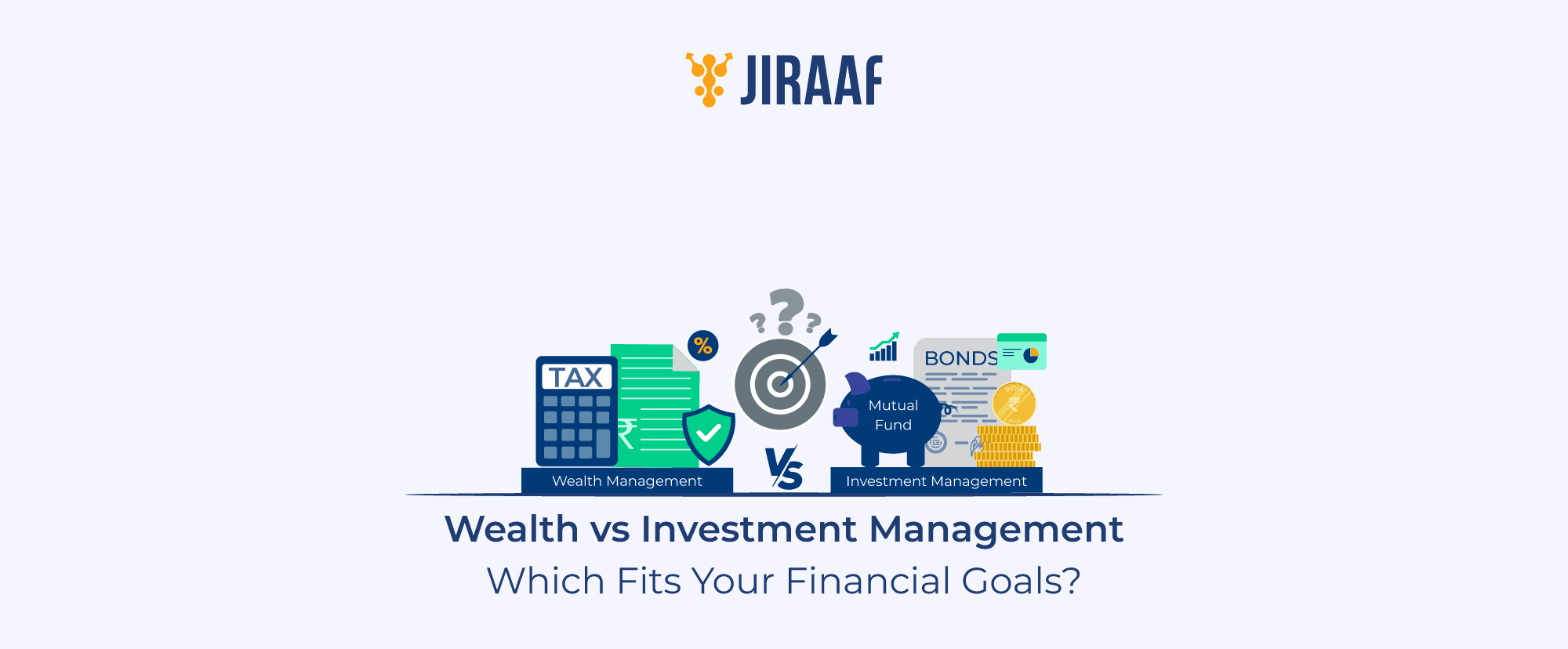
The key difference between wealth management and investment management lies in their scope. Wealth management offers holistic financial planning, whereas investment management concentrates mainly on investment decisions and portfolio performance.
Choosing the right financial guidance often starts with understanding what kind of support you actually need. Do you need investment management focused primarily on your portfolio and market exposure, or wealth management that takes a broader view of your overall financial life? While both approaches aim to support financial growth, they differ significantly in their scope, strategy, and level of personalization.
In this blog, we break down the key differences between wealth management and investment management to help you better understand which approach may align with your financial goals and long-term priorities.
What is Wealth Management?
Wealth management is a personalized financial advisory and planning process designed to help affluent individuals manage, preserve, and grow their wealth. It typically caters to high-net-worth individuals (HNWIs), business owners, and investors with complex financial needs.
A wealth manager has to take a broader view of their client’s financial life to offer a customized plan. They have to work closely with their clients to understand their income, assets, liabilities, financial goals, lifestyle requirements, and long-term aspirations.
Wealth Management Services in India
Wealth management firms commonly provide services like:
- Personalized financial planning and goal mapping
- Portfolio diversification and asset allocation strategies
- Tax-efficient wealth structuring
- Estate, succession, and legacy planning
- Insurance and risk assessment solutions
- Alternative investment advisory services
- Family office and multi-generational wealth solutions
- Philanthropy and charitable giving advisory
- Periodic portfolio monitoring and performance reviews
What is Investment Management?
Investment management refers to the professional management of financial assets and investment portfolios to generate returns and grow capital over time. It primarily focuses on making investment decisions, managing market exposure, and optimizing portfolio performance across different asset classes.
Investment managers typically serve institutional investors, including pension funds, insurance companies, mutual funds, corporations, and large investors. However, they may also manage portfolios for individual clients through Portfolio Management Services (PMS), which in India requires a minimum investment of ₹50 lakh as per SEBI regulations.
The process begins by understanding the client’s investment objectives, return expectations, time horizon, and risk appetite. Based on these factors, the investment manager builds and manages a portfolio that may include equities, bonds, commodities, mutual funds, ETFs, or other financial instruments. The portfolio is then actively monitored and adjusted in response to market movements, economic conditions, and investment opportunities.
Investment Management Services Explained
Investment management firms commonly provide services such as:
- Equity, debt, and multi-asset portfolio management
- Research-driven investment advisory
- Institutional fund management
- Portfolio rebalancing and risk monitoring
- Fixed-income and bond investment strategies
- Alternative asset and commodity exposure
- Capital market and securities management
- Discretionary and non-discretionary portfolio services
- Quantitative analysis and risk-adjusted return modeling
- Performance tracking and portfolio reporting
Difference Between Wealth Management and Investment Management
| Parameter | Wealth Management | Investment Management |
| Primary focus | Focuses on overall financial well-being, including planning, wealth preservation, tax efficiency, retirement, and legacy creation | Focuses primarily on managing investments and generating returns through market-linked financial assets |
| Who It serves | Typically serves high-net-worth individuals (HNWIs), affluent families, business owners, and individuals with complex financial needs | Commonly serves institutional investors, corporates, funds, and HNIs seeking specialized Portfolio Management Services (PMS) |
| Scope of services | Offers a holistic approach covering financial planning, estate planning, insurance, succession, and lifestyle-linked financial strategies | Concentrates mainly on portfolio construction, asset allocation, market analysis, and investment performance monitoring |
| Approach to client management | Takes a highly personalized and relationship-driven approach based on the client’s long-term life goals and financial priorities | Follows an investment-centric approach driven by risk appetite, return expectations, and market opportunities |
| Core objective | Aims to preserve, grow, and transfer wealth efficiently across different life stages and generations | Aims to maximize portfolio performance and deliver risk-adjusted returns over time |
Final Thoughts: Which One is Right for You?
As financial priorities evolve, so does the kind of guidance that you may require. If you primarily seek professional support for managing your portfolio, you may find investment management more suitable. However, if you want guidance that extends into areas such as taxation, retirement, insurance, succession, and legacy planning, wealth management offers a more comprehensive and structured approach.
Ultimately, the decision is less about wealth size alone and more about the level of financial planning, personalization, and long-term strategic guidance you require.