Learn the key differences between liquidity and solvency, their important ratios, and how investors and analysts use them to evaluate financial health.
In financial analysis, profitability alone rarely tells the complete story of a business. A company may generate strong revenue and still face financial stress if it cannot manage its short-term obligations and long-term debt efficiently.
This is why analysts, investors, lenders, and creditors closely examine financial stability indicators, such as liquidity and solvency, along with other factors, before evaluating a company’s overall financial health.
In this blog, we will understand key financial concepts such as liquidity and solvency, their important ratios, key differences, and their role in financial analysis.
What is Liquidity in Finance?
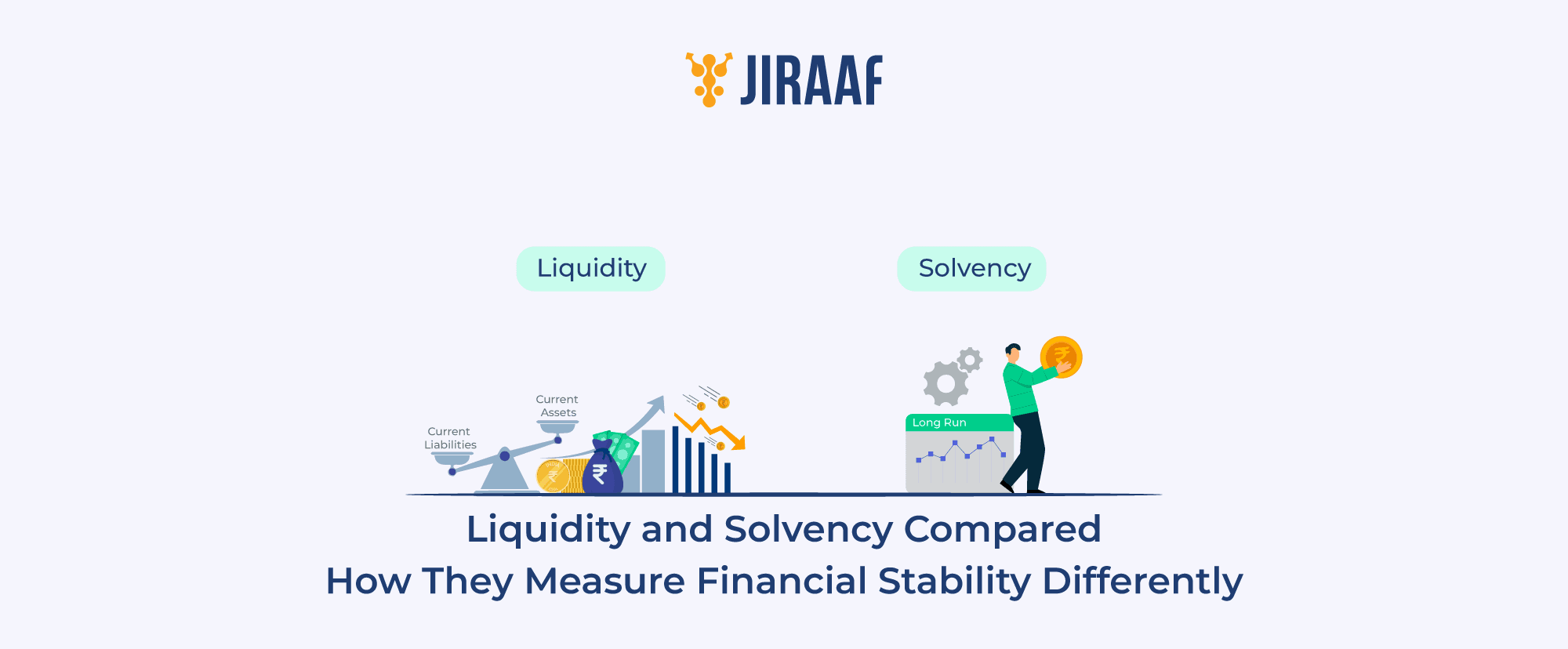
In finance, liquidity refers to a business’s ability to quickly convert its assets into cash without significantly affecting their market value. In simple terms, liquidity measures how easily cash is available to meet short-term financial obligations.
For businesses, liquidity is critical to managing day-to-day operations. A company with strong liquidity can comfortably cover immediate expenses, such as supplier payments, salaries, rent, taxes, and other short-term debt obligations, without financial stress.
Common examples of liquid assets include cash in hand, bank balances, marketable securities like treasury bills, and accounts receivable that can be converted into cash relatively quickly.
What are Liquidity Ratios?
Liquidity ratios are financial metrics used to evaluate whether a company can meet its short-term financial obligations using its current or highly liquid assets. These ratios are commonly used by investors, lenders, analysts, and creditors to assess a business’s short-term financial stability.
- Current Ratio

The current ratio measures a company’s ability to pay its short-term liabilities with its current assets, such as cash, receivables, and inventory. In general, a higher current ratio indicates a relatively stronger liquidity position.
- Quick Ratio (Acid-test ratio)

The quick ratio evaluates a company’s ability to meet short-term obligations using only its most liquid assets. Since inventory and prepaid expenses may not always be converted into cash immediately, they are excluded from the calculation.
- Days Sales Outstanding (DSO)

Days Sales Outstanding measures the average number of days a company takes to collect payments from customers after making a sale. While often grouped with liquidity, it is technically an activity or efficiency ratio that influences liquidity. A higher DSO may indicate slower cash collection and weaker short-term liquidity management.
- Cash Ratio
Cash Ratio = Cash and Cash Equivalents
────────────────────────────
Current Liabilities
The cash ratio measures a company’s ability to repay its short-term liabilities using only cash and cash equivalents. While DSO is an efficiency metric, the Cash Ratio is the most conservative liquidity measure because it excludes receivables, inventory, and other current assets from the calculation.
While liquidity helps evaluate a company’s short-term cash position and operational flexibility, financial analysis also requires understanding whether the business can remain financially sustainable over the long term.
What is Solvency in Finance?
Solvency refers to the long-term financial health of a business. It is used to measure a business’s ability to meet all of its financial obligations, both now and in the distant future, based on its long-term financial health.
So, while liquidity focuses on the immediate, solvency is a long-term measure of the financial health of an individual or a business. To put simply, a solvent company generally owns more assets in total than its total liabilities, maintains manageable debt levels, and operates with positive net worth.
What are Solvency Ratios?
Solvency ratios help investors, analysts, lenders, and creditors understand whether a business is operating with manageable financial leverage or excessive debt dependency.
- Debt-to-Equity (D/E) Ratio

The debt-to-equity ratio measures how much debt a company uses compared to shareholders’ equity. A rising D/E ratio generally indicates higher financial leverage, which can increase interest obligations and financial risk over time.
- Debt-to-Assets Ratio

This ratio measures the proportion of a company’s assets financed through debt. A higher ratio indicates greater dependence on borrowed funds and may signal elevated long-term financial risk.
- Interest Coverage Ratio

The interest coverage ratio evaluates how comfortably a company can pay interest expenses using its operating profits or EBIT (Earnings Before Interest and Taxes). In general, a higher ratio indicates stronger debt repayment capacity and better long-term financial stability.
Difference Between Solvency and Liquidity
While liquidity and solvency are both used to evaluate the financial health of a business, they measure very different aspects of financial stability.
| Basis of Difference | Liquidity | Solvency |
| Meaning | Measures a company’s ability to meet short-term financial obligations | Measures a company’s ability to meet all financial obligations (total liabilities) and continue operations indefinitely |
| Primary focus | Focuses on immediate cash availability and working capital management | Focuses on long-term financial health, capital structure, and overall net worth |
| Time horizon | Concerned mainly with short-term obligations usually due within one year | Concerned with long-term obligations extending over several years |
| Key financial indicators | Evaluated using current assets, cash balances, receivables, and short-term liabilities | Evaluated using total assets, total liabilities, equity, and long-term debt levels |
| Common ratios used | Current Ratio, Quick Ratio, Days Sales Outstanding (DSO), and Cash Ratio | Debt-to-Equity Ratio, Debt-to-Assets Ratio, and Interest Coverage Ratio |
Importance of Liquidity and Solvency Ratios in Financial Analysis
Financial stability indicators provide deeper insight into whether a company can manage its obligations efficiently in both the short and long term.
- Help assess short-term financial health
Liquidity indicators help determine whether a company can comfortably meet immediate operational expenses and short-term liabilities without facing cash flow stress.
- Measure long-term financial sustainability
Solvency indicators help evaluate whether a business maintains manageable debt levels and sufficient asset strength to survive financially over long periods.
- Assist lenders and creditors in risk evaluation
Banks and creditors often analyze liquidity and solvency ratios before lending money to assess the company’s repayment capability and financial reliability.
- Help identify financial stress early
Weak liquidity or solvency ratios may indicate rising financial pressure, excessive leverage, poor cash flow management, or potential default risks before they become visible operationally.
- Enable comparison across companies and industries
Financial ratios make it easier to compare the financial health of different businesses operating within the same sector or industry.
This is why liquidity and solvency ratios are some of the most widely used financial stability indicators in business analysis and fundamental financial evaluation.
Conclusion
Financial analysis becomes far more meaningful when businesses are evaluated beyond just revenue growth or profitability numbers. In reality, a company’s long-term stability also depends on how efficiently it manages cash flows, liabilities, debt, and overall financial discipline across different business cycles.
This is exactly why liquidity and solvency indicators remain important in business analysis. Together, they help provide deeper insight into a company’s financial resilience, operational efficiency, and ability to sustain itself through both short-term disruptions and long-term financial obligations.