The Basic Statistical Return (BSR) code is a unique 7-digit identification number assigned by the Reserve Bank of India (RBI) to registered bank branches for tracking tax collections and banking statistics. This guide explains the meaning, structure, and classification of BSR codes, highlights their key uses in filing Income Tax Returns (ITR) and tax challans, compares BSR with IFSC codes, and provides actionable steps to locate BSR codes for top Indian banks.
When filing your Income Tax Return (ITR) or uploading tax payment challans, like Challan 280, you inevitably encounter requests for bank identification numbers. While most taxpayers are familiar with standard transaction codes used for online transfers, tax filings demand a specific identifier established by the Reserve Bank of India (RBI). Understanding what a BSR code is and how it functions ensures that your tax credits, Tax Deducted at Source (TDS), and advance tax payments align accurately with the Income Tax Department’s portal.
What Is BSR Code in Banking?
The Basic Statistical Return (BSR) code is an official numerical identifier assigned by the Reserve Bank of India to every registered bank branch in India. It serves as a uniform cataloging system that enables the central bank to track monetary inflows, credit distributions, and revenue collections across the country’s banking landscape.
When you make a direct tax payment, such as advance tax, self-assessment tax, or corporate tax, the receiving bank branch logs the transaction under its unique identifier. This ensures that the Income Tax Department can trace every tax payment directly back to the exact physical or authorized branch that processed the transaction.
BSR Code Full Form and Meaning
The BSR code full form stands for Basic Statistical Return code. In practical terms, the BSR code refers to a 7-digit code designed to centralize fiscal reporting for commercial, cooperative, and regional rural banks.
Introduced by the RBI in December 1972, the system was created to streamline the collection and analysis of banking data. Over the decades, its scope expanded beyond macroeconomic data gathering. Today, it acts as a primary verification key for tax receipts, Tax Deducted at Source (TDS) certificates (Form 16/16A), Tax Collected at Source (TCS) returns, and Online Tax Accounting System (OLTAS) records.
Structure of the BSR Code
The bank BSR code consists of exactly 7 numeric digits. This structure is divided into two distinct components: the bank identifier and the specific branch identifier.

- First 3 digits (bank code): Identifies the overall banking institution. Every registered bank is allocated a unique 3-digit numeric sequence by the Reserve Bank of India. For instance, public sector banks, private banks, and foreign institutions operating in India each have designated prefix ranges.
- Last 4 digits (branch code): Identifies the exact physical or authorized branch BSR code of that bank. Even if two branches belong to the same parent bank, these final 4 digits will differ, providing a unique code for the BSR code of the bank branch.
Structural Example
Consider a hypothetical BSR code: 0002145
- 000: Indicates the parent banking entity (e.g., State Bank of India)
- 2145: Represents the specific branch location processing the tax transaction
Together, these 7 digits form a uniform code that eliminates confusion between different branches of the same bank during centralized tax processing.
Classification of BSR Code
To organize financial data systematically, the RBI categorizes Basic Statistical Returns into seven distinct reporting returns, numbered from BSR-1 to BSR-7. Each classification focuses on a specialized area of banking operations:
| Return Classification | Primary Purpose & Scope | Reporting Frequency |
| BSR-1 | Details occupation-wise credit limits and outstanding advances from bank branches | Half-yearly (as of March & September) |
| BSR-2 | Covers deposit distributions by type (current, savings, fixed), interest rate structures, and staff counts | Annual (as of March 31) |
| BSR-3 | Tracks advance rate distributions against total credit extensions | Discontinued / Historical Analysis |
| BSR-4 | Records committee composition, branch management details, and operational parameters | Periodic |
| BSR-5 | Tracks investment portfolios of bank branches in government securities, shares, and bonds | Annual |
| BSR-6 | Records bank debits to deposit accounts and turnover rates | Quinquennial (Every 5 years) |
| BSR-7 | Compiles aggregate data on deposits and gross bank credit across all operations | Monthly |
When filing income tax returns or verifying OLTAS payment receipts, taxpayers interact primarily with the system established under BSR-1 and BSR-2 data networks, which manage tax collection and branch-level accounting.
Uses and Advantages of Bank BSR Code
The primary applications of the bank BSR code center around government revenue administration, tax filings, and institutional reporting.
1. Income Tax Return (ITR) filing
When filing your BSR code in ITR, you must furnish the 7-digit BSR code of the bank branch where your self-assessment tax or advance tax was deposited. The Income Tax Department uses this code, alongside the Challan Serial Number and Deposit Date, to verify that the money was actually credited to the Government of India’s account.
2. OLTAS and tax challan tracking
Under the Online Tax Accounting System (OLTAS), paper challans and online tax payments generate a Challan Identification Number (CIN). The CIN is a composite key consisting of:
Challan Identification Number (CIN)=BSR Code (7 digits)+Payment Date (8 digits)+Challan Serial Number (5 digits)Challan Identification Number (CIN)=BSR Code (7 digits)+Payment Date (8 digits)+Challan Serial Number (5 digits)
Without a valid BSR code, an electronic tax payment receipt cannot generate a valid CIN, making it impossible to claim credit for prepaid taxes.
3. TDS and TCS verification
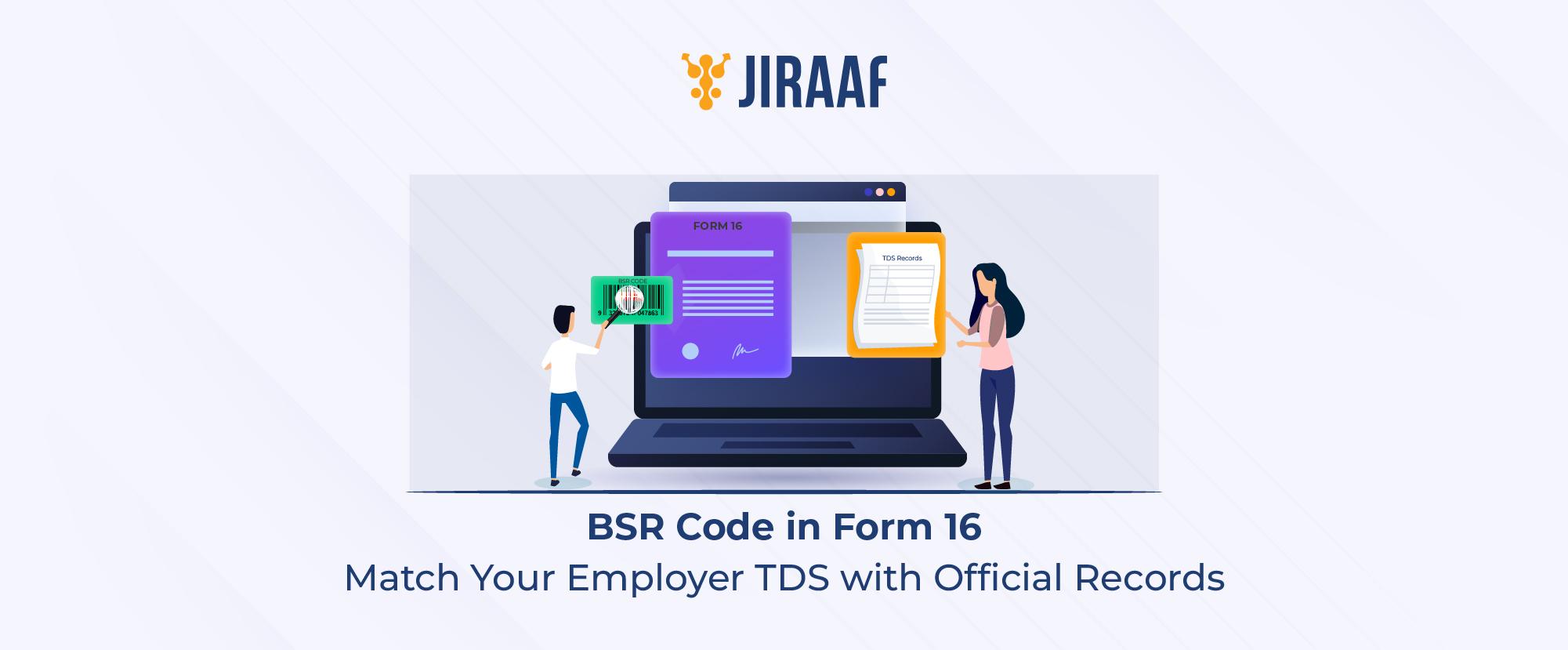
Employers and tax deductors must include the bank’s BSR code when depositing tax deducted at source and generating Form 16 or Form 16A certificates. This allows deductees to view accurate tax credits in their Annual Information Statement (AIS) and Form 26AS.
4. Direct Benefits Transfer (DBT) and pension distributions
Government agencies utilize BSR records to monitor pension disbursements, subsidy allocations, and welfare distributions across specific geographic branches.
Advantages for Taxpayers and Banking Systems
- Error minimization: Prevents tax payments from being misallocated to the wrong taxpayer account or bank branch.
- Automated reconciliation: Allows the Income Tax Department to match taxpayer claims electronically without manual intervention.
- Macroeconomic accuracy: Provides the RBI with reliable statistical data on credit trends, regional savings rates, and financial inclusion metrics.
BSR Code vs IFSC Code
Taxpayers frequently confuse the BSR code with the Indian Financial System Code (IFSC). While both codes identify bank branches, their structural compositions, regulatory functions, and operational applications are entirely distinct.
| Feature | BSR Code | IFSC Code |
| Full Form | Basic Statistical Return Code | Indian Financial System Code |
| Length & Format | 7 Digits (Purely Numeric) | 11 Characters (Alphanumeric) |
| Governing Authority | Reserve Bank of India (Statistics & Tax) | Reserve Bank of India (Payments) |
| Primary Purpose | Tracking tax collections, OLTAS, and banking statistics | Facilitating electronic fund transfers (NEFT, RTGS, IMPS) |
| Structure Breakdown | First 3 digits = Bank, Last 4 digits = Branch | First 4 chars = Bank, 5th char = ‘0’, Last 6 chars = Branch |
| Used In | ITR Filing, TDS Certificates, Tax Payment Challans | Online banking transfers, wire settlements, beneficiary setup |
| Example | 0002145 | SBIN0002145 |
Where to Find the BSR Code
Locating your branch BSR code is straightforward once you know where to look. Here are the primary methods to find the correct 7-digit number:
- Tax payment receipt/counterfoil (Challan 280): When you pay advance tax or self-assessment tax online or offline, the stamped counterfoil or downloadable PDF receipt explicitly lists the 7-digit BSR code alongside the Challan Number and Payment Date.
- Form 16 and Form 16A: The TDS certificate provided by your employer or financial institution displays the BSR code of the bank branch through which the tax was deposited to the government treasury.
- Bank passbook and checkbook: Many commercial banks print the BSR code on the first page of the customer passbook or at the top of physical cheque leaves, adjacent to the IFSC and MICR codes.
- Official RBI and income tax portals: The RBI maintains an updated BSR code list of all authorized receiving branches on its official portal. Additionally, the Income Tax e-Filing portal provides search tools to look up authorized tax-collecting bank branches.
- Online banking & mobile apps: Major public and private banks list their branch-specific BSR codes in the account details or tax service sections of their internet banking portals.
BSR Code of SBI, HDFC Bank, ICICI Bank & Other Top Banks
Every commercial bank authorized by the RBI to collect direct taxes maintains a series of branch-level BSR codes. Below is an overview of how leading Indian banks structure their BSR coding system along with representative branch examples:
| Bank Name | 3-Digit Bank Prefix | Sample Branch BSR Code |
| State Bank of India | 000/002 | 0000001 (Main Branch, Mumbai) |
| 0000001 (Main Branch, Mumbai) | 051 | 0510001 (Kasturba Gandhi Marg) |
| ICICI Bank | 029 | 0290001 (Connaught Place, Delhi) |
| Punjab National | 024 | 0240001 (Sansad Marg, New Delhi) |
| Bank of Baroda | 012 | 0120001 (Mandvi, Vadodara) |
BSR Code of SBI
As India’s largest public sector bank, the BSR code of SBI branches typically starts with prefixes like 000 or 002. Because SBI handles a large volume of direct tax collections across India, almost all its commercial branches carry active BSR identification numbers.
BSR Code of HDFC Bank
The BSR code of HDFC bank (often referenced as the HDFC BSR code) usually begins with the 051 bank prefix. Selected urban and rural branches of HDFC Bank are authorized under OLTAS to accept tax deposits, generating a unique 7-digit sequence for every transaction.
BSR Code of ICICI Bank
The ICICI BSR code sequence generally starts with the bank prefix 029. Taxpayers making tax payments via ICICI Bank internet banking receive an automated electronic receipt containing the specific 7-digit BSR code associated with the central tax-processing branch.
Conclusion
The Basic Statistical Return (BSR) code plays an important role in India’s fiscal infrastructure. By bridging the gap between individual banking transactions, central statistical tracking, and government revenue collections, the 7-digit number ensures that tax payments are correctly registered and credited.
Whether you are filing your annual Income Tax Return, claiming credit for prepaid advance tax, or verifying TDS details on Form 16, referencing the correct BSR code ensures seamless reconciliation with the Income Tax Department’s records. Always verify the 7-digit code printed on your tax payment challan receipt before submitting your tax returns to avoid processing delays or mismatched tax credits.