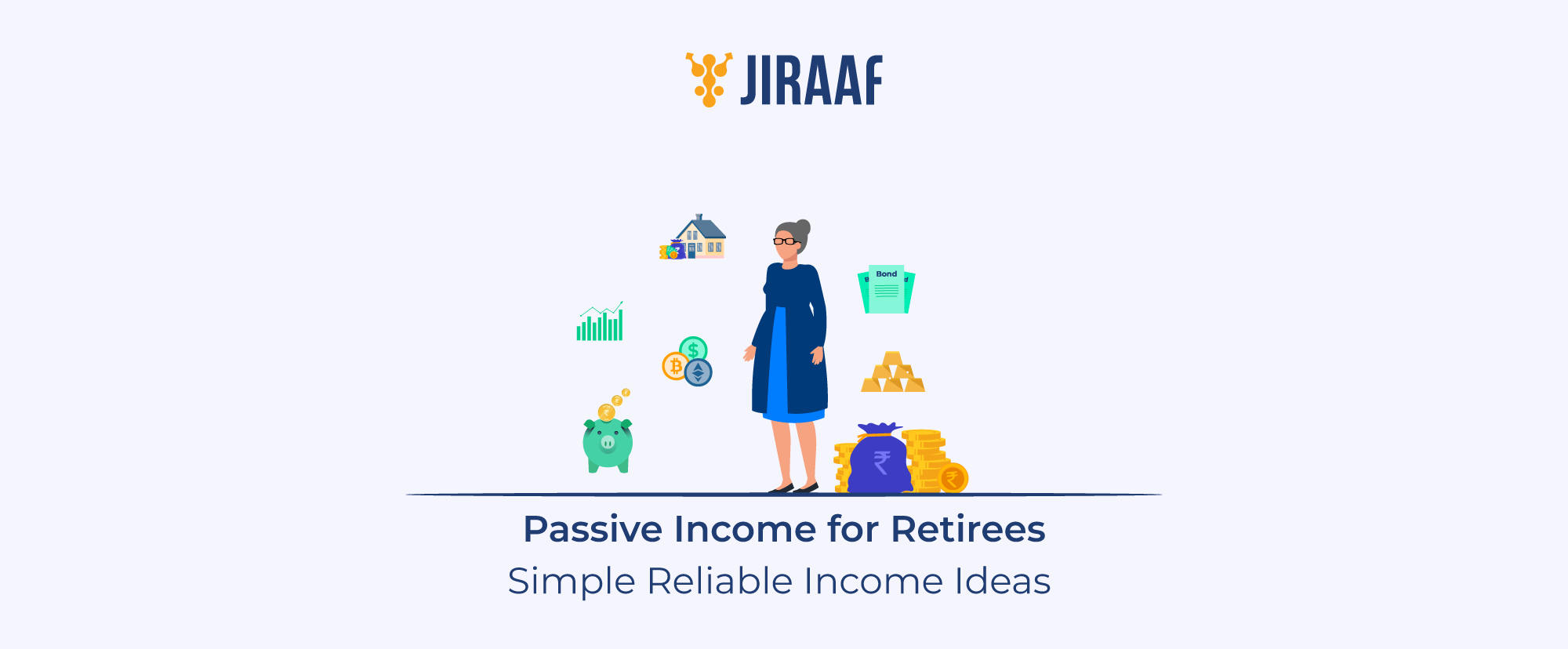
Explore how passive income options can add stability, flexibility, and financial comfort after retirement. This blog breaks down reliable passive income options suited for retirees like you.
Once regular earnings stop, the way money enters your life changes completely. During this time, exploring passive income options becomes useful because it fills the gap left by the absence of a predictable monthly salary.
This blog outlines the options that typically suit retirees, explains how each works, and clarifies the role they can play in creating a stable financial routine. The goal is to help you understand the available choices, so you can evaluate which approaches fit comfortably into a retirement lifestyle.
Why Passive Income Matters After Retirement
Passive income ensures that while your professional career may pause, your earnings don’t. It’s about replacing salary-based income with dependable cash flow that supports independence and stability. Here’s how passive income options can contribute to building a dependable retirement portfolio:
1. Protecting your capital
Investments such as government securities, fixed deposits, and investment-grade corporate bonds are generally designed to safeguard the original amount invested while still providing consistent returns. This makes them suitable for retirees who want to reduce exposure to excessive market volatility.
2. Staying ahead of inflation
Over time, inflation can steadily erode the purchasing power of savings. Instruments like inflation-linked bonds or actively managed bond funds attempt to align returns with prevailing inflation trends, helping retirees maintain the real value of their money.
3. Creating a regular income stream
Once employment income stops, investments must step in to generate cash flow. Many fixed-income products distribute interest payments at regular intervals, such as monthly, quarterly, or semi-annually by providing you with predictable income to cover everyday expenses.
4. Access to liquidity when needed
Having investments that can be converted into cash without significant loss is crucial during retirement. Options such as short-duration bond funds or treasury bills offer relatively quick access to funds, making them useful for managing unexpected expenses or emergencies.
5. Improving portfolio stability through diversification
Adding fixed-income instruments alongside equities and other assets can help moderate overall portfolio volatility. This balance between growth-oriented and stable investments is essential for maintaining long-term financial resilience during retirement.
6. Potential tax advantages
Certain fixed-income investments, such as tax-free bonds or government-backed savings schemes, may offer tax benefits. These advantages can help retirees retain a larger portion of their investment income, improving overall financial efficiency.
Let’s look at the safest and most reliable passive income avenues designed specifically for retirees seeking stability and comfort.
Safe Passive Income Options for Senior Citizens
Here are some of the most popular investment avenues many senior investors turn to for stable and predictable passive income.
RBI Floating Rate Savings Bond
The RBI Floating Rate Savings Bond (FRSB) is a sovereign investment designed to provide both safety and consistent returns. As of March 2026, the bond offers an interest rate of 8.05%, with a maturity period of seven years and interest paid out twice a year. Since there is no maximum investment limit, you can allocate funds according to your financial needs.
To improve accessibility for you, the RBI also allows age-based premature withdrawals. Investors aged 60 to 70 can exit after six years, those between 70 to 80 after five years, and individuals above 80 after four years. If redeemed early, 50% of the interest due and payable for the last six months of the holding period is deducted as a penalty, which still keeps the bond attractive in case you are conservative.
Tax-free Bonds
Tax-free bonds are typically issued by government-backed institutions to raise funds for sectors such as infrastructure and housing development. The key advantage is that the interest earned is completely exempt from tax under Section 10(15) of the Income Tax Act, 1961, allowing you to retain the full income generated from the investment.
These bonds generally provide annual returns between 7% and 8.5%, offering retirees like you a predictable income stream with relatively low risk. Since there is no upper limit on investment, they allow you to allocate larger sums and generate stable, tax-efficient income without significant exposure to market fluctuations.
Senior Citizen Fixed Deposits (FDs)
Senior citizen fixed deposits have remained one of the most popular investment choices for retirees like you who prefer stable and predictable returns without market risk. In this option, you deposit a lump sum with a bank or NBFC for a specified tenure, earning a fixed interest rate that remains unchanged throughout the investment period.
Safety is another advantage, as bank deposits are insured up to ₹5 lakh under the Deposit Insurance and Credit Guarantee Corporation (DICGC).
Senior citizens also receive higher interest rates compared to regular FDs, usually 0.25% to 0.75% more, which can significantly enhance retirement income. As of March 2026, interest rates for 1 to 5-year tenures range between 7.3% and 7.9%.
If you seek higher returns, you can consider small finance bank FDs, which may offer interest rates of up to 8.5%. Platforms such as Jiraaf also provide access to high-yield FD opportunities for investors looking to explore better fixed-income returns.
Senior Citizen Savings Scheme (SCSS)
The Senior Citizen Savings Scheme (SCSS) is an investment program created specifically to provide stable income if you are aged 60 and above.
You can open an SCSS account at banks or post offices. The scheme allows investments starting from ₹1,000, up to a maximum of ₹30 lakh, in multiples of ₹1,000. Deposits exceeding ₹1 lakh must be made via cheque or bank transfer, while smaller contributions can be made in cash.
As of March 2026, the scheme offers an interest rate of 8.2% per year, which is reviewed quarterly. Interest is credited every quarter, on April 1, July 1, October 1, and January 1, providing you with a regular income stream.
Furthermore, the scheme has a five-year maturity period, with an option to extend it for an additional three years if the extension request is submitted within one year of maturity. Investments made under SCSS qualify for tax deduction under Section 80C, although the interest earned remains taxable. TDS is applicable if annual interest exceeds ₹1 lakh (₹50,000 for individuals below 60).
Premature closure is permitted, but it involves a small deduction of 1.5% of the principal if withdrawn between one and two years, and 1% if withdrawn after two years. If the account is closed within the first year, the interest already paid is deducted from the principal amount.
Additionally, from August 29, 2024, while the principal amount returned upon closure is not subject to further tax, the interest earned throughout the tenure remains taxable as per your income slab, providing you greater flexibility and improved liquidity.
Each of these options offers a different balance of safety, returns, and liquidity. When combined thoughtfully, they can form the backbone of a steady retirement income stream.
Making the Most of Your Passive Earnings After Retirement
A thoughtful retirement plan balances withdrawals, taxes, and modest growth so that your financial foundation stays solid throughout retirement.
- Calculate safe withdrawal rate
Determining how much to withdraw from your corpus each year helps prevent your savings from running out too soon. The general guideline for withdrawing is about 3 to 3.5% annually, and it can be adjusted based on inflation, medical expenses, and life expectancy. You should consult a financial planner to help determine the right withdrawal rate to support your after-retirement lifestyle.
- Tax efficiency
Even a safe income can lose value if it’s not tax-efficient. Understanding which investments are taxable and how to structure them, can save you thousands every year.
For instance, SCSS interest is taxable, but tax-free bonds or systematic withdrawals from mutual funds (which are now taxed at slab rates without indexation for debt funds) can be planned to manage your burden. You can also enjoy senior citizen benefits with higher basic exemption limits, and the ₹50,000 deduction on interest income under Section 80TTB, which can be leveraged for smarter income planning.
- Consider taking a little risk for growth
Completely avoiding risk may seem safe, but it can limit growth. Allocating 10% to 15% of your portfolio to balanced advantage funds, low-risk mutual funds, or REITs can help beat inflation without endangering principal. These options generate moderate appreciation, ensuring your money doesn’t stagnate while you enjoy stability from safer instruments.
- Consider rental income
If you own property, you already hold a powerful passive income asset. You can consider leasing a portion of your home, creating a studio space, or even investing in managed properties that take care of maintenance for you. Regular rent inflow supplements your other earnings and provides an inflation-protected buffer.
By combining disciplined withdrawals, tax planning, and selective growth opportunities, you can turn your retirement savings into a steady and sustainable source of income.
Conclusion
A comfortable retirement doesn’t depend on just one income source. It requires a combination of different options, such as government schemes, deposits, bonds, and rental income, to create multiple streams that work together to support your expenses. While some investments offer stability, others can help your money grow gradually over time. This balanced approach allows retirees like you to protect your savings while still maintaining financial flexibility. With the right mix, you can get one step closer to quietly replacing the role that a monthly salary once played.