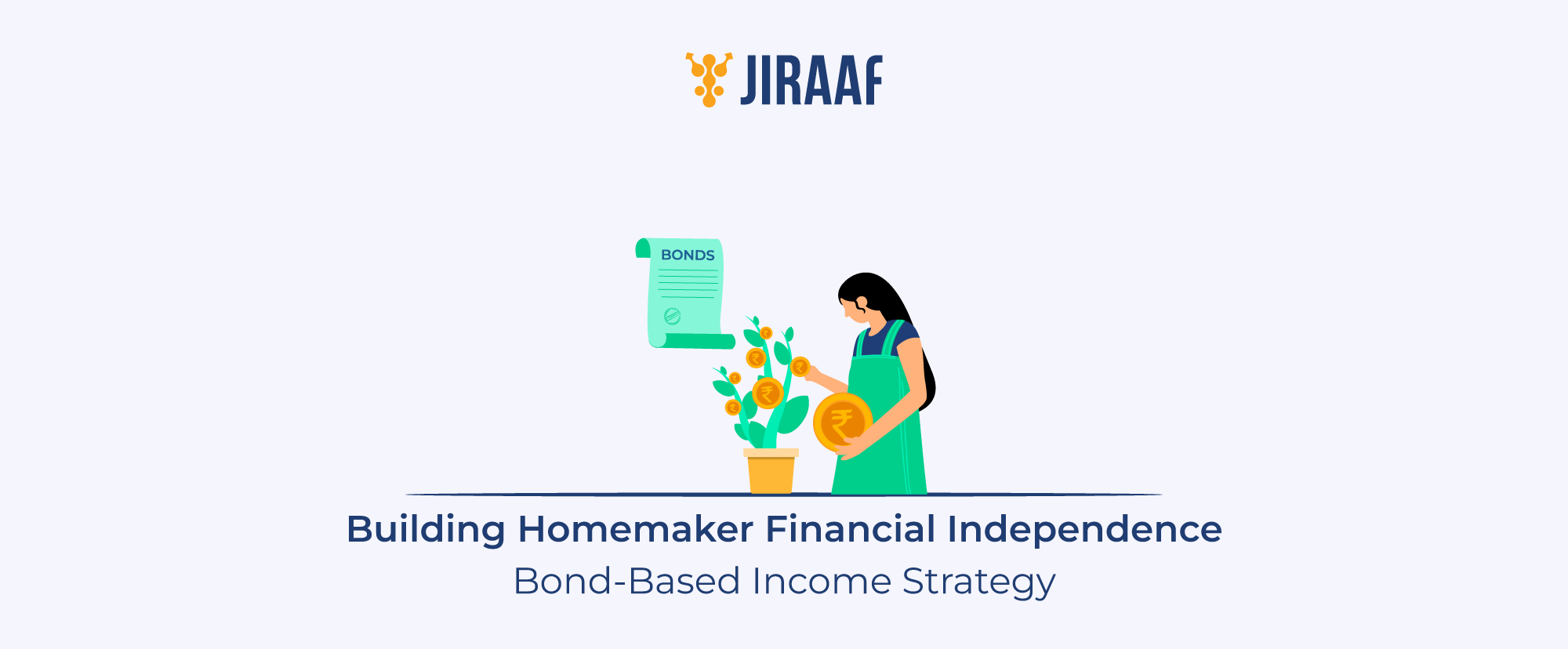
As more Indian women enter capital markets, financial independence is shifting from participation to predictable income and capital ownership. Discover how bonds can help homemakers generate steady payouts while preserving long-term savings.
Every Women’s Day, we celebrate women’s achievements in careers, leadership, and entrepreneurship. Yet one form of progress often remains understated: promoting financial independence among homemakers.
As India moves toward its 2047 vision of becoming a developed nation, the scale and quality of homemakers’ participation will play a key role in the country’s economic momentum. Encouragingly, more women are opening bank accounts, investing in the markets, and actively managing their money than ever before.
In the sections ahead, we explore how stable, income-generating instruments such as bonds can help homemakers like you can plan finances more efficiently by creating predictable payouts and strengthening financial security.
Why Financial Independence Matters for Homemakers
Financial independence is about having control, choice, and confidence in making better financial decisions. For you, this independence carries even deeper significance.
1. It builds decision-making power within the household
When you own income-generating assets or investments in your own name, you participate more actively in long-term financial decisions; from children’s education planning to retirement strategies. Financial contribution strengthens financial voice.
2. It creates personal financial identity
Managing money and building assets fosters confidence. It shifts you from being a financial manager of expenses to financial owners of assets.
4. It supports long-term security beyond working years
Retirement planning is not limited to working individuals. Structured investments can help you build a steady income base for later years, ensuring dignity and autonomy.
Financial Planning for Homemakers and Working Women
Financial planning for you as well as working women in India is entering a new phase.
Women now hold nearly 40 million demat accounts approx. in 2025, up from just 6.7 million in 2021. At one of India’s largest brokerages, women account for almost 30% of the investor base, compared to just 2–3% a decade ago. According to NSE data (June 2025), women now represent 24.5% of India’s total investor registrations, with states like Maharashtra and Delhi crossing 28-30%.
These data points show an important shift: women are not just saving, they are investing. However, financial planning differs for you and other working women.
For instance, salaried women may deploy monthly cash flows into SIPs and market-linked instruments, actively participating in India’s equity markets. However, increasing exposure to equities also heightens portfolio volatility.
You, on the other hand, rely on lump-sum savings, family allocations, or accumulated reserves. Your portfolios, therefore, demand greater emphasis on stability and predictable income.
Traditionally, Indian women have used equities to build long-term growth and fixed deposits to protect capital. But equities can swing sharply with market cycles and FDs often deliver limited post-tax returns.
By adding fixed-income instruments such as bonds to their portfolios, you can seek greater stability than equities while aiming for potentially higher returns than traditional deposits.
Bonds as a Source of Regular Income for Homemakers
Bonds are fixed-income instruments that provide fixed coupon payouts at pre-defined intervals and principal repayment at maturity. Unlike equities, their returns are not driven by daily market fluctuations.
Investment-grade corporate bonds today offer yields ranging from 8% to 14%, depending on the credit rating of their issuer. According to CRISIL, corporate bond default rates stand at a 17-year low of 0.7% in FY25. This indicates relatively contained credit risk in quality issuances.
For working women looking to stabilize equity-heavy portfolios and for you seeking predictable payouts with capital preservation, bonds offer a balanced middle ground.
Building a Regular Income Through Bonds
Bonds generate cash flows through periodic interest payments, often paid at monthly, quarterly, or annual intervals. By building a laddered portfolio (a mix of bonds with different maturities and payout schedules), working women as well as you can create a predictable income stream while safeguarding their capital for the long term.
Let’s take a practical example: ₹10 lakh invested in investment-grade bonds yielding 9-11% annually.
Consider investing ₹10 lakh from accumulated household savings into a diversified bond portfolio yielding around 9 to11% annually.
By allocating
- 40% to AAA-rated bonds for stability
- 30% to AA-rated bonds for moderate yield
- 30% to select A/BBB-rated bonds for enhanced returns
You can efficiently balance safety with income optimization.
At an average 10% yield, this translates to approximately ₹1 lakh per year, or nearly ₹8,000 to ₹9,000 per month (gross) in predictable income.
Conclusion
This Women’s Day, make a decision; not to redefine your role, but to strengthen it financially. You are self-sufficient in running households, managing responsibilities, and shaping futures. Extending that self-sufficiency into personal finances adds another layer of stability and confidence.
When you move from managing money to generating it, even quietly through disciplined fixed-income investing, it marks a powerful shift. Because true financial independence is not loud, it is stable, consistent, and entirely yours.