The see-saw portfolio rule is a dynamic framework for balancing risk and reward in Indian investment portfolios. This blog explains how to apply the rule through asset allocation, diversification, rebalancing, and strategic risk management tailored for long-term wealth building.
Building long-term wealth in Indian financial markets requires a steady approach. The Indian stock market, represented by benchmark indices like the Nifty 50 and S&P BSE Sensex, offers high returns over long horizons, but it also experiences market swings. During periods of market volatility, an unmanaged equity portfolio can lose value rapidly, prompting impulse selling. Conversely, keeping all capital in low-yield Fixed Deposits (FDs) or traditional savings accounts, risks losing purchasing power to inflation over time.
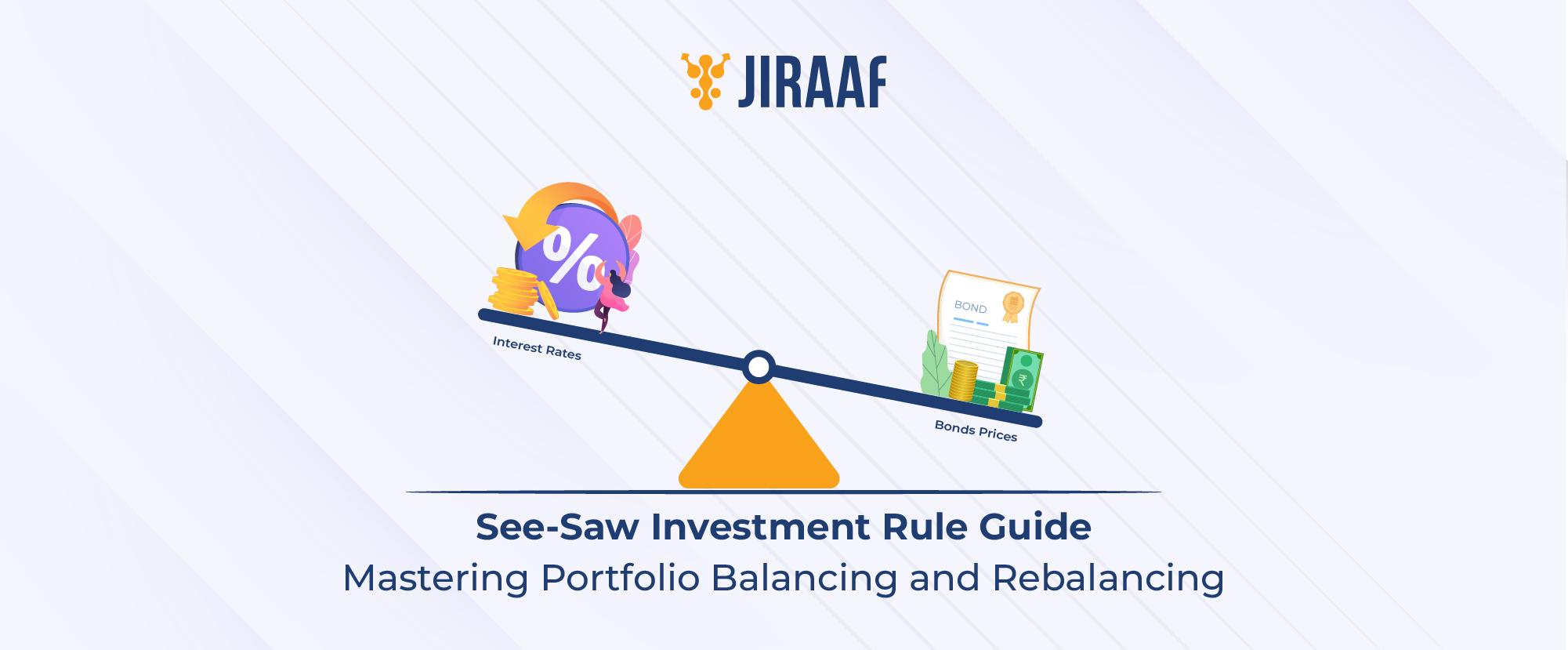
The see-saw portfolio rule addresses this balance. Like two children balancing on a playground see-saw, a healthy investment portfolio balances risk and return. When equity prices rise, risk exposure increases; when stock prices pull back, safer instruments like fixed income, corporate bonds, and debt mutual funds protect capital. Understanding how this rule works can help you build a portfolio designed to ride out market cycles.
What is the See-Saw Portfolio Rule?
The see-saw portfolio rule is a core framework within modern portfolio management strategies. It describes the inverse relationship between growth assets (stocks and equity mutual funds) and stability assets (sovereign debt, public provident funds, corporate bonds, and fixed income).

In a balanced investment portfolio, equity acts as the seat that moves up to capture growth, while debt acts as the seat that lowers risk and absorbs market shocks. When equity markets rally, the equity portion of your portfolio expands. When stock prices decline, debt assets maintain stability, keeping your overall wealth secure.
Understanding this see-saw motion helps prevent common behavioral errors, such as buying stocks near market peaks out of fear of missing out (FOMO) or selling equity near market bottoms due to panic. Instead of reacting emotionally to daily news, the see-saw rule establishes a rules-based system where market shifts automatically trigger portfolio adjustments.
Role of Asset Allocation in Portfolio Stability
An effective asset allocation strategy serves as the foundation of portfolio risk management. Rather than trying to time market tops and bottoms, strategic asset allocation divides your capital across distinct asset classes according to your investment horizon, financial goals, and personal risk tolerance.
In the Indian financial context, asset classes generally fall into three main categories:
- Growth assets (equity): Flexi-cap mutual funds, large-cap index funds, mid-cap stocks, and sectoral funds aimed at driving wealth accumulation over 5+ year horizons.
- Defensive assets (debt & fixed income): Public Provident Fund (PPF), Employees’ Provident Fund (EPF), Target Maturity Debt Funds, Sovereign Gold Bonds (SGB), and high-quality corporate bonds that generate predictable yields and preserve capital.
- Liquid Buffers (Cash & Cash Equivalents): Emergency funds placed in liquid mutual funds or high-yield savings accounts to cover immediate expenses without disturbing long-term investments.

Selecting an allocation ratio creates the pivot point for your investment see-saw.
For example, an aggressive investor in their late 20s might maintain a 70:30 equity-to-debt ratio, whereas an investor five years from retirement might choose a more conservative 30:70 split to protect built-up capital.
How Diversification Helps Balance Risk
While asset allocation sets the broad division between growth and safety, an investment portfolio diversification strategy ensures that a single underperforming asset does not undermine your financial plan. Diversification means spreading investments across different sectors, market capitalizations, and security types so their returns do not move in perfect tandem.
A clear diversification strategy addresses risk across multiple levels:
- Market capitalization diversification: Allocation across large-cap (top 100 companies offering stability), mid-cap, and small-cap funds (higher growth potential with higher short-term volatility)
- Sectoral spread: Avoiding heavy concentration in a single sector, such as Information Technology or Banking, by spreading investments across pharmaceuticals, fast-moving consumer goods (FMCG), capital goods, and automobiles
- Instrument-level fixed income spread: Combining government securities (G-Secs) through gilt funds with corporate bond funds and banking & PSU debt funds to balance credit risk and interest rate exposure
- Geographic diversification: Allocating a modest portion (5%−10%5%−10%) to international equity funds to reduce home-country bias and gain exposure to foreign markets
| Diversification dimension | Concentrated portfolio risk | Diversified portfolio strategy |
| Market cap | 100% Small-cap equity (extreme volatility) | 60% Large-cap, 25% Mid-cap, 15% Small-cap |
| Sector concentration | 80% Banking & financials (high regulatory exposure) | Balanced spread across IT, FMCG, banking, pharma, and Infra |
| Fixed income assets | Single corporate fixed deposit (default risk) | Combination of G-Secs, corporate bonds, and Sovereign gold bonds |
Through multi-layered diversification, poor performance in one market sector can be offset by stability or growth in another, smoothing out portfolio returns over time.
Why Portfolio Rebalancing is Important
Over time, market movements cause your original asset allocation to drift. During a stock market rally, your equity allocation might increase from 60% to 75% of your portfolio’s total value, exposing you to higher risk than intended. Portfolio rebalancing is the mechanism that restores your original risk profile.

Rebalancing works by systematic reallocation: selling a portion of the outperforming asset class (buying high) and reinvesting the proceeds into the underperforming asset class (buying low).
Step-by-Step Numerical Example: Rebalancing a ₹10 Lakh Portfolio
Consider an investor who starts with a ₹10,00,000 (₹10 Lakh) portfolio with a target ratio of 60% Equity / 40% Debt.
Initial state
- Equity: ₹6,00,000 (60%)
- Debt: ₹4,00,000 (40%40%)
After a 1-year market shift
- Equity markets surge by 30%30% = Equity value becomes ₹7,80,000
- Debt yields return 7%7% = Debt value becomes ₹4,28,000
- Total Portfolio Value = ₹12,08,000
Allocation drift analysis
- Equity share = [Equation]
- Debt share: [Equation]
- The rebalancing calculation
To restore the original [Equation] target allocation:
- Target Equity Value ([Equation] of ₹12,08,000) = ₹7,24,800
- Target Debt Value ([Equation] of ₹12,08,000) = ₹4,83,200
Execution
- Sell ₹55,200 worth of equity mutual fund units (₹7,80,000 – ₹7,24,800)
- Move ₹55,200 into debt funds/instruments
This disciplined transaction locks in stock gains at higher valuations and builds up defensive holdings at relatively lower prices, putting the see-saw back in balance.
Tax and Transaction Efficiency in India
When rebalancing, consider tax implications under Indian tax laws:
- Equity Long-Term Capital Gains (LTCG): Gains on equity holdings held for over 12 months are taxed at [Equation] on gains exceeding ₹1.25 Lakh in a financial year
- Debt Mutual Fund Gains: Capital gains from debt funds are added to your taxable income and taxed at your applicable income tax slab rate
- Tax-Efficient Alternatives: Instead of selling equity and triggering capital gains tax, you can rebalance by directing new Systematic Investment Plans (SIPs) or fresh cash top-ups into the under-allocated asset class
Managing Risk Through Strategic Portfolio Design
Effective portfolio risk management requires aligning your strategy with your life stage and financial goals. Wealth preservation strategies focus on adjusting your investment approach as your age, goals, and risk profile evolve.
| Life stage/ goal | Equity allocation | Debt allocation | Primary focus |
| Early career (20s-30s) | 70-80% | 20-30% | Long-term aggressive growth |
| Mid-career (40-50s) | 40-50% | 40-50% | Balanced growth and stability |
| Pre-retirement (55+) | 20-30% | 70-80% | Capital preservation and income |
The “100-Minus-Age” Guideline
A widely used reference point for determining equity allocation is the 100-Minus-Age Rule. Here’s how it goes:
[Equation]
Under this framework:
- A 25-year-old investor allocates [Equation] ([Equation]) to equity and [Equation] to debt instruments
- A 50-year-old investor adjusts their target allocation to [Equation] equity and [Equation] debt to shield capital as retirement approaches
Many modern advisors adapt this guideline to “110-Minus-Age” or “120-Minus-Age” to account for longer life expectancies, but the core principle remains the same: as your investment horizon shortens, your portfolio should gradually tilt toward stability.
Core Risk Protection Elements

- Emergency buffer first: Maintain 6 to 12 months of living expenses in liquid mutual funds or high-yield savings accounts before allocating capital to long-term equity. This prevents you from having to sell growth investments during a market loss to cover immediate expenses.
- Comprehensive Insurance: Maintain adequate pure term insurance and health insurance coverage so unexpected events do not drain your investment portfolio.
- Automated Volatility Management: Use SIPs to invest fixed amounts at regular intervals, rupee-cost averaging your equity purchases over market cycles. When shifting large lump sums into growth assets, use Systematic Transfer Plans (STPs) from debt funds to equity funds over 6 to 12 months to manage entry-point risk.
Following the see-saw portfolio rule helps create a resilient investment framework. By establishing clear asset allocation targets, diversifying across asset classes, rebalancing systematically, and adjusting for your life stage, you can navigate market volatility with confidence and work toward your long-term financial goals.