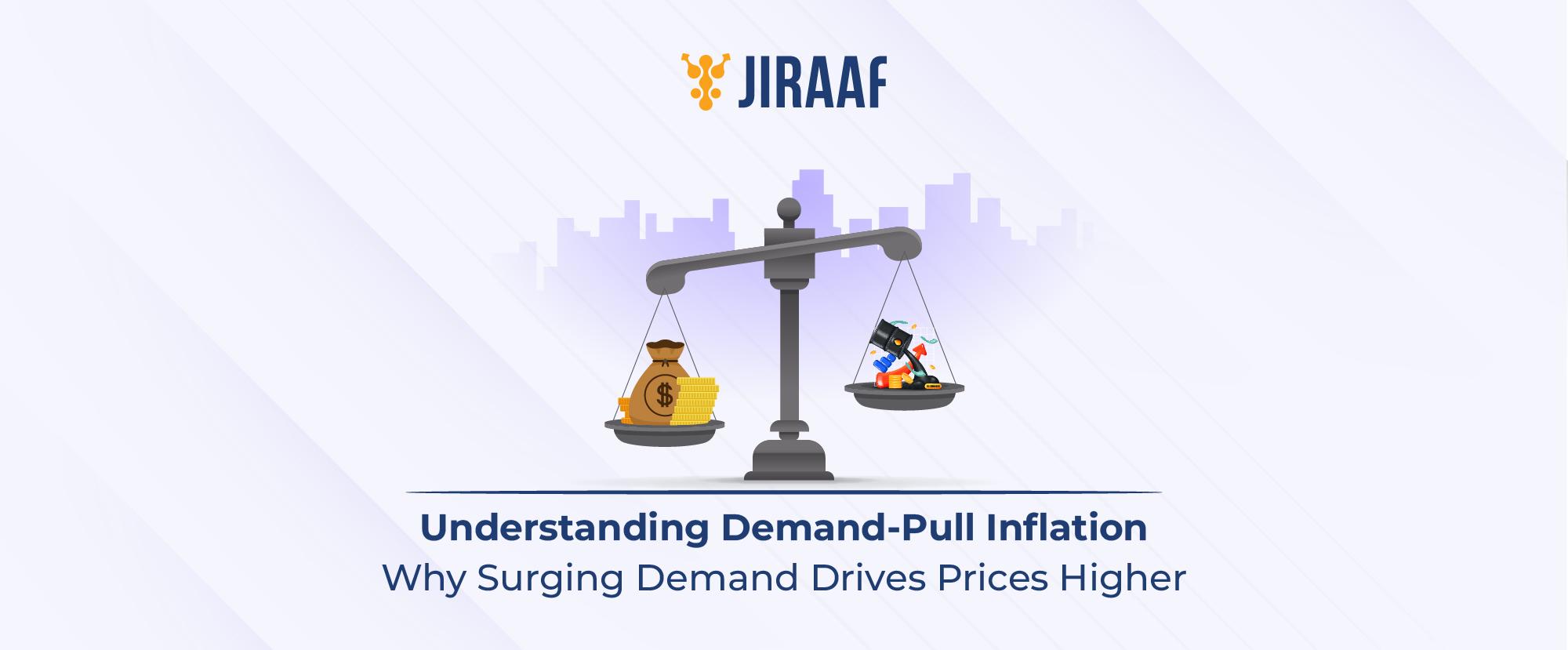
Demand-pull inflation is one of the primary macroeconomic forces driving price hikes in a growing economy like India. This blog explains its core meaning, primary causes, real-world examples, major economic effects, and key policy controls used to manage it.
Inflation is a concept every Indian household encounters regularly, whether when purchasing monthly groceries, buying a family vehicle, or tracking Reserve Bank of India (RBI) interest rate announcements. However, price hikes stem from different underlying market forces. One of the most prominent drivers in a rapidly expanding economy is demand-pull inflation.
When aggregate consumer appetite outpaces an economy’s capacity to produce goods and services, prices rise naturally. Economists often describe this dynamic as “too much money chasing too few goods”.
What is Demand-Pull Inflation?
When exploring foundational macroeconomic concepts, understanding what is demand-pull inflation provides essential context for analyzing market cycles.
In simple terms, demand-pull inflation occurs when the overall market demand for goods and services rises significantly faster than the available aggregate supply. When consumer confidence grows, employment expands, or household incomes rise, total spending surges across the country.
Factories and service providers attempt to expand output to keep pace with customer orders. However, once production facilities run near full capacity, supply cannot expand further in the short term. To balance the market and ration limited inventory, sellers adjust prices upward, resulting in demand-pull inflation, which economists measure through consumer price indices.

How Demand-Pull Inflation Works
To understand the core mechanics of a demand-pull phenomenon, it helps to analyze the relationship between Aggregate Demand (AD) and Aggregate Supply (AS):
- Aggregate Demand (AD): The total quantity of goods and services requested across the entire economy by households, businesses, government entities, and foreign trade (AD=C+I+G+(X−M)AD=C+I+G+X−M)
- Aggregate Supply (AS): The total volume of goods and services that producers can create and sell at a given price level
When aggregate demand shifts outward due to strong consumer sentiment or easy access to credit, short-term supply remains constrained by factory limits, raw material availability, or worker shortages. As a result, prices shift upward to establish a new equilibrium point.

Primary Causes of Demand-Pull Inflation
Analyzing the main causes of demand-pull inflation helps identify how broader macroeconomic trends translate into retail price increases. Fundamentally, demand-pull inflation is caused by factors that boost liquidity, elevate household disposable income, or stimulate aggregate expenditure.
1. Robust economic growth & high consumer spending
When GDP expands steadily, unemployment drops and household earnings climb. Confident consumers increase their discretionary spending on electronics, automobiles, home upgrades, and travel, putting upward pressure on existing retail inventory.
2. Expansionary fiscal policy
When government expenditure increases on large-scale public infrastructure (such as highways, urban transit, and railways through initiatives like PM Gati Shakti) or personal income tax slabs are lowered, liquidity flows into the economy. Citizens retain higher disposable income, increasing retail market demand.
3. Expansionary monetary policy (low interest rates)
When the central bank maintains low benchmark lending rates (such as a low Repo Rate), borrowing becomes cheaper for businesses and individuals. Cheap home loans, auto loans, and personal credit lines encourage immediate buying, inflating prices in real estate and retail sectors.
4. Rapid surge in overseas exports
When global demand for domestic items surges, such as Indian software services, pharmaceuticals, or agricultural goods, foreign buyers absorb a large portion of local output. This leaves fewer goods available for domestic consumers, bidding up local prices.
5. Increased money supply
When the central bank permits total circulating money to grow significantly without a corresponding increase in real economic output, citizens hold excess liquid cash. As households spend these reserves, prices rise accordingly.
Demand-Pull Inflation Examples
Reviewing practical demand-pull inflation examples clarifies how these economic theories manifest in everyday Indian market scenarios. The structural demand-pull inflation effect appears consistently across several major consumer industries.
Example 1: Festive Season & Wedding Demand Surges
During festive periods such as Diwali or peak wedding seasons (November to January), demand for items like ethnic wear, gold jewelry, passenger vehicles, and travel tickets climbs rapidly.
- Scenario: Major airlines operate with fixed seating capacities on high-density routes like Delhi–Mumbai or Bengaluru–Delhi
- Mechanism: As millions of travelers attempt to book flights simultaneously, ticket requests exceed seat capacity
- Result: Airfares double or triple due to dynamic pricing models directly driven by surging buyer demand
Example 2: Post-Lockdown Economic Rebound
Following the reopening of businesses after health lockdowns, consumer spending surged rapidly in a phenomenon widely recognized as “revenge spending”.
Lockdowns Increase Savings ➔ Reopening Demand Spikes ➔ Production Lags ➔ Retail Price Inflation
Households rushed to buy personal cars, upgrade household electronics, and book long-deferred holidays. Automotive manufacturers faced massive order backlogs (often 6 to 12 months for popular models) because microchip production could not keep up with order volumes, prompting dealerships to cut promotional discounts and hike vehicle prices.
Example 3: Metro Housing & Rental Market Pressures
In growing metropolitan hubs like Bengaluru, Hyderabad, and Pune, corporate expansions drive steady population inflows. As thousands of IT professionals compete for apartment rentals near tech corridors, housing demand quickly outstrips available residential units, pushing up rental yields and home purchase prices.
Major Effects of Demand-Pull Inflation
Evaluating the broader effects of demand-pull inflation shows how price shifts impact households, corporate balance sheets, and central bank policies. While mild demand-pull inflation can encourage business investments in the short run, rapid price inflation strains consumer finances over time.
| Economic Parameter | Impact Type | Detailed Breakdown |
| Economic Output & Growth | Positive (Short-Term) | High product demand encourages firms to run additional factory shifts, hire workers, and invest in expanding production capacity. |
| Household Purchasing Power | Negative | As general prices rise faster than fixed salaries, actual household purchasing power drops, making daily living more expensive. |
| Lending Rates | Negative | Central banks respond to overheating demand by raising interest rates, increasing costs for home loans, personal loans, and credit cards. |
| Value of Fixed Savings | Negative | Traditional fixed-income deposits (yielding 6–7%) may offer negative real returns if overall market inflation outpaces nominal yields. |
| Business Profit Margins | Positive (Initial Phase) | Companies enjoy stronger pricing power, enabling them to improve profit margins as buyers accept price increases. |
Demand-Pull Inflation vs. Cost-Push Inflation
To accurately assess market trends, it is essential to differentiate between a demand-driven price surge and a cost-driven cost spike.
Demand-Pull Inflation: Demand Curve shifts RIGHT ──► Driven by Buyer Demand
Cost-Push Inflation: Supply Curve shifts LEFT ──► Driven by Supply Shortages
| Factor | Demand-Pull Inflation | Cost-Push Inflation |
| Primary Driver | Increase in total aggregate demand (ADAD) | Decrease in aggregate supply (ASAS) due to higher production costs |
| Core Causes | Excess market liquidity, low interest rates, high public spending, economic growth | Supply disruptions, crude oil price surges, crop failure, higher import tariffs |
| GDP Trajectory | Usually accompanied by expanding GDP and higher employment | Often paired with stagnant economic growth or recession (Stagflation) |
| Price & Output Link | Both real economic output and prices move upward initially | Prices rise while real economic output contracts |
| Indian Market Context | Car prices increase due to long waiting lists during festive seasons | Edible oil or fuel price hikes caused by global supply disruptions |
How Can Demand-Pull Inflation Be Controlled?
Managing excessive price growth requires cooling down aggregate expenditure without pushing the economy into a downturn. Regulatory authorities rely on two primary toolkits:
1. Monetary Policy Controls (Reserve Bank of India)
The RBI adjusts monetary conditions to absorb excess market liquidity:
- Increasing the Repo Rate: Raising the repo rate increases borrowing costs for commercial banks, leading to higher interest rates on consumer and corporate loans. Higher borrowing costs encourage saving while moderating credit-financed purchases.
- Raising Cash Reserve Ratio (CRR): Increasing the CRR requires commercial banks to hold a higher percentage of their cash deposits with the RBI, reducing funds available for market lending.
2. Fiscal Policy Measures (Government Intervention)
The Ministry of Finance uses fiscal tools to regulate aggregate market spending:
- Targeted public expenditure: Moderating non-essential administrative or public spending reduces the flow of cash into circulation
- Adjusting tax rates: Calibrating direct taxes reduces excess disposable income, moderating retail consumer spending across sectors
Demand-pull inflation remains a natural outcome of strong economic development. When driven by expanding employment, wage gains, and healthy business activity, moderate inflation (around 4% with a tolerance band of +/- 2%, as targeted by the Reserve Bank of India) signals economic vitality.
However, when aggregate spending outpaces structural supply capacities, price hikes erode household purchasing power. Maintaining stable economic growth requires coordinated monetary actions from the central bank alongside balanced fiscal policies from the government.