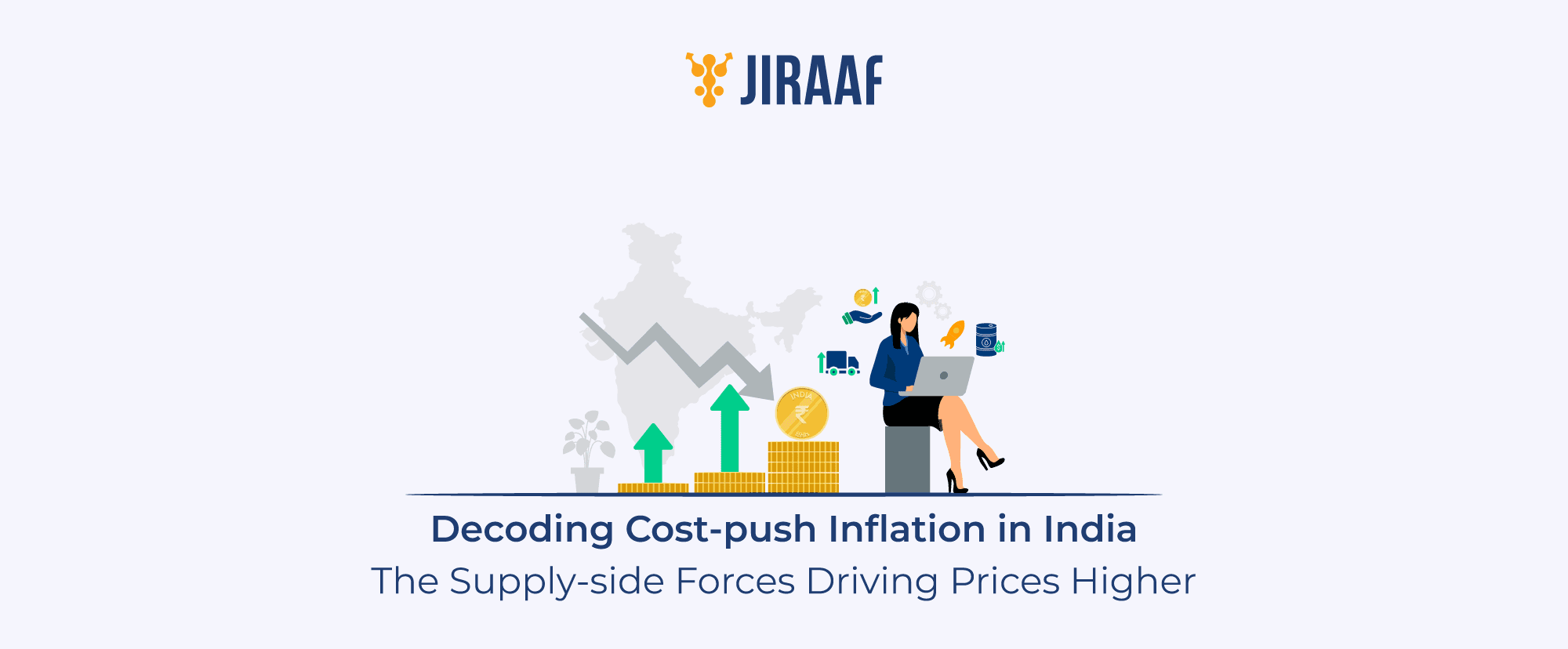
This blog provides a deep dive into cost-push inflation, an economic phenomenon where rising production costs drive up consumer prices. It explores the specific triggers within the Indian market while offering a clear theoretical framework and practical analysis of the 2026 economic landscape.
Inflation is a term that frequently dominates financial news, but it is rarely a single, uniform event. While many people associate rising prices with the idea of “too much money chasing too few goods”, this only addresses one aspect of inflation. The other key factor is cost-push inflation. In the Indian context, where supply chains are sensitive to global commodity shifts and domestic climate patterns, understanding cost-push inflation is crucial for both businesses and consumers.
What is Cost Push Inflation?
Cost-push inflation occurs when overall price levels rise due to increases in the cost of wages and raw materials. Unlike other forms of inflation, it is not driven by increased consumer demand. Instead, it originates from the supply side. When production costs rise, companies face shrinking profit margins. To preserve these margins, they pass the increased costs onto consumers in the form of higher prices.
In essence, even when demand remains stable, the supply of goods decreases or becomes more expensive, causing prices to rise.
Cost Push vs. Demand Pull Inflation
To fully grasp cost-push inflation, it is helpful to compare it to demand-pull inflation:
- Demand pull inflation: This form of inflation is considered “good” in moderation. It occurs when the economy is growing, people have more money to spend, and demand exceeds supply.
- Cost-push inflation: This is often viewed as “bad” inflation. It arises when supply is restricted or costs increase, even if the economy is stagnant. In India, cost-push inflation can result in “stagflation”, where prices rise despite slow economic growth.
Major Causes of Cost Push Inflation in India
Several specific factors contribute to cost-push inflation in the Indian market:
- Rising commodity and raw material prices
India imports many essential commodities. When global prices for raw materials like crude oil, coal, or metals rise, domestic production costs increase. For instance, since crude oil is a primary input for transportation and manufacturing, a spike in global oil prices quickly raises the cost of a wide range of consumer goods in India, from vegetables to electronics.
- Supply chain disruptions
Recent years have demonstrated the fragility of global supply chains. Natural disasters, geopolitical tensions (such as conflicts in the Middle East), or trade barriers can restrict the flow of essential components, like semiconductors or chemicals (Comin & Johnson, 2026). When manufacturers cannot access necessary parts, the available supply becomes more expensive.
- Wage-push inflation
As the cost of living increases, employees and labor unions demand higher wages. If companies raise wages without corresponding gains in productivity, they must increase product prices to cover higher payroll costs. This can trigger a “wage-price spiral”, where higher wages lead to higher prices, which in turn prompt demands for even higher wages.
- Government taxes and regulations
Increases in indirect taxes, such as the Goods and Services Tax (GST), can cause immediate jumps in the final prices of goods. Similarly, environmental regulations that require investment in cleaner (and costlier) technology can drive up production costs, which are ultimately passed on to consumers.
- Natural disasters and climate impact
In India, erratic monsoon seasons are a classic cause of cost-push inflation. Crop failures, such as those affecting tomatoes, onions, or pulses, lead to sudden drops in supply and sharp price increases. These supply-side shocks push up the Consumer Price Index (CPI), regardless of changes in consumer demand.
Cost Push Inflation Graph Explained

How to read this graph
- The shift: The green line (SRAS 1) represents the initial supply state. Due to rising costs (such as oil or wages), the supply curve shifts leftward to the red dashed line (SRAS 2).
- Price Increase (P1 to P2): You can see the equilibrium point move upward along the blue demand curve, leading to a higher price level.
- Output Decrease (Y1 to Y2): As prices rise, the total output (Real GDP) shrinks, illustrating why cost-push inflation is often linked to economic stagnation.
This visual clearly demonstrates the “squeeze” in the economy, where prices go up even as production goes down.
In economic theory, this process is shown using the Aggregate Supply (AS) and Aggregate Demand (AD) model. The vertical axis represents the Price Level, and the horizontal axis represents Real GDP (Output). The Aggregate Demand curve slopes downward, and the Short-Run Aggregate Supply (SRAS) curve slopes upward.
In cost push inflation, the SRAS curve shifts left, moving the equilibrium to a higher price level and lower output. This dynamic makes cost-push inflation particularly challenging for policymakers, as raising interest rates to control prices can further reduce output.
Effects on Consumers and Businesses
Cost-push inflation affects the entire economy:
For Consumers
- Reduced purchasing power: As prices for essentials like fuel and food rise, households have less disposable income for discretionary spending
- Lower standard of living: If wages do not keep pace with rising production costs, families may cut back on healthcare, education, or nutrition
- Uncertainty: Rapid price changes make long-term financial planning difficult for households
For Businesses
- Squeezed profit margins: Businesses unable to pass the full cost increase to consumers (due to competition) see profits shrink
- Reduced investment: High costs and uncertainty often delay expansion or hiring plans
- Operational challenges: Small and medium enterprises (SMEs) are hit hardest, as they often lack the resources to absorb sudden increases in raw material prices
India’s Current Inflation Landscape (2025–2026)
As of early 2026, the Indian economy faces a complex inflationary environment. While food prices showed signs of moderation toward the end of 2025, headline inflation is projected to hover around 4.5% for the 2026 fiscal year. Much of this pressure remains cost-push in nature, driven by:
- Continued volatility in the Middle East, affecting energy imports
- A 4.5% depreciation of the Indian rupee against the US dollar, making imported raw materials more expensive
- Revised Consumer Price Index (CPI) baskets that better reflect modern consumption patterns, revealing underlying supply constraints
Conclusion
Cost-push inflation poses a significant economic challenge because it originates from the supply side. Whether triggered by global spikes in oil prices, domestic crop failures, or rising labor costs, the outcome is consistent: higher prices and reduced economic output. For India, a nation reliant on both agriculture and imported energy, maintaining resilient supply chains and a stable currency is critical to managing the “push” of rising costs.