Summary: The Consumer Price Index (CPI) measures changes in the prices of goods and services to monitor consumer inflation. This guide explains how the NSO calculates CPI, its types, uses, limitations, and importance for consumers, policymakers, and investors.
Quick Overview
- CPI tracks changes in prices of commonly purchased goods and services
- The MoSPI publishes CPI monthly using a representative consumer basket
- It helps you understand inflation while also helping businesses and policymakers make informed decisions
- CPI trends can influence interest rates, financial markets, and investment outlooks
- It is an important indicator, but should be viewed alongside other economic data
The grocery list you make today may look almost the same as it did a few years ago, but the amount you pay at checkout is probably different. Even small increases in the prices of everyday essentials can gradually affect your monthly budget and reduce what your money can buy.
To track these changes, the National Statistical Office (NSO), part of the Ministry of Statistics and Programme Implementation (MoSPI), publishes the Consumer Price Index (CPI) every month. Although economists and policymakers closely follow the report, the information it contains affects everyone.
Understanding what the CPI measures can help you make sense of inflation, interpret economic news, and evaluate your finances with greater confidence.
What is the Consumer Price Index (CPI)?
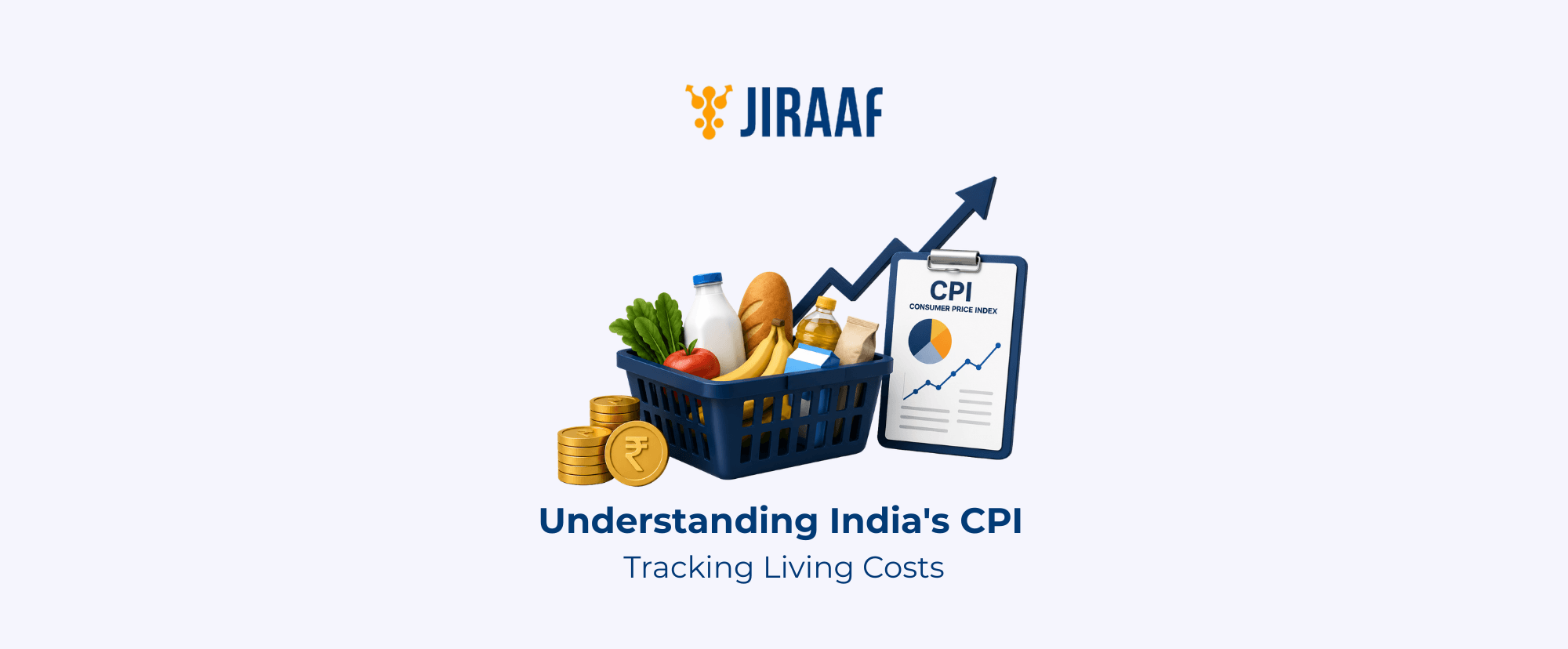
The Consumer Price Index (CPI) measures how the prices of goods and services that households commonly buy change over time. It serves as India’s primary measure of consumer inflation and helps you understand whether the overall cost of living is rising, falling, or remaining relatively stable.
To do this, the CPI tracks the prices of a broad basket of everyday goods and services, including food, housing, transportation, healthcare, education, clothing, fuel, and other essential expenses.
For example, suppose you spent ₹6,000 a month on groceries last year, and the same groceries now cost ₹6,400. The ₹400 increase shows that prices have risen over time. When prices rise across a broad basket of goods and services over time, economists call it inflation. The CPI measures these price changes to track consumer inflation over time.
While this example focuses on groceries, the CPI applies the same approach across a much broader basket of goods and services that households regularly buy.
A rising CPI generally indicates that consumer prices are increasing, while slower growth in the CPI suggests that inflation is easing.
How is CPI Calculated?
Although the calculation involves detailed data collection, the overall process is simple. The goal is to measure how prices paid by consumers change over time.
The NSO Builds the CPI Basket
The National Statistical Office (NSO) begins by conducting the Household Consumption Expenditure Survey (HCES). This survey shows what households buy, how much they spend, and how often they purchase different goods and services, helping the NSO create a representative basket of items.
The NSO also reviews and updates the basket and its weights periodically so that the CPI continues to reflect changing household spending patterns.
The NSO Assigns Weights to Each Category
The NSO assigns a weight to every category based on how much households typically spend on it. Since families usually spend a larger share of their income on food than on recreation, changes in food prices have a greater impact on the CPI.
Prices are Collected from Markets across India
Every month, the NSO collects prices for the selected goods and services from markets across both rural and urban areas. The prices are gathered from a large network of retail outlets, service providers, and local markets to capture regional price variations.
Current Prices are Compared with the Base Year
The latest prices are compared with those from a fixed base year to measure inflation. Since February 2026, India’s CPI has used 2024 = 100 as its base year, replacing the earlier 2012 = 100 series.
The Weighted Price Changes are Combined to Calculate the CPI
After calculating the price changes, the NSO applies the assigned weights to each category and combines them into a single index value. Because essential categories carry higher weights, their price movements have a greater influence on the final CPI than categories where households spend less.
The NSO Publishes the Monthly CPI
Once the calculations are complete, the NSO publishes the Consumer Price Index every month. The government, businesses, and policymakers use this data, while you can use it to understand how inflation affects everyday expenses.
Types of CPI in India
Different groups experience price changes differently, which is why the NSO publishes separate CPI series for specific populations.
| CPI Series | Who It Covers | Primary Purpose |
| CPI (Combined) | Rural and urban households | Measures overall retail inflation across India |
| CPI (Rural) | Rural households | Tracks inflation experienced in rural areas |
| CPI (Urban) | Urban households | Measures inflation for households living in cities and towns |
| CPI-IW | Industrial workers | Used for Dearness Allowance (DA) revisions and wage indexation |
| CPI-AL | Agricultural laborers | Measures inflation affecting agricultural labor households |
| CPI-RL | Rural laborers | Tracks inflation experienced by rural labor households engaged in non-agricultural work |
CPI (combined) is usually the most relevant measure because it reflects overall retail inflation across both rural and urban India. The news most commonly reports this figure, and the Reserve Bank of India (RBI) monitors it closely.
Headline CPI vs Core CPI
Not every CPI measure serves the same purpose. Headline CPI includes every category in the CPI basket, including food and fuel. Since the prices of food and fuel can change quickly due to factors such as weather conditions, supply disruptions, or global oil prices, Headline CPI often shows more short-term fluctuations.
Core CPI excludes food and fuel prices. By removing these more volatile categories, it helps economists identify underlying inflation trends that are less affected by temporary price changes.
India’s official monthly inflation measure is based on Headline CPI, but analysts also monitor core CPI to better understand longer-term inflation trends.
Uses of CPI
Once the CPI is published, different groups use it in different ways.
- Consumers:
- Monitor living costs
- Plan household budgets
- Businesses:
- Estimate input costs
- Make pricing decisions
- Governments:
- Track inflation
- Design economic policies
- RBI:
- Assess inflation trends
- Support monetary policy decisions
- Economists:
- Analyze inflation trends
- Compare economic conditions over time
Although each group uses CPI differently, they all rely on it to interpret inflation and make informed decisions.
Why CPI Matters for the Economy and Investors
Knowing the CPI isn’t just about understanding inflation. It also assesses you to see how changes in prices can influence your finances and the economy around you.
It Helps you Understand your Purchasing Power
Even if your income stays the same, rising prices can reduce what your money can buy.
For example, if your investment earns 8% in a year while consumer prices rise by 6%, your money has grown, but your purchasing power has increased by 2%. Comparing your returns with inflation gives you a more realistic view of your financial progress.
It can Influence Interest Rates
One of the RBI’s key responsibilities is to maintain price stability. Because of this, it closely monitors CPI when deciding whether interest rates should change.
If inflation remains higher than expected for a prolonged period, the RBI may raise interest rates to help slow price increases. If inflation is under control, it may keep rates unchanged or lower them to support borrowing and economic activity.
It Affects Borrowing and Business Decisions
Changes in interest rates can affect the cost of borrowing. Higher rates generally make home loans, vehicle loans, and business loans more expensive, while lower rates can make borrowing more affordable.
Businesses also monitor inflation when planning pricing, managing costs, and making long-term investment decisions.
It can Influence Financial Markets
If you invest, CPI is worth tracking because inflation can affect company profits, consumer spending, and market expectations.
Higher-than-expected inflation may create uncertainty in financial markets, while businesses and investors often view stable or easing inflation as a positive sign.
How to Read a CPI Announcement
The CPI figure alone doesn’t provide enough context. Economists and investors also compare the published number with market expectations to understand whether inflation is higher or lower than anticipated.
| CPI Result | What It Could Indicate |
| Higher than expected | Prices are rising faster than anticipated. This may increase expectations of higher interest rates and influence borrowing costs, investments, and financial markets. |
| Lower than expected | Inflation is easing. This can improve confidence among consumers and businesses and may reduce expectations of future interest rate increases. |
| In line with expectations | Inflation is broadly moving as expected, creating greater certainty for households, businesses, investors, and policymakers. |
Example
Suppose economists expect monthly CPI inflation to be 4.0%.
- If the published figure is 4.6%, inflation is higher than expected
- If the published figure is 3.8%, inflation is lower than expected
- If the published figure is close to 4.0%, economists generally consider inflation largely in line with expectations
Even a small difference between the expected and actual CPI can influence financial markets because it may affect expectations about future interest rates and economic conditions.
However, you shouldn’t interpret a single CPI report in isolation. Economists also consider indicators such as economic growth, employment, and industrial production before drawing conclusions.
Benefits of CPI
The CPI provides a consistent way to understand how consumer prices are changing over time. It helps consumers, businesses, and policymakers interpret price movements using a common measure.
- Provides a reliable benchmark: CPI creates a common reference point for measuring price changes over time. This makes it easier to compare inflation trends across different months and years and understand whether price increases are accelerating, slowing down, or remaining stable.
- Improves economic understanding: CPI helps you interpret what rising or falling prices mean for the broader economy. It allows consumers, businesses, and investors to look beyond individual price changes and understand overall inflation trends.
- Supports long-term planning: By showing how consumer prices are changing, CPI helps you plan future expenses, businesses prepare for changing costs, and policymakers make decisions based on current economic conditions.
Limitations of CPI
Although CPI is an important measure of inflation, it does not capture every individual’s experience with rising prices.
- Reflects average spending patterns: The CPI reflects the spending habits of an average household, so your personal expenses may increase at a different rate depending on your lifestyle and priorities.
- Varies across households: Factors such as location, income level, and spending choices can influence how strongly rising prices affect you.
- Covers only consumer prices: CPI focuses on consumer prices and does not track changes in areas such as stock prices, real estate values, or individual investment performance.
For this reason, you understand CPI best when you read it alongside other economic indicators rather than as a complete measure of economic conditions.
Conclusion
The CPI may appear to be just another economic figure reported every month, but it provides useful context for understanding changes that affect everyday financial decisions.
Once you understand what the CPI represents, it becomes easier to look beyond headlines and interpret why prices, interest rates, and economic expectations change. Whether you are managing household expenses, planning savings, or evaluating investments, understanding inflation can help you make more informed financial decisions.
While the CPI cannot tell you exactly how prices will move next, it can help you interpret inflation reports, understand policy decisions, and understand broader economic trends over time.