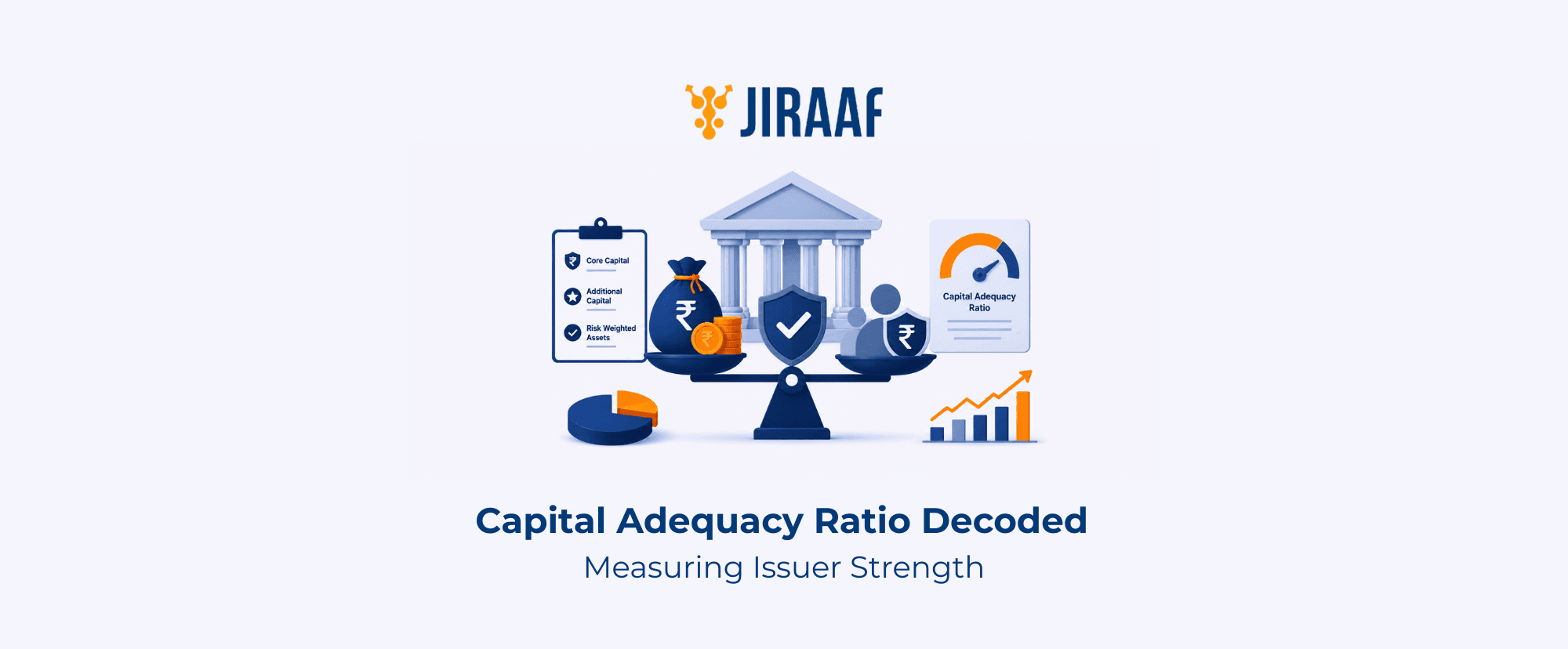
Capital Adequacy Ratio (CAR) shows how much loss-absorbing capital a bank or NBFC holds against its risk exposure, and it directly shapes what happens to AT1, Tier 2, and Non-Convertible Debentures (NCDs) bondholders if that position weakens. This guide walks through what CAR means, how it’s calculated, RBI’s norms for it, and how to check an issuer’s CAR before you invest.
Quick Overview
- CAR helps regulators, investors, and rating agencies assess the capital cushion a bank or NBFC has against risk-weighted exposures
- RBI requires a stricter minimum CAR than the global Basel III standard
- The issuer can write down AT1 bonds while it’s still operating, based on its CET1 ratio
- The regulator only writes off Tier 2 bonds at the point of non-viability, generally after AT1
- NCDs don’t carry CAR-linked write-down features, only standard credit risk
- The Yes Bank AT1 case shows why bond structure matters more than issuer reputation
If you hold or are considering an AT1, Tier 2 bond, or NCD from a bank or NBFC, you’ve probably seen the issuer’s Capital Adequacy Ratio (CAR) mentioned in its disclosures. It’s easy to treat this as just another regulatory metric buried in a factsheet. But CAR is more than that.
A healthy, stable CAR generally indicates a stronger capital cushion. A falling CAR, or one already below the regulatory floor, can signal greater stress and, for certain instruments, the risk of a principal write-down. Here’s what the ratio measures, how RBI enforces it, and what a breach can mean for each of these three instruments.
What is the Capital Adequacy Ratio?
You may see two different names for the same metric. Capital Adequacy Ratio (CAR) and Capital to Risk-Weighted Assets Ratio (CRAR) mean the same thing. Both terms appear interchangeably across RBI circulars, rating reports, and bond disclosures.
In practical terms, it tells you how much capital cushion the institution has to absorb losses before those losses put greater pressure on its financial position. Regulators track this closely because banks and NBFCs operate on borrowed money, and an institution that lends aggressively without holding enough capital has little room to absorb defaults before running into solvency trouble. That cushion is what the formula below calculates.
How is the Capital Adequacy Ratio Calculated?
CAR = (Tier 1 Capital + Tier 2 Capital) ÷ Risk-Weighted Assets × 100
Tier 1 capital: This is the core capital that absorbs losses while the institution continues operating as a going concern. It splits into Common Equity Tier 1 (CET1), made up of paid-up equity capital and reserves, and Additional Tier 1 (AT1), made up of specific hybrid instruments such as AT1 bonds.
Tier 2 capital: This refers to supplementary capital that absorbs losses at a later stage, typically when the institution is no longer viable. It includes items such as subordinated debt, certain general provisions, and revaluation reserves.
The denominator matters just as much as the capital figure. Risk-Weighted Assets (RWA) aren’t simply the institution’s total assets. The bank weights each asset by how risky it is, so a government bond carries a lower weight than an unsecured personal loan, and two banks with identical total assets can end up with very different RWA depending on how risky each bank’s loan book is.
Here’s a simplified example. A bank with ₹700 crore in Tier 1 capital, ₹300 crore in Tier 2 capital, and ₹10,000 crore in risk-weighted assets has a CAR of (700 + 300) ÷ 10,000 × 100, or 10%.
What are the RBI Norms for Capital Adequacy Ratio in India?
A 10% CAR may look healthy, but its significance depends on the regulatory minimum that applies to the issuer. RBI sets requirements above the global Basel III minimum.
- Basel III’s global minimum CAR is 8%
- RBI requires a minimum CAR of 9% for Indian banks
- Once you add the mandatory Capital Conservation Buffer of 2.5%, most banks need a total capital of around 11.5% of RWA
- Within that, Tier 1 capital must be at least 7%, and CET1 alone must be at least 5.5%
- Small Finance Banks face a higher minimum CAR of 15%
- Most NBFCs must maintain a minimum CAR of 15%, with at least 10% in Tier 1 capital
These norms can change over time, and an issuer’s reported CAR can shift as regulations evolve, so don’t assess its capital position based on a single figure.
How Banks and NBFCs Raise Capital and What it Means for Your Bond
Knowing the floor is one thing. Knowing how issuers stay above it is what affects you as a bondholder. When an issuer’s CAR needs strengthening, it has three levers: retain more profits, raise fresh equity, or issue capital instruments such as AT1 or Tier 2 bonds.
That third lever connects directly to your bond. When a bank or NBFC issues an AT1 or Tier 2 bond, that bond counts as regulatory capital and adds to the issuer’s CAR. You aren’t just lending to the issuer. You’re supplying part of its loss-absorbing buffer, and the bond terms reflect that with built-in triggers letting the issuer write down your principal if its capital position weakens enough.
A Non-Convertible Debenture (NCD) falls outside this system. It is ordinary debt, not regulatory capital, so it carries no CAR-linked write-down clause. Default risk on an NCD still exists, but it works through the standard insolvency process rather than a capital-ratio trigger.
That distinction matters most when an issuer’s capital position starts to weaken.
What Happens if an Issuer’s CAR Falls Too Low?
A CAR breach affects the issuer’s operations differently from its bondholders, so a bank appearing operational doesn’t automatically tell you what happens to your bond.
RBI monitors CAR through its Prompt Corrective Action (PCA) framework, which can impose escalating restrictions on dividend payouts, branch expansion, and management compensation, and can require a capital restoration plan.
For bondholders, AT1 and Tier 2 bonds carry their own trigger mechanics, and this is where a breach turns into something more serious than a delay.
- AT1 bonds carry a pre-specified trigger tied to CET1. If CET1 falls below 6.125% of RWA, the bond’s principal may be written down, depending on the terms of the instrument.
- Tier 2 bonds don’t have this going-concern trigger; RBI can write them off once it determines that the issuer has reached the Point Of Non-Viability (PONV)
- A write-down can be partial or run to zero, and if it runs to zero, that portion of your principal is gone for good; you don’t get it back. “Written down” as a general term covers that entire range, not just a full loss.
The Yes Bank case provides a real-world example of how these capital-related risks can affect bondholders.
Yes Bank Case Study
In March 2020, the RBI placed Yes Bank under a moratorium and superseded its board amid a sharp deterioration in asset quality. As part of the RBI-led reconstruction scheme, backed by SBI and a consortium of other banks, the administrator wrote down Yes Bank’s AT1 bonds, worth about ₹8,415 crore, to zero. The administrator didn’t wipe out equity shareholders the same way, though 75% of their shares stayed locked in for three years.
The bondholders challenged the write-down in court. In January 2023, the Bombay High Court ruled that the reconstruction scheme didn’t explicitly authorize the AT1 write-off and that the administrator had exceeded his powers. Yes Bank, RBI, and the central government appealed to the Supreme Court, which stayed the High Court’s order. Final arguments concluded in February 2026, and the Supreme Court has reserved its verdict. The outcome remains pending as of this writing, so check current reporting before drawing conclusions from this case.
The takeaway doesn’t depend on how that verdict lands. The structure of the bond matters more than the name of the company issuing it. In fact, Yes Bank’s AT1 bonds were contractually senior to equity, yet the administrator wrote them down to zero without writing down equity first, the reverse of the loss-absorption order the bonds were sold on. That’s part of what the Bombay High Court took issue with. The instrument you hold and the fine print behind it determine your position in a stress scenario, regardless of how established the issuer is.
How to Check an Issuer’s Capital Adequacy Ratio Before You Invest?
That case is a reminder to check the instrument, not just the issuer’s name, before you commit money. A few practical steps for doing that:
- Find the number in the issuer’s quarterly disclosures, annual report, or rating agency reports, as listed banks and NBFCs publish CAR every quarter
- Look at the trend across four to six quarters, not just the latest print, since one strong quarter doesn’t show whether the capital position is improving or eroding
- Check CAR against the regulatory minimum for that issuer type, since banks, Small Finance Banks, and NBFCs have different floors
- Read the instrument type before comparing yields, and consider it alongside the issuer’s broader default risk profile
- Check whether the issuer’s CET1 sits comfortably above the AT1 trigger of 6.125%, since that gap is your real cushion on an AT1 holding
Conclusion
Together, these checks point to one practical takeaway: when you invest in a bank or NBFC bond, don’t assess the issuer on its name or headline yield alone. The bond structure determines how losses can affect your investment, while the issuer’s capital position helps you assess how much room it has to absorb stress. AT1, Tier 2, and NCD bonds carry different loss-absorption features, so the same issuer can present very different risks across these instruments.
Before you invest, check the issuer’s CAR trend, regulatory minimum, CET1 position, and the terms of the specific bond. This helps you assess the risk and compare bonds based on more than just their coupon or yield.