How the Liquidity Adjustment Facility (LAF) Shapes Interest Rates and Bond Markets
Summary: The Liquidity Adjustment Facility (LAF) is the RBI’s framework for managing short-term liquidity in the banking system by injecting or absorbing funds to keep money markets stable. This guide explains how the LAF works, its key components, its role in monetary policy, and how it influences interest rates, bond markets, and investment decisions.
Quick Overview
- LAF is the RBI’s framework for managing short-term liquidity
- Helps inject or absorb funds to keep money markets stable
- Uses Repo, SDF, reverse repo, and MSF to manage liquidity
- Keeps overnight interest rates aligned with the RBI’s policy stance
- Supports inflation control and effective monetary policy transmission
- Influences bond yields, debt funds, loan rates, and fixed deposit rates
- Helps investors understand the impact of RBI policy decisions on fixed-income markets
Every day, customers withdraw salaries, companies deposit revenue, banks disburse loans, and fixed deposit interest gets paid out. These high-volume transactions happen simultaneously across systems, locations, and accounts, and banks cannot predict them perfectly. When the RBI announces changes in liquidity or interest rates, these everyday banking activities can influence borrowing costs, bond yields, and the returns you earn on fixed-income investments.
When banks run short of cash, they cannot settle their payments. When they have excess cash, idle funds generate little or no return. The RBI addresses both situations through the Liquidity Adjustment Facility (LAF), lending funds to banks that need liquidity and absorbing surplus funds from banks with excess liquidity.
Understanding the LAF goes beyond learning another banking term. It helps you make sense of RBI policy announcements, interest rate movements, and changing bond yields. This guide explains how the RBI uses the LAF to manage liquidity and financial stability in India, and why it matters for what you earn on your savings and investments.
What is the Liquidity Adjustment Facility?
The RBI uses the LAF as an operational framework to fine-tune day-to-day money supply and credit conditions within the banking ecosystem in India. It is a framework that brings together several policy tools and auction mechanisms to manage short-term liquidity.
Two tools handle the bulk of LAF’s day-to-day work:
- The repo rate lets banks borrow cash from the RBI when they face a funding shortage
- The standing deposit facility lets banks park excess cash they have with the RBI to earn interest
The other two tools are the Marginal Standing Facility (MSF), which provides emergency liquidity support, and the reverse repo rate, which the RBI now uses selectively for liquidity absorption operations.
Think of the LAF as a balancing mechanism that helps the RBI manage day-to-day liquidity in the banking system and keep interest rates relatively stable. Through this framework, the RBI influences how much banks can lend and the interest rates they charge. As a banking customer, these changes can affect how much you pay on loans and how much you earn on your savings.
How Does LAF Work?
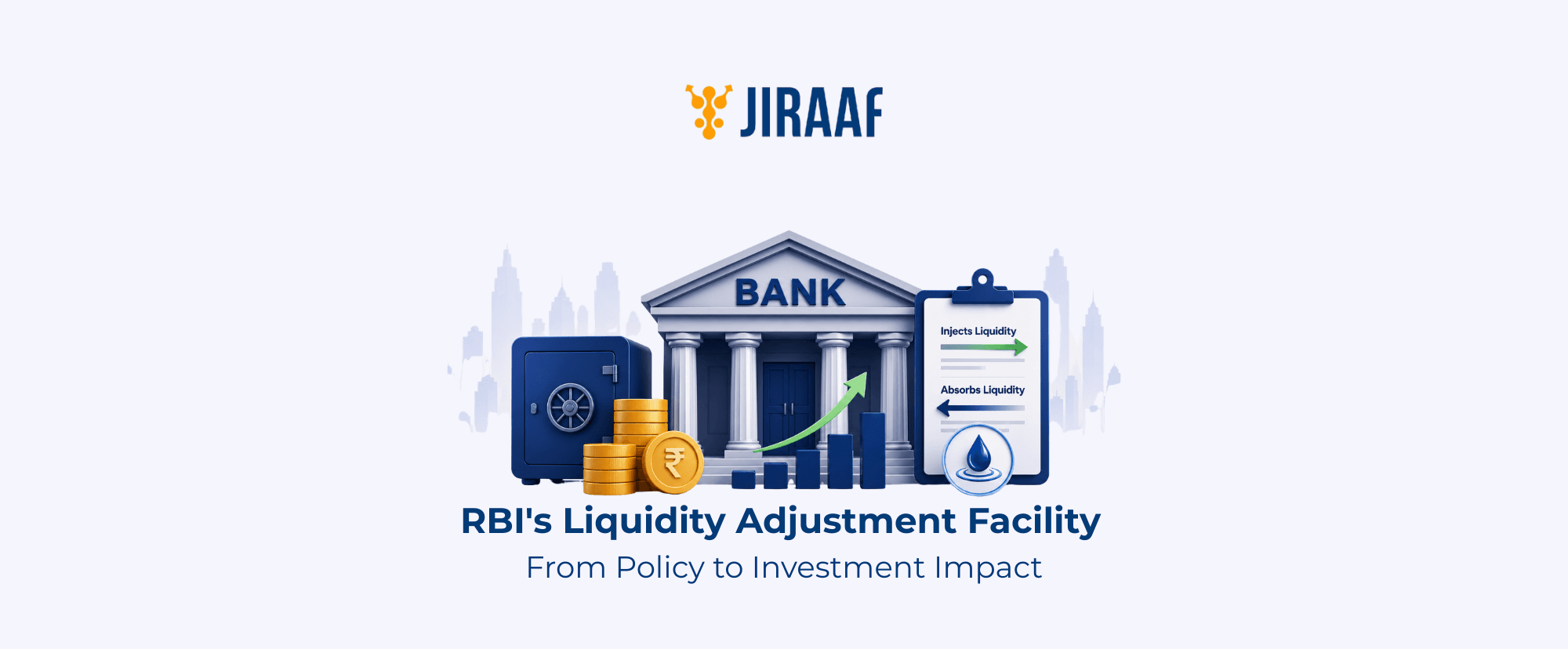
LAF injects money into the banking system when banks need it and absorbs excess funds when necessary.
Handling Cash Shortage: Liquidity Injection
When commercial banks have a cash shortage, the RBI intervenes to inject liquidity. The RBI charges the repo rate to lend money to banks overnight:
- A bank in need of liquidity sells government securities to the RBI to get quick cash
- The bank promises to buy back the same securities at a pre-agreed future date, usually the next day, at a higher price
- The difference between the bank’s selling price and the repurchase price of the government securities represents the interest cost, which is calculated based on the repo rate
- The RBI now conducts most liquidity injection operations through Variable Rate Repo (VRR) auctions rather than the standing overnight repo window
Handling Extra Cash: Liquidity Absorption
Sometimes, banks may have excess cash, and the RBI absorbs this excess liquidity to avoid inflation. Here, two tools come into play.
- Standing Deposit Facility (SDF): Banks deposit or park the extra overnight funds with the RBI using the SDF, and the RBI pays interest. Unlike repo borrowing, SDF deposits don’t require the RBI to provide collateral. SDF is the RBI’s primary daily liquidity absorption tool.
- Reverse repo rate: The bank lends its excess money to the RBI, which offers government securities as collateral in return. At maturity, the RBI repays the bank’s money along with interest (calculated at the reverse repo rate) and takes back its securities.
Unlike the SDF and Marginal Standing Facility (MSF), which banks can use at their discretion, the RBI now uses the reverse repo rate selectively for liquidity absorption operations. It mainly conducts these operations through Variable Rate Reverse Repo (VRRR) auctions.
Why are both SDF and Reverse Repo Rate needed?
The reverse repo comes with a real constraint. It requires collateral, and the RBI holds only a finite stock of government securities. During 2016’s demonetization and again through the COVID-19 pandemic, banks held trillions of rupees they wanted to park with the RBI. Reverse repo alone would eventually have run into a limit, since the RBI cannot collateralize more than it holds in securities.
The SDF (introduced in April 2022) removes that constraint. No security changes hands, because it doesn’t require any collateral. The RBI is the counterparty, and it is generally regarded as carrying negligible default risk as the central bank. Banks can park surplus funds with the RBI and earn interest on them without needing that collateral in place.
Understanding the LAF Corridor
The LAF corridor is the interest rate bracket the RBI uses to prevent short-term market rates from varying widely. It sets a strict floor and ceiling that fixes how cheaply banks can borrow or lend money.
The key components of the LAF corridor are:
- Ceiling: MSF is the absolute highest rate in the corridor. It caps how expensive short-term emergency borrowing can become for the bank
- Policy target: Repo rate is the midpoint benchmark that anchors the entire banking ecosystem
- Floor: SDF is the absolute lowest interest rate that prevents excess money from driving market rates to zero
The table below breaks down how each tool functions within the LAF corridor:
| Tool | Role in Corridor | Collateral | Typical Use / Frequency |
| Standing Deposit Facility (SDF) | Floor: RBI absorbs surplus liquidity to keep rates from falling too low | No collateral required; uncollateralized deposits directly with the RBI | Banks use it routinely when the banking system has excess daily liquidity |
| Repo rate | Midpoint/policy rate: RBI lends short-term funds to banks against securities | Banks pledge government securities (G-Secs) as collateral; the RBI applies a haircut (it lends slightly less than the securities’ market value as a safety margin) | Banks use it frequently for daily liquidity needs, while the RBI uses it to signal monetary policy |
| Reverse repo rate | Historical liquidity tool: Served as the floor before the SDF; the RBI now uses it selectively for specialized operations | Banks receive G-Secs as collateral when the facility is used | The RBI uses it selectively; it has become less central since the introduction of the SDF |
| Marginal Standing Facility (MSF) | Ceiling: RBI provides emergency overnight funds at a higher penalty rate during severe liquidity stress | Banks pledge G-Secs, including those maintained for SLR requirements, as collateral | Banks use it rarely, mainly during severe cash stress or unexpected end-of-day shortfalls |
LAF vs Other RBI Monetary Tools
LAF is the RBI’s day-to-day liquidity management framework. The central bank also uses tools such as the MSF, bank rate, and open market operations (OMO) for regulatory enforcement and long-term money supply management.
- Marginal Standing Facility (MSF): MSF is the RBI’s emergency overnight lending window. Banks that cannot meet their short-term liquidity needs through the regular repo window can borrow at the higher MSF rate by using a portion of the government securities maintained to meet their Statutory Liquidity Ratio (SLR) requirements as collateral, up to the permitted limit.
- Bank rate: The bank rate is the RBI’s oldest lending tool, historically used for longer-term, uncollateralized lending to banks. Today, that role is largely dormant. Instead, the bank rate moves in lockstep with the MSF rate and primarily serves as the penal rate for banks that fail to meet their CRR or SLR requirements. It rarely functions as an actual borrowing channel and appears mainly in compliance contexts.
- Open Market Operations (OMO): Unlike the LAF, which manages short-term liquidity through lending and borrowing, OMO permanently changes system liquidity by buying or selling government securities. When the RBI buys these securities, it injects durable liquidity into the banking system. When it sells them, it withdraws liquidity.
The table below highlights how these tools differ from the LAF.
| Feature | LAF (Repo Window) | Marginal Standing Facility (MSF) | Bank Rate | Open Market Operations (OMO) |
| Purpose | Routine day-to-day liquidity management | Emergency overnight rescue | Penal benchmark for reserve shortfalls | Permanent money supply control |
| Duration | Overnight (or short-term) | Overnight | Not applicable (reference rate) | Permanent |
| Collateral | Required (G-Secs above mandatory SLR) | Required (Can use SLR bonds) | Not applicable | Direct purchase/Sale of bonds |
| Interest rate | Normal repo rate | Higher penalty rate | Aligned with MSF rate | Market-determined bond prices |
Common myths about the LAF include:
| Myth | Reality |
| LAF and repo are the same thing | LAF is the liquidity management framework, while the repo rate is one of the tools used within it. |
| Retail investors can use LAF | Only eligible financial institutions participate. LAF is strictly an interbank market for commercial banks and primary dealers. |
| LAF directly changes bond prices | It influences liquidity and short-term interest rates. This shifting liquidity can affect bond yields and prices over time, but LAF does not set bond prices directly. |
How LAF Fits into RBI’s Monetary Policy
The RBI splits its responsibilities into two stages:
- Policy formulation: RBI analyzes inflation, economic growth, and global trends to determine the appropriate monetary policy stance, and decides whether interest rates should go up, down, or stay unchanged. A Monetary Policy Committee (MPC), a six-member committee that meets bimonthly, votes on the benchmark repo rate.
- Policy implementation: Once the MPC decides to change interest rates, the RBI must enforce those changes in practice. An official announcement doesn’t automatically make it cheaper or more expensive to borrow or lend money. This is where LAF becomes essential. The RBI’s financial markets operations department holds daily LAF auctions to inject or absorb the exact amount of cash needed to force real market interest rates to match the MPC’s target.
By strictly enforcing day-to-day liquidity management through the LAF, the central bank’s policy decisions change the interest rates that commercial banks charge their customers. If the MPC wants to fight inflation, it raises the repo rate to make borrowing expensive. If the RBI doesn’t absorb excess liquidity through the LAF, the banks may continue to lend cheaply. This control ensures that when the RBI changes the market rates, commercial banks quickly change the interest rates they charge their customers.
Why LAF Matters for Investors
You don’t use the LAF directly as a retail investor, but it influences borrowing costs and investment returns. As the LAF shapes liquidity conditions, banks adjust the interest rates and yields they offer.
When the RBI tightens liquidity, short-term borrowing rates rise. Government and corporate bond yields also rise, which pushes bond prices lower.
Since debt funds invest in market-traded bonds, changes in liquidity conditions can influence the yields of liquid, ultra-short duration, and money market funds.
Under tight liquidity conditions, banks face higher funding costs and may raise fixed deposit interest rates to attract deposits.
When the repo rate and the LAF corridor move higher, banks’ borrowing costs increase. This often raises external benchmark lending rates, making loans more expensive.
You can track these indicators to understand where interest rates and investment returns may be headed:
- RBI policy stance by reading the MPC’s bimonthly statements
- Daily systemic liquidity by following financial news for liquidity deficits or surpluses
- Inflation metrics by monitoring the Consumer Price Index (CPI)
- Movement of the 10-year government bond yield
- Commercial borrowing trends by tracking whether credit growth is outpacing deposit growth in the country
Conclusion
The RBI’s day-to-day liquidity management through the LAF helps ensure that monetary policy decisions influence interest rates across the banking system. While you, as a retail investor, do not participate in the LAF directly, its effects can be seen in borrowing costs, fixed deposit rates, bond yields, and debt fund performance.
Tracking liquidity conditions alongside indicators such as inflation, credit growth, and RBI policy decisions can help you better interpret movements in fixed-income markets and understand how monetary policy may influence different investment products.