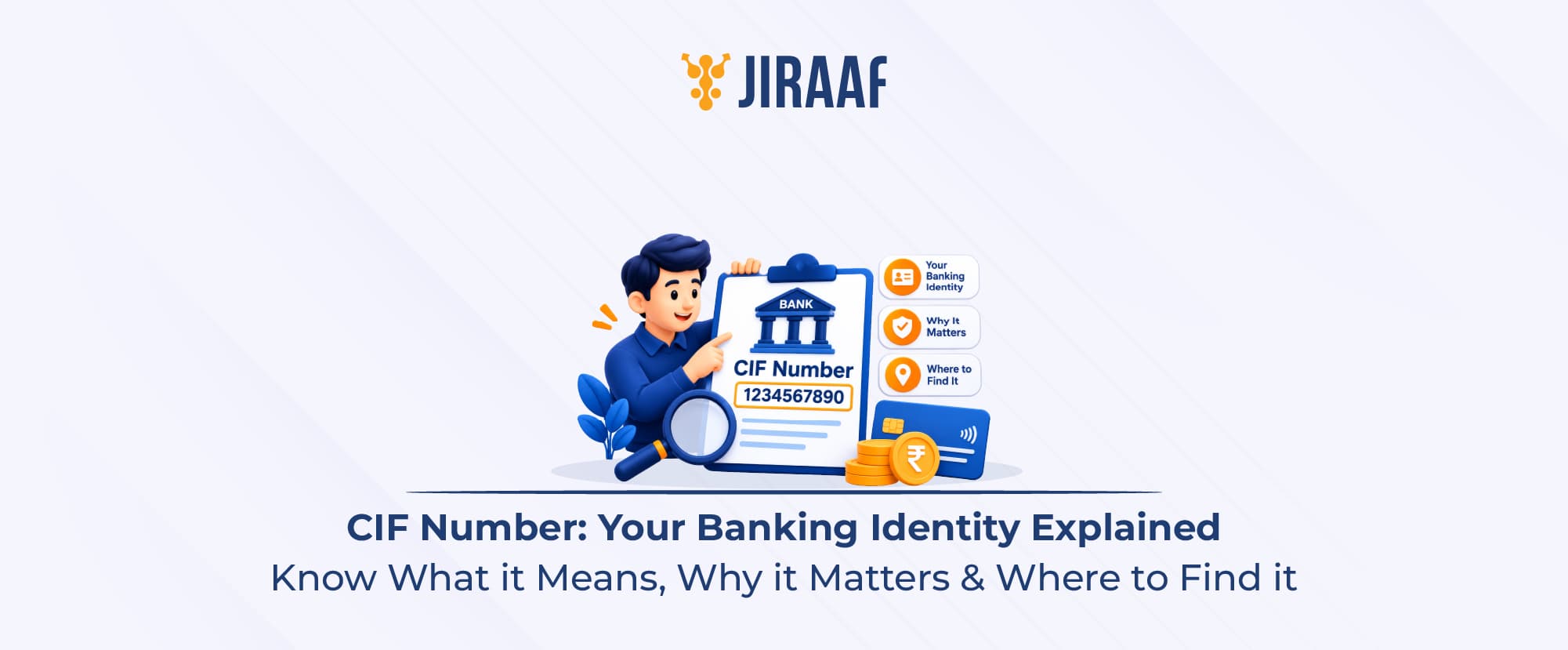
A CIF number is a unique customer identifier that helps banks link your accounts, KYC records, loans, and other financial details to one customer profile.
Quick Overview:
- Your CIF number may appear on your passbook, cheque book, bank statement, or digital banking profile.
- Banks use CIF records to streamline customer verification, manage linked accounts, and maintain KYC information.
- You can retrieve your CIF through internet banking, mobile apps, customer care, or a bank branch, depending on your bank’s facilities.
Every time you open a bank account or sign up for a financial service, you share personal information with your bank. Over time, these records can span multiple accounts, deposits, loans, and other banking products. So, how does your bank keep track of everything without mixing up your details?
The answer lies in how banks organize customer information. Instead of treating every account or financial product as a separate relationship, banks use a unique identifier called a Customer Information File (CIF) number to link all your records under one profile.
Here’s everything you need to know about your CIF number, including its importance, where to find it, and how it differs from an IFSC code.
What is The Full Form of CIF Number and Its Meaning in Banking?
A CIF (Customer Information File) number is a unique identification number that your bank assigns to you to identify and manage your banking relationship. It links your personal details, account information, and other banking records to a single customer profile.
This centralized record helps the bank access and manage your information without maintaining a separate customer profile for every account you hold.
What Information Does CIF Contain?
A CIF helps the bank link various details to your customer profile, including:
- Personal details: Your name, date of birth, registered address, mobile number, and email ID.
- Bank account details: Your savings, current, and other linked accounts, along with relevant account information and opening dates.
- KYC documents: Your submitted identity and address proofs, such as PAN, Aadhaar, passport, or driving license details.
- Loan information: Details of your active loans, outstanding balances, EMI obligations, repayment history, and loan tenure.
- Other banking products: Information about your fixed deposits, recurring deposits, credit cards, and other services linked to your profile.
- Account activity: Relevant transaction records and debit or credit details associated with your linked accounts, as maintained by the bank.
A CIF number helps your bank maintain a consolidated view of your financial relationship with it. This makes it an important identifier for both the bank’s internal operations and your banking experience.
Why is a CIF Number Important?
A CIF number plays an important role in how a bank manages its relationship with you. It makes banking operations more organized for the institution and helps deliver a smoother experience for you.
- Creates a unified customer profile: A CIF number links multiple accounts and banking relationships held with the same bank to a single customer record.
- Makes banking services more efficient: When you approach the bank for a service or query, employees can retrieve your linked customer information through your CIF. This reduces the need to locate and verify details across multiple records.
- Supports better customer service: A consolidated profile helps bank representatives understand your existing relationship with the institution, making it easier to address service requests, resolve queries, and provide relevant banking assistance.
- Strengthens record management and compliance: Banks use CIF records to maintain customer information, support KYC processes, and meet regulatory requirements. Keeping customer details organized also helps with monitoring and managing banking relationships.
- Helps maintain consistency across accounts: If you hold multiple accounts or use different banking services with the same institution, a CIF helps associate them with your customer profile. This makes it easier for the bank to keep your records connected and updated.
Now that you know why a CIF number matters, the next step is to locate yours. Here are the different ways to find your CIF number.
How to Find a CIF Number?
You don’t have to visit your bank every time you need your CIF number. Most banks make it available through physical banking documents and digital channels. However, its exact location and the steps to retrieve it can vary by bank. Here are the places you can check.
Finding CIF Number on Passbook
Start by checking the account details page of your passbook. Many banks print the CIF number on the first page, alongside your name, account number, branch details, and IFSC code. However, bank layouts vary. Depending on the passbook format, the CIF number may appear on an inside page or in another section containing your account information. Look for labels such as CIF Number, Customer ID, or Customer Information File.
Finding CIF Number on Cheque Book
Check the first page or the account details section of your cheque book, rather than the individual cheque leaves. Some banks print the CIF or customer ID alongside your account and branch information. However, not every bank includes it in the cheque book, so check your account-opening welcome kit or contact your bank.
Finding CIF Number Through Internet Banking
Log in to your bank’s official net banking portal and look for sections such as My Account, Profile, Account Summary, or Customer Information. The CIF number may appear alongside your account details or personal banking information. The navigation differs by bank.
Finding CIF Number Through Mobile Banking App
Open your bank’s official mobile banking app and sign in using your registered credentials. Check the Profile, Services, Account Details, or Account Information section. Some banks display the CIF number directly under your customer profile, while others place it within account-related services. If you can’t find it on the home screen, check the account information options instead of assuming the app doesn’t provide it.
Finding CIF Number on a Bank Statement
Check the first page or header of your account statement, particularly the section containing your name, account number, and branch details. Some banks include the CIF number in both physical and electronic statements. If you use net banking, download an e-statement and check its account summary. You can also request a statement through your bank’s supported channels, such as registered email or customer care. Do note that the CIF may not appear on every bank’s statement format.
Finding CIF Number on ATM or Bank Branch
An ATM card, ATM screen, or transaction receipt is generally not a reliable place to look for your CIF number. If you cannot retrieve it through your bank’s ATM services, visit your home branch or another branch that handles your account-related requests. Bring a valid ID and your account details so the bank can verify your identity before sharing the number. You can also contact customer care and request assistance after completing the required verification.
Note: Your bank may use the term Customer ID instead of the CIF Number. Check the context before assuming they refer to different identifiers.
Now that you know where to locate your CIF number, let’s understand how it differs from another commonly used banking code: the IFSC.
Is CIF Number the Same as IFSC Code?
No, a CIF number and an IFSC code serve two different purposes in banking.
| Basis of Difference | CIF Number | IFSC Code |
| Full form | Customer Information File Number | Indian Financial System Code |
| Purpose | Identifies a customer and links their personal, KYC, account, and banking details in one profile | Identifies a specific bank branch for routing electronic transactions |
| Primary use | Helps the bank manage customer records, linked accounts, and banking services | Enables electronic fund transfers through NEFT, RTGS, and IMPS |
| Assigned to | An individual customer within a particular bank | A specific bank branch |
| Uniqueness | Unique to each customer within the bank | Unique to each bank branch |
| Who uses it? | Primarily the bank, for internal customer identification and record management | Customers and banks, when initiating or processing electronic fund transfers |
Conclusion
Your CIF number may not be something you use every day, but knowing where to find it can make certain banking requests easier. Keep it handy when you need to verify your customer details, access account-related information, or raise a query with your bank. Also, check your bank’s terminology, as some institutions refer to it as a Customer ID. A little familiarity with these details can help you navigate your banking relationship with greater clarity and confidence.