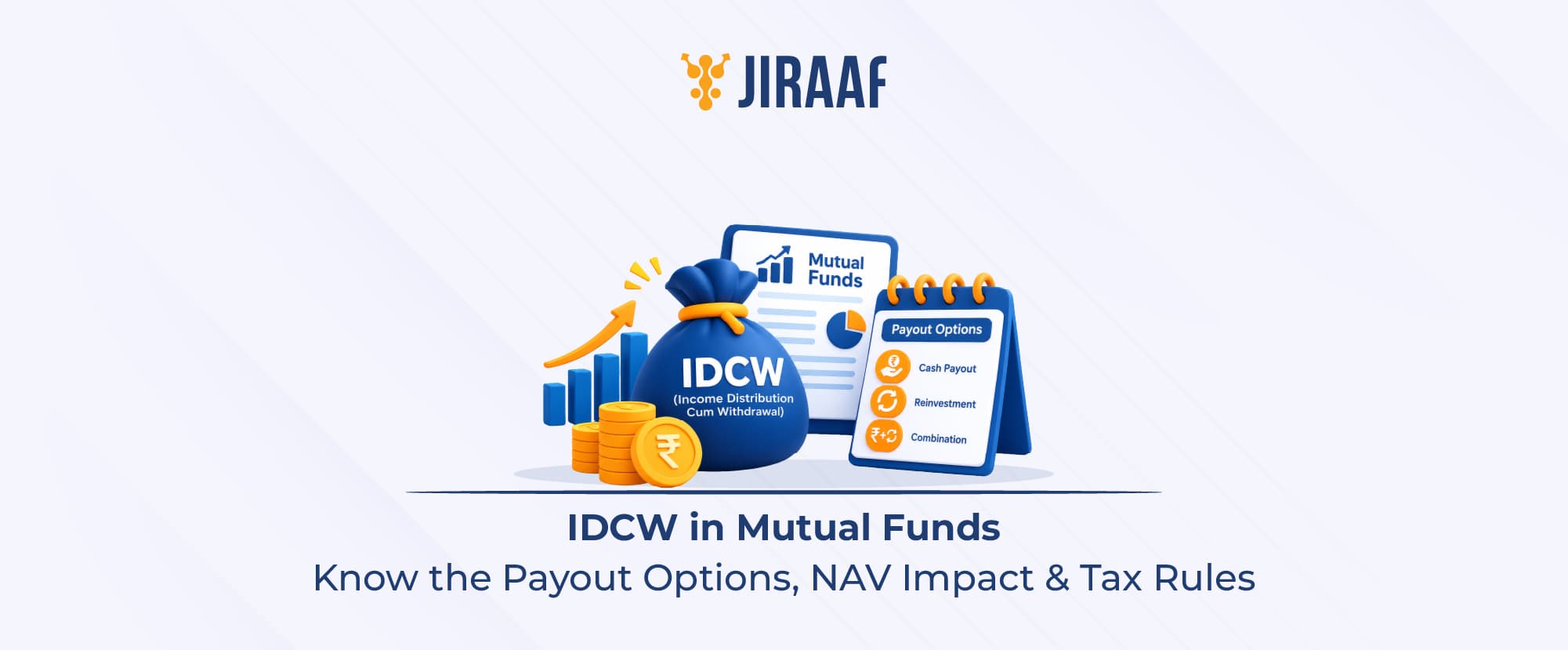
IDCW in mutual funds allows investors to receive distributions from a scheme, either as cash or reinvested units. These payouts can affect the scheme’s NAV and overall investment value.
Quick Overview
- Investors can generally choose to receive IDCW as cash or reinvest it to buy additional units, depending on the scheme.
- The scheme’s NAV typically decreases by the per-unit distribution amount, all else being equal.
- IDCW is generally taxed as income from other sources at the investor’s applicable income tax slab rate.
A mutual fund investment can help you build wealth over time, but what if you also need money along the way? The IDCW option allows you to receive distributions from your mutual fund without having to redeem units each time. However, IDCW works differently from FD interest or company dividends.
Read on to understand how IDCW payouts work, the different payout options available, its benefits, limitations, and tax implications.
What is the Full Form and Meaning of IDCW in a Mutual Fund?
Income Distribution cum Capital Withdrawal (IDCW) is a mutual fund option that allows investors to receive periodic payouts from their investments. These payouts may come from the scheme’s distributable profits or its capital. However, IDCW doesn’t offer dividends like a listed company.
Earlier known as the dividend option, SEBI renamed it IDCW in April 2021. The change helps investors understand that a mutual fund payout isn’t necessarily a dividend from the fund’s profits. It may also include a portion of the investor’s own capital returned through the distribution.
How Does an IDCW Payout Work?
When a mutual fund declares an IDCW payout, it distributes money from the scheme’s assets to investors. Since the scheme’s assets are reduced by the amount distributed, the fund’s Net Asset Value (NAV) also falls by a corresponding amount, all else being equal.
For example, if a scheme has an NAV of ₹20 and declares an IDCW of ₹2 per unit, its NAV may fall to ₹18 after the payout. The investor receives ₹2 per unit, but the total value of their investment does not increase simply because of the distribution.
How Often Can a Mutual Fund Declare IDCW?
Depending on the scheme, IDCW payouts may be announced monthly, quarterly, half-yearly, or annually. However, IDCW payouts are not guaranteed. A mutual fund may choose not to declare a payout during a particular period if it does not have sufficient distributable surplus.
The fund, not the investor, decides whether to declare a payout. Investors can generally choose to receive the distribution in cash or reinvest it, depending on the options available under the scheme.
What are the Different Types of IDCW Payouts?
Mutual fund schemes offer two different types of IDCW options depending on its structure: the IDCW Payout Option and the IDCW Reinvestment Option. Both distribute an amount declared by the scheme, but they differ in how the investor receives and uses that money.
1. IDCW Payout Option
Under the IDCW Payout Option, the mutual fund transfers the declared distribution directly to the investor’s registered bank account.
- The investor’s bank account is credited with the amount.
- The scheme’s NAV reduces by the amount distributed per unit, all else being equal.
- The investor receives the payout in cash and does not receive additional units.
This option may suit investors who want to receive periodic cash flows from their mutual fund investments. However, the payout is not guaranteed and may include a portion of the investor’s capital.
2. IDCW Reinvestment Option
Under the IDCW Reinvestment Option, the mutual fund uses the declared distribution to purchase additional units of the same scheme on behalf of the investor. The payout does not go to the investor’s bank account.
- The amount is reinvested in the same scheme.
- The scheme’s NAV reduces by the amount distributed per unit, all else being equal.
- The investor receives additional units based on the reinvestment amount and the applicable reinvestment NAV.
This option allows the investor to keep the distribution invested in the scheme rather than receive it as cash. However, the additional units do not represent a separate return; they reflect reinvestment of the distributed amount.
What Are the Advantages and Disadvantages of IDCW?
IDCW can offer investors a way to access money from their mutual fund investments without having to redeem units each time. However, the payouts also affect the value of the investment and may not always align with an investor’s income needs.
Advantages of IDCW
- Periodic payouts
IDCW can provide investors with periodic cash payouts, depending on the scheme’s distribution decisions. This may help those who want to access money from their investments to meet regular expenses.
- Balancing income and growth
Investors can receive payouts while keeping the rest of their units invested in the mutual fund. This allows them to access a portion of their investment while the remaining units continue to participate in market movements.
- Flexibility in using payouts
Investors can use the amount received to cover expenses, meet short-term financial needs, or invest in other opportunities. This gives them flexibility in managing their money as their priorities change.
IDCW payouts can be useful when investors need access to cash, but the amount and timing of these distributions are not assured. It is equally important to understand the limitations before choosing this option.
Disadvantages of IDCW
- Unpredictable payouts
IDCW payouts are not guaranteed. The amount and frequency depend on the scheme’s distribution decisions, making them an unreliable source of fixed income.
- Reduction in NAV
When a mutual fund declares an IDCW, its NAV reduces by the amount distributed per unit, all else being equal. The payout is not an additional return on top of the investment’s value.
- Lower potential for compounding
When investors receive payouts instead of reinvesting them, the distributed amount no longer remains invested in the scheme. Over time, this may reduce compounding potential compared with a growth option, where gains remain invested.
IDCW’s benefits and limitations can influence how well it fits an investor’s needs. Tax treatment is another important consideration, as it affects how much of the payout an investor ultimately retains.
Is IDCW Taxable in Mutual Funds?
Yes. IDCW is taxable, whether the scheme is equity, debt, or hybrid, and whether you take the payout or reinvest it. The amount is added to your total income under “Income from Other Sources” (Section 56(2) of the Income-tax Act, 1961; Section 92 of the Income-tax Act, 2025, which applies from 1 April 2026) and taxed at your slab rate, plus applicable surcharge and cess. For example, if you fall in the 20% slab, your IDCW is generally taxed at 20%.
TDS on IDCW
For resident investors, the fund house deducts TDS at 10% under Section 194K (covered by Section 393 of the Income-tax Act, 2025) if the IDCW you receive from one mutual fund exceeds ₹10,000 in a financial year. Once you cross the limit, TDS applies to the entire amount. For example, on ₹12,000 of IDCW, the fund house may deduct ₹1,200. On ₹8,000, no TDS applies, but the income is still taxable. If you have not provided a valid PAN, a higher rate of 20% applies, and NRI investors face TDS at 20% or a lower treaty rate. TDS is not your final tax liability. You can adjust it against your tax payable or claim a refund when you file your return.
No interest deduction
From tax year 2026-27, you cannot deduct interest paid on money borrowed to invest in mutual fund units against your IDCW income.
Capital gains on IDCW
IDCW does not change your units’ cost. When you redeem them, capital gains tax applies to any profit, in addition to the tax on IDCW you received.
Conclusion
IDCW may be worth considering if accessing money from your mutual fund investment is part of your financial plan. However, it is important to distinguish between receiving an IDCW payout and building predictable cash flow.
For regular expenses, IDCW may not offer the consistency you need. Before choosing this option, assess your cash flow requirements and investment horizon to determine whether periodic payouts support your financial goals.