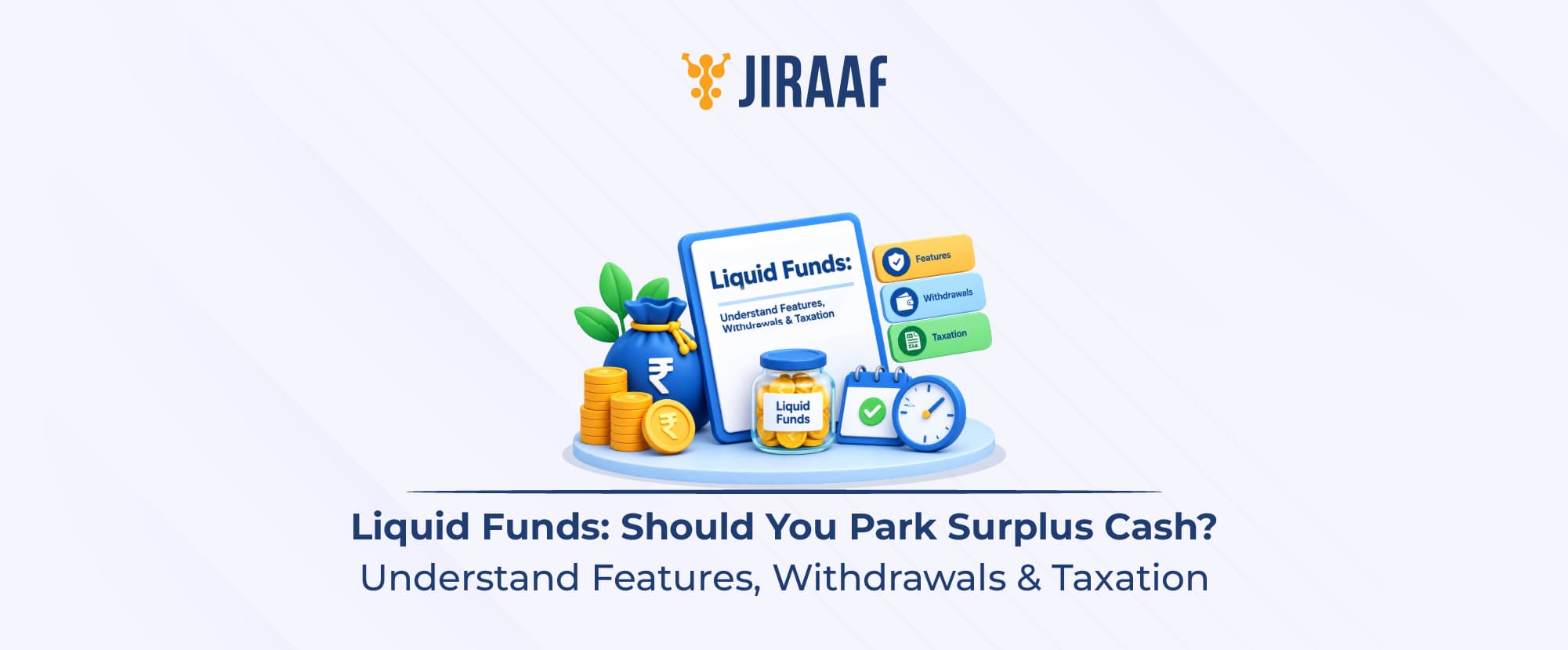
Liquid funds are debt mutual funds that invest in short-term debt and money market securities with maturities of up to 91 days. They offer a way to manage surplus cash while keeping it accessible for short-term needs.
Quick Overview:
- Liquid funds invest in short-term securities such as Treasury Bills, Commercial Papers, and Certificates of Deposit.
- Redemption proceeds are typically processed within one business day (T+1), subject to applicable cut-off times.
- Gains are generally taxed at the investor’s applicable income tax slab rate under the rules for specified mutual funds.
Investors often end up keeping surplus cash in savings accounts, even when they may not need it immediately. Liquid funds offer an alternative for putting this money to work while keeping it accessible for short-term needs.
They invest in short-term debt and money market instruments, making them an option for managing surplus cash. This blog explores how liquid funds work, their key features, expected returns, withdrawal timelines, and tax implications.
What Are Liquid Funds?
Liquid funds are a type of debt mutual funds that invest in short-term debt and money market securities with maturities of up to 91 days. These funds help limit interest rate risk and offer a liquid investment option for short-term cash management.
Generally, liquid funds invest in Treasury Bills (T-bills), Commercial Paper (CPs), Certificates of Deposit (CDs), and Tri-Party Repo (TREPS). Because these securities have shorter maturities, the fund can manage its portfolio around near-term liquidity needs.
Liquid funds are commonly used to park surplus money temporarily, such as a bonus awaiting allocation, savings earmarked for an upcoming expense, or funds kept aside for emergencies.
Their suitability for short-term needs comes down to how they invest, generate returns, and manage liquidity.
How Do Liquid Funds Work?
Liquid funds pool money from investors and use it to buy short-term debt, and money market instruments.
The fund earns returns primarily through interest income from these securities. Investors also profit from the market gains in the underlying securities. These gains or losses reflect directly in the fund’s Net Asset Value (NAV).
SEBI’s Rules for Liquid Mutual Funds
SEBI sets specific requirements for liquid funds to support liquidity and limit certain investment risks. These rules govern the securities they can hold, the assets they must keep readily accessible, and the charges that apply to early withdrawals.
- Maximum maturity: Liquid funds can invest only in securities with a residual maturity of up to 91 days.
- Minimum liquid assets: At least 20% of the portfolio must be held in liquid assets like cash, government securities, T-bills and repo on government securities.
- One scheme per category: Each Asset Management Company (AMC) can offer only one scheme in the liquid fund category.
- Exit load: Redemptions made within the first seven days of investment can attract an exit load, as prescribed under SEBI’s framework.
- Restricted investments: Liquid funds cannot invest in structured obligations or credit-enhanced instruments.
These rules shape how liquid funds manage money, while their core features determine how they fit into an investor’s short-term plans.
Features of Liquid Funds
Liquid funds stand out for practical advantages, from relatively low investment costs to the flexibility to redeem units without a fixed lock-in period.
- High liquidity
Liquid funds allow investors to redeem their units on business days, making them suitable for managing short-term cash needs. The time taken to receive the money depends on the applicable redemption process.
- Low expense ratio
Liquid funds generally have lower expense ratios than many actively managed equity funds. However, costs vary across schemes and between direct and regular plans.
- No lock-in period
Liquid funds do not have a fixed lock-in period. Investors can redeem their units when needed, although an exit load may apply to redemptions made within the first seven days.
- Diversification across short-term instruments
Liquid funds spread investments across eligible short-term debt and money market securities, such as treasury bills, commercial papers and certificates of deposit.
With their key features in mind, the next step is to understand how investors can choose a suitable scheme and invest in liquid funds.
How to Invest in Liquid Funds?
Investing in liquid funds is straightforward. Investors can use a broking app or invest directly through a mutual fund’s official website.
Steps to Invest Through a Broking App
- Log in to the app: Open a broking or investment app that offers mutual funds.
- Search for liquid funds: Browse the liquid fund category and compare schemes based on their returns, expense ratios and risk levels.
- Select a scheme: Review the scheme details and choose one that suits the investment period and cash requirements.
- Enter the amount: Decide how much to invest and select a one-time investment.
- Complete the payment: Pay through the available banking options and confirm the transaction.
Investors can also follow a similar process on an Asset Management Company (AMC) website. They can choose to invest directly without using a distributor.
What Documents Are Required?
Before investing, investors must complete the Know Your Customer (KYC) process. The usual requirements include:
- PAN card: Used for identity verification and tax-related records.
- Identity and address proof: Aadhaar, passport or another accepted document, depending on the KYC requirements.
- Bank account details: Used to make investments and receive redemption proceeds.
- Basic personal details: Date of birth, mobile number, email address, occupation, and income details, as requested by the platform.
Investors who have already completed KYC may not need to repeat the entire process. However, they should check their KYC status and provide any additional information the platform requests.
What Is the Withdrawal Time for Liquid Funds?
Liquid funds typically process redemption requests within one business day (T+1). The money is generally credited to the investor’s registered bank account within this period, provided the request is submitted successfully and before the applicable cut-off time.
While liquidity is a key consideration when choosing a liquid fund, investors should also understand how their gains are taxed.
How Is Tax Calculated on Liquid Funds?
Liquid funds fall under the debt mutual fund category. For units purchased on or after 1 April 2023, investors pay tax on capital gains at their applicable income tax slab rate, regardless of how long they hold the units. These investments do not qualify for the indexation benefit.
Conclusion
Money needed for immediate expenses requires easy access, while funds set aside for longer-term goals may allow for a different investment approach. The key is to avoid treating all savings alike. Investors should consider when they might need the money, how much risk they can accept, and how quickly they can withdraw their investment. This helps determine whether liquid funds fit their cash management needs or whether another option would be more suitable.