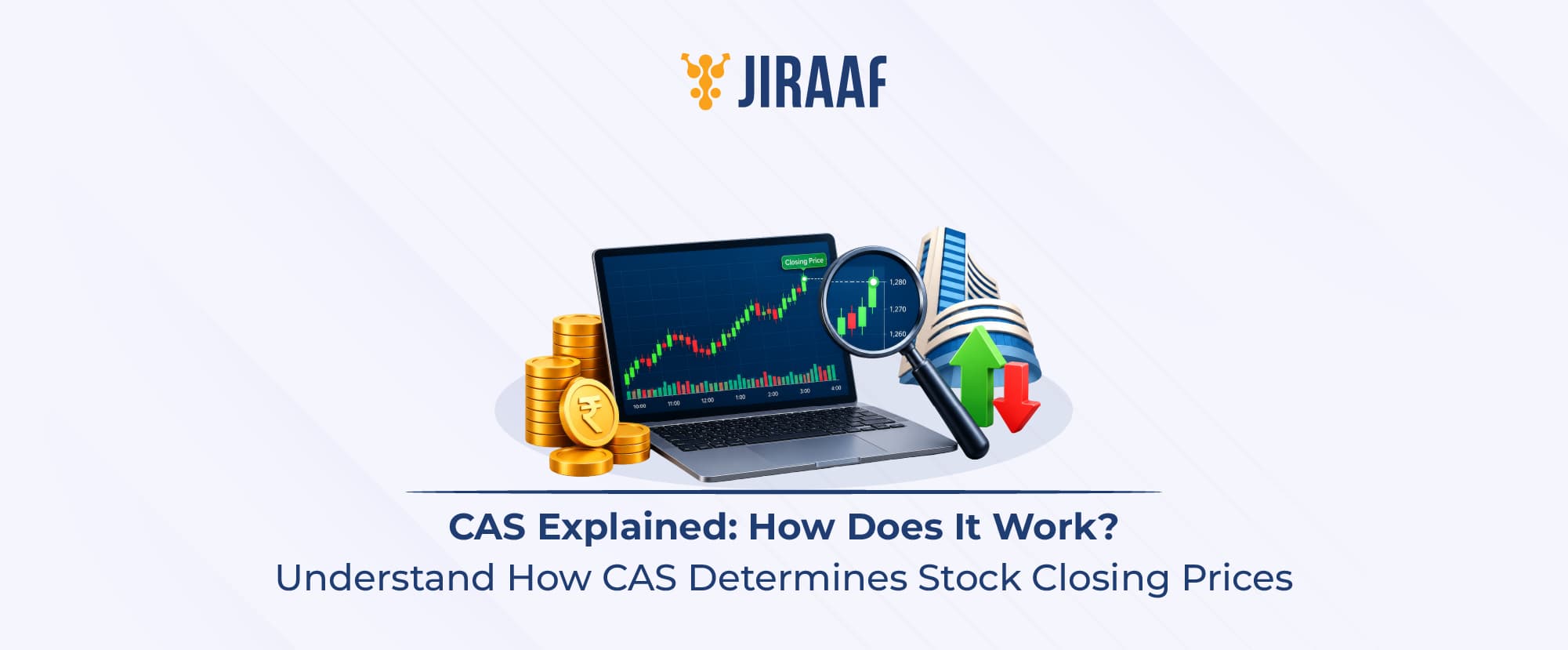
The Closing Auction Session (CAS) is an auction-based process that matches eligible buy and sell orders at the equilibrium price to determine a stock’s official closing price.
Quick Overview:
- The CAS runs from 3:15 PM to 3:35 PM and covers order entry, order matching, and closing-price determination.
- The exchange evaluates eligible buy and sell orders to identify the price at which the maximum number of shares can be traded.
- CAS changes certain trading timelines and order-handling rules, while its closing price serves as a reference for market benchmarks and investment valuations.
Since 3 August 2026, SEBI’s new Closing Auction Session (CAS) framework has changed how closing prices are determined for eligible F&O stocks and adjusted certain end-of-day trading processes. If you actively trade in the stock market, you may have already noticed changes to trading hours, order handling, or intraday square-offs.
But what exactly happens during this session? More importantly, does CAS change how you should manage your trades or investments? Let’s break down how the system works, what has changed, and what it means for you.
What Is the Full Form and Meaning of CAS?
CAS stands for Closing Auction Session. It is a 20-minute auction-based trading session that runs from 3:15 PM to 3:35 PM for stocks with listed F&O contracts on NSE and BSE. During this session, the exchange brings together eligible buy and sell orders, including qualifying open orders carried forward from regular trading. It then determines the price at which the maximum number of shares can be traded. This price is known as the equilibrium price and becomes the stock’s official closing price.
By establishing a closing price, CAS provides a common reference for several market processes including index calculations, derivatives settlement, exchange-traded fund (ETF) rebalancing and mutual fund Net Asset Value (NAV) calculations.
Why was CAS introduced?
Earlier, exchanges calculated a stock’s closing price using the Volume-Weighted Average Price (VWAP) of trades executed during the final 30 minutes of the trading day. However, a sudden surge in buying or selling activity near the 3:30 PM closing bell could skew this average. As a result, the closing price may not accurately reflect overall market supply and demand. This could also affect index tracking, mutual fund NAV calculations, and derivatives settlement.
CAS fixes this by using an auction-based approach instead. By evaluating eligible buy and sell orders across price levels, the exchange identifies the price at which the most shares can trade. This helps establish a closing price based on the balance of buying and selling interest.
So, what does CAS change for you as a trader or investor? Let’s look at the changes to trading hours, intraday square-offs, and open orders.
What Changes After CAS Introduction?
CAS changes the closing process for F&O stocks and adjusts the timing of certain trading activities. Here are the key changes you need to know.
- Earlier intraday square-off: For stocks with F&O contracts that are eligible for CAS, brokers will schedule automatic square-off earlier, around 3:07–3:12 PM, depending on the platform. Other cash market stocks will have a later square-off window, around 3:20–3:25 PM.
- Extended F&O trading hours: F&O trading will continue until 3:40 PM, extending the previous closing time of 3:30 PM by 10 minutes.
- Changes to open orders at 3:15 PM: Unexecuted limit orders in CAS-eligible stocks will carry forward into the auction automatically, except orders outside the applicable price band. Stop-loss and iceberg orders will be canceled. GTT orders on CAS-eligible stocks can trigger only until 3:15 PM, while those on non-CAS stocks can continue triggering until 3:30 PM.
These changes affect when orders are accepted, carried forward or squared off. To understand how they work together, let’s walk through the CAS timeline, from regular trading to the final closing price.
How Does the Closing Auction Session Work?
CAS initially applies to stocks in the cash market that have listed derivative contracts on NSE and BSE. While, other stocks continue to follow the existing closing-price mechanism.
During the phased rollout, exchanges can calculate an indicative closing index using the indicative equilibrium prices of CAS-eligible stocks. Here’s how the process unfolds with timing.
What Are the Timings of the Closing Auction Session?
| Time | Session | What Happens |
| 3:00–3:15 PM | Regular Trading | Trading continues as usual. The VWAP calculated over these 15 minutes becomes the reference price for the auction. |
| 3:15–3:20 PM | Transition | Continuous trading and order entry pause. The exchange publishes the reference price and sets a ±3% price band around it. Eligible open orders carry forward, except stop-loss orders, iceberg orders, and orders outside this band. |
| 3:20–3:25 PM | Order Entry Session I | You can place, modify, or cancel market and limit orders. The exchange displays an indicative price and the imbalance between buy and sell orders. |
| 3:25–3:30 PM | Order Entry Session II | You can place, modify, or cancel limit orders only. Market orders can no longer be placed, modified, or cancelled. The exchange closes order entry at a random time between 3:28 PM and 3:30 PM. |
| 3:30–3:35 PM | Matching and Confirmation | The exchange matches eligible orders at the equilibrium price, the price at which the most shares can trade. This becomes the official closing price. Matching prioritizes market orders first, then remaining market orders against limit orders, then limit orders by time priority. |
Note:
- F&O contracts on these stocks keep trading until 3:40 PM.
- Brokers may handle orders placed between 3:15 and 3:20 PM differently. Some hold them as After Market Orders (AMO) and send them to the exchange at 3:20 PM.
How Does CAS Determine the Final Stock Price?
To see how the auction translates market orders into a closing price, let’s walk through a hypothetical trading scenario.
Step 1: Review the buy and sell orders
Suppose traders submit the following orders for a stock during CAS.
| Buy Price (₹) | Buy Quantity (Shares) | Sell Price (₹) | Sell Quantity (Shares) |
| 306 | 300 | 296 | 250 |
| 304 | 450 | 298 | 350 |
| 302 | 500 | 302 | 400 |
| 300 | 250 | 304 | 300 |
| 298 | 200 | 306 | 150 |
The above orders show the prices buyers are willing to pay, and the minimum prices sellers are willing to accept.
- A buyer offering ₹306 can also buy at any lower price in the table.
- A seller asking ₹296 can also sell at any higher price in the table.
This means an order may qualify for execution at several possible auction prices. The exchange evaluates those prices to find the one that allows the most shares to trade.
Step 2: Calculate the executable quantity at each price
The exchange adds the eligible buy and sell quantities at each potential price. Market orders, which don’t specify a price, also contribute to the cumulative quantities at every price level.
The executable quantity at each price is the lower of the cumulative buy quantity and the cumulative sell quantity.
| Potential Price (₹) | Cumulative Buy Quantity | Cumulative Sell Quantity | Executable Quantity |
| 296 | 1,700 | 250 | 250 |
| 298 | 1,700 | 600 | 600 |
| 300 | 1,500 | 600 | 600 |
| 302 | 1,250 | 1,000 | 1,000 |
| 304 | 750 | 1,300 | 750 |
| 306 | 300 | 1,450 | 300 |
Step 3: Identify the closing price
The price that allows the highest executable quantity becomes the equilibrium price, subject to the exchange’s applicable price-discovery rules.
In this example, ₹302 is the equilibrium price because it allows 1,000 shares to trade, the highest executable quantity among the prices evaluated. Therefore, ₹302 becomes the stock’s official closing price.
Final Thoughts: Importance of CAS for Investors & Traders
The impact of the CAS will depend on how you participate in the market.
For intraday traders, timing matters more. With cash-market MIS positions squared off earlier, you have less time to manage positions before the closing process begins.
For F&O traders, the extended trading window changes the end-of-day routine. F&O trading continues until 3:40 PM, even as the cash-market auction determines the closing price of eligible underlying stocks. This makes it important to distinguish between the underlying stock’s closing price and the price at which its derivatives continue to trade. The two are connected, but they are not interchangeable.
For long-term equity investors, there is less reason to change your investment approach. CAS does not affect the underlying value of your investments or change a company’s long-term fundamentals and valuation. However, if you use closing prices to track daily portfolio movements or evaluate short-term performance, remember that the auction-determined close may differ from the last traded price you saw during regular trading.