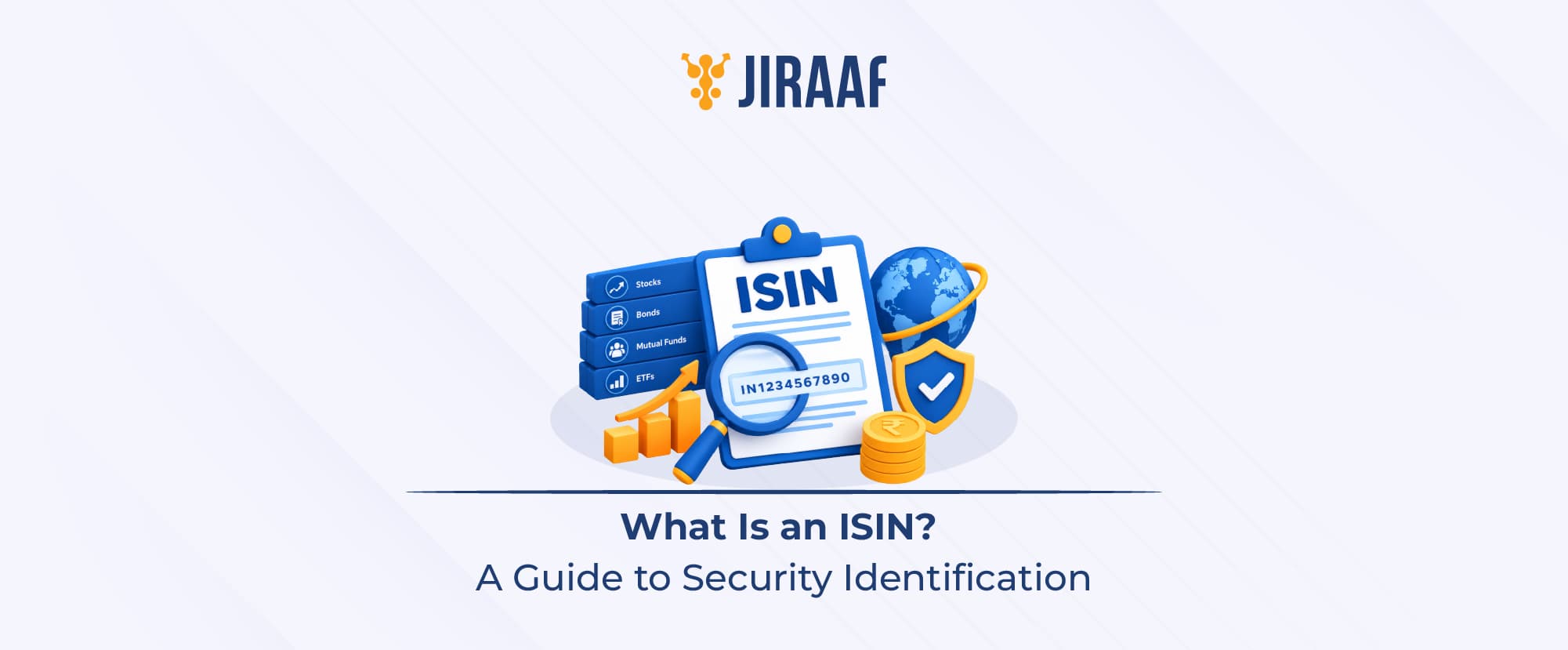
An International Securities Identification Number (ISIN) is a unique 12-character alphanumeric code used to identify securities such as stocks, bonds and mutual fund units across financial markets.
Quick Overview:
- Understand what an ISIN is, its full form and how its 12-character alphanumeric code identifies a specific security.
- Learn how to interpret an ISIN using Reliance Industries Limited’s equity shares as an example.
- Discover how ISINs help identify securities, support trade settlement and maintain accurate investment records.
A security may trade on different exchanges, pass through multiple financial intermediaries or appear in records maintained by different institutions. Without a common identification system, matching the right security across these records becomes difficult. An ISIN (International Securities Identification Number) provides that common reference.
Explore what an ISIN means, how it is structured, a real-world example, and why it matters to investors and financial institutions.
What Is an ISIN Number and its Full Form?
ISIN stands for International Securities Identification Number. It is a unique 12-character alphanumeric code assigned to securities such as stocks, bonds, debentures, or mutual fund schemes.
An ISIN identifies an individual security. This matters because one company can issue several types of securities. Unlike ticker symbols, which can vary across exchanges, an ISIN follows an international standard, allowing you to identify the same security across different markets and exchanges.
Each country’s National Numbering Agency (NNA) is responsible for issuing and maintaining ISIN allotments for underlying securities. The International Organization for Standardization (ISO) defines this in ISO 6166.
In India, NSDL allots ISINs for securities under SEBI’s authorization, while the Reserve Bank of India (RBI) handles allotments for government securities.
Anatomy of an ISIN Code
Each part of an ISIN identifies the country of issuance, the issuer, the specific security, and the code’s validity.
- IN (Country code): Identifies the country of issuance. In this case, “IN” refers to India.
- E002A (Issuer identifier): Identifies the issuing company, with E indicating a company, and 002A representing its issuer code.
- 0101 (Security type and serial number): The first two digits, 01, denote equity shares, while the next two digits, 01, indicate the serial number among the issuer’s securities of that type.
- 8 (Check digit): The final digit is calculated using the preceding characters to help detect errors in the code.
Let’s examine an actual ISIN to see how these components work together.
Example of an ISIN
Consider the equity shares of Reliance Industries Limited. The ISIN for these shares, traded on the NSE and BSE, is INE002A01018.
Here’s how the 12-character code breaks down:
- IN (Country code): Identifies India as the country of issuance.
- E002A (Issuer identifier): Identifies Reliance Industries Limited.
- 0101 (Security type and serial number): Indicates the security type and its serial number within the issuer’s securities of that type.
- 8 (Check digit): Helps systems detect mistyped or corrupted code.
This consistency helps ensure that the exact security is identified across exchanges and depository records.
Why Is ISIN Code Important?
As of October 2026, the ISIN system helps identify securities traded across more than 100 exchanges in over 200 countries. This standardized identification matters because securities move between investors, exchanges, depositories and financial institutions.
1. Helps identify securities
An ISIN distinguishes one security from another, even when the instruments come from the same company. This helps you identify the correct stock, bond, or mutual fund scheme when checking investment details.
2. Supports clearing and settlement
A trade doesn’t end when a buyer and seller agree on a transaction. The financial intermediaries must also transfer securities and complete settlement. An ISIN helps the institutions involved identify the correct security throughout this process.
3. Helps track and manage securities
Your demat statement, transaction records and other investment documents use security identifiers to distinguish holdings. An ISIN gives you a consistent reference when checking your investments or verifying a transaction.
Now that you understand why an ISIN matters, let’s look at how you can find the code for a specific stock, bond or mutual fund scheme.
How to Get ISIN of Bonds, Stocks & Mutual Funds?
Official market and industry websites publish security details that help you find the code for the instrument you’re looking for.
For Bonds and Stocks
Follow these steps to search for a company’s securities on NSDL:
Step 1: Visit the official NSDL website.
Step 2: Find the “Advanced Search” section and select “Company Search”.
Step 3: Open the search interface and select Detailed Search.
Step 4: Enter the company name and click Search.
Note: Each bond issue or series have a separate ISIN.
For Mutual Funds
AMFI publishes mutual fund scheme information through its website. Follow these steps to look up a scheme’s ISIN:
Step 1: Visit the official AMFI website.
Step 2: Open the “Latest NAV” section.
Step 3: Select the mutual fund scheme you want to check. Choose the relevant scheme category, such as open-ended or close-ended, where prompted.
Step 4: Click “Get NAV” to view the scheme details.
Look for the ISIN in the results. Check the scheme name and plan details carefully to ensure the code matches the investment scheme you’re researching.
Conclusion
Trade execution relies on absolute precision. In a financial system processing millions of daily transactions, an ISIN helps in ensuring your capital goes exactly where you intend. gives brokers, exchanges, and depositories a common reference, which helps reduce identification errors.