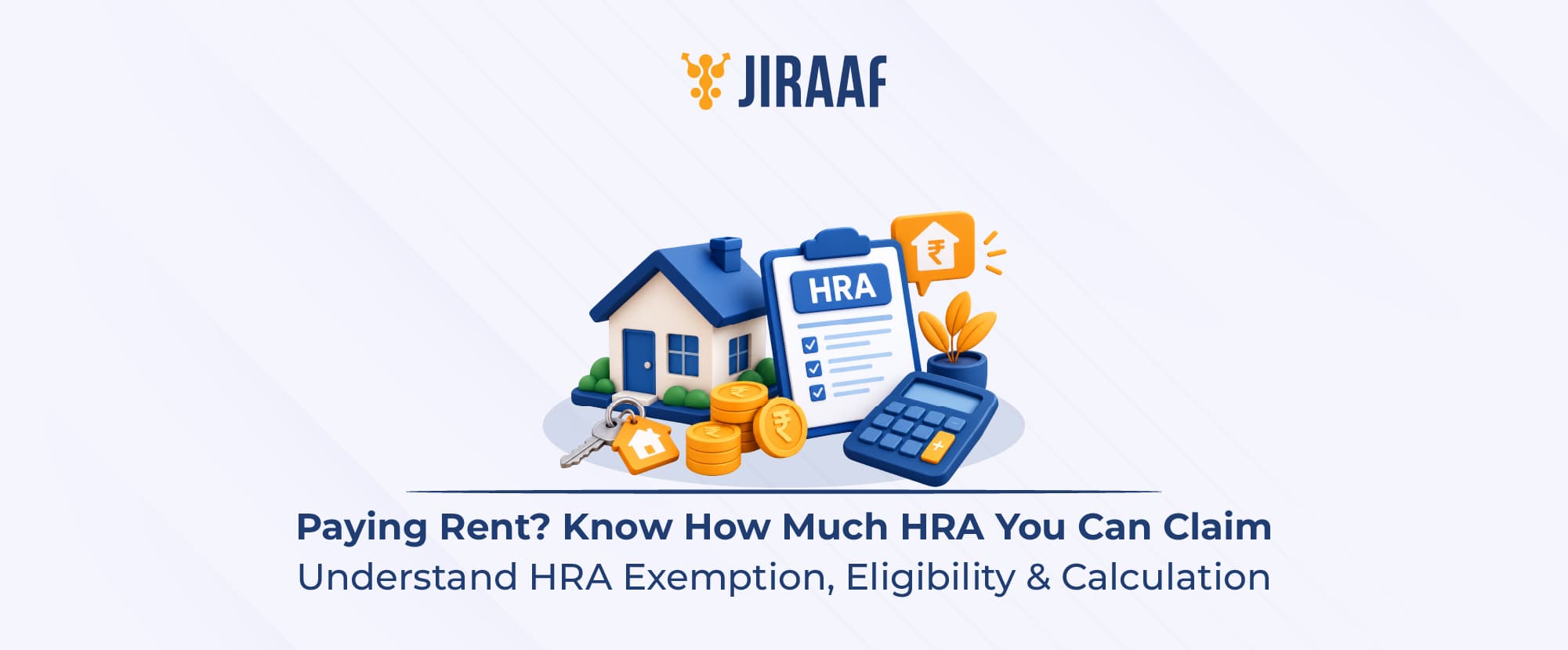
House Rent Allowance (HRA) is a salary component that helps salaried employees cover rent and claim a tax exemption on eligible amounts. The exemption depends on HRA received, rent paid, eligible salary, city of residence and the chosen tax regime.
Quick overview
- Your exemption is the lowest of three amounts: actual HRA received, rent paid minus 10% of eligible salary, and 50% or 40% of eligible salary, depending on your city.
- You must receive HRA as part of your salary and pay rent for residential accommodation you occupy.
- Eight specified cities qualify for the 50% salary limit, while other locations generally fall under the 40% limit.
- HRA exemption is available under the old tax regime, so compare your overall tax liability under both regimes before deciding.
Rent is one of the biggest recurring expenses for salaried professionals, whether you live in a metro like Bengaluru or a growing city like Jaipur. If you receive HRA as part of your salary, you may be able to reduce your taxable income through an HRA exemption. However, the amount you can claim depends on factors such as your salary, rent paid, city of residence, and chosen tax regime.
Read this guide to understand who qualifies for HRA exemption, how to calculate it, and which rules apply from FY 2026–27.
What Is HRA in Salary and Full Form?
House Rent Allowance (HRA) is a salary component that helps employees meet the cost of rented accommodation. If you receive HRA and pay rent for a home you occupy, you may qualify for a tax exemption on part or all of the allowance.
From FY 2026–27, the Income-tax Act, 2025, and the Income-tax Rules, 2026, govern HRA tax exemptions. Schedule III of the Act specifies the exemption, while Rule 279 explains how to calculate it. These replace the earlier provisions under Section 10(13A) of the Income-tax Act, 1961, and Rule 2A of the Income-tax Rules, 1962.
To qualify for the exemption, you must meet these conditions:
- You must receive HRA from your employer. The exemption applies to the allowance paid as part of your salary.
- You must actually pay rent. You must occupy the rented residential accommodation and not own it.
- You must opt for the old tax regime. The new tax regime does not offer the HRA exemption.
- Your exemption depends on three limits: The amount exempt cannot exceed the lowest of the actual HRA received, rent paid minus 10% of eligible salary, and 50% or 40% of eligible salary, depending on the city.
Is HRA Exempt Under the New Tax Regime?
No. The new tax regime under Section 202 of the Income-tax Act, 2025, does not allow the HRA exemption. Therefore, the HRA you receive is included in your taxable salary.
To claim the HRA exemption, you must opt for the old tax regime and meet the applicable conditions.
Before calculating your HRA exemption, it helps to understand the key rules, forms, and salary definitions that determine how the exemption works. Let’s look at the terms that matter most.
Key HRA Tax Terms You Should Know
From the documents you submit, a few key provisions shape the salary considered for exemption and your HRA claim.
1. Rule 279 of the Income-tax Rules, 2026
Rule 279 explains how you calculate your HRA exemption. You can claim the lowest of three amounts: the HRA you receive, rent paid minus 10% of eligible salary, and 50% or 40% of eligible salary, depending on your city. It replaces Rule 2A of the Income-tax Rules, 1962.
2. Form 124: Employee Tax Claims Statement
To claim HRA through your employer, you must submit the required details and supporting documents. Form 124 replaces Form 12BB for this purpose. If your annual rent exceeds ₹1 lakh, you must provide your landlord’s name, address, and PAN. You must also disclose whether you are related to your landlord.
3. Landlord’s PAN for Rent Exceeding ₹1 Lakh
If your annual rent exceeds ₹1 lakh, you must provide your landlord’s PAN. If your landlord doesn’t have one, check with your employer about the required declaration or alternative documents.
4. Eight Cities Eligible for the 50% HRA Limit
Your city determines which salary percentage applies to your HRA calculation. The income-tax Rules, 2026 classifies 8 metro cities with 50% HRA limit while other non-metro cities fall under the 40% limit.
5. Salary Considered for HRA Calculation
To calculate your exemption correctly, you must also identify the salary components included in the calculation. Eligible salary generally includes your basic salary, Dearness Allowance (DA) if it forms part of retirement benefits, and commission calculated as a fixed percentage of turnover. Other allowances and perquisites are excluded. The calculation considers your eligible salary for the period you occupy rented accommodation.
6. Form 31: Rent Deduction When HRA Is Not Available
If you do not receive HRA, you may still qualify for a rent deduction under Section 134 of the Income-tax Act, 2025, corresponding to Section 80GG of the Income-tax Act, 1961. Form 31, which replaces Form 10BA, relates to this separate deduction. For FY 2025–26, the earlier Section 80GG and Form 10BA provisions apply.
Knowing these terms helps you understand how HRA exemption works. However, receiving HRA does not automatically make you eligible to claim it. Your tax regime, rental arrangement, and other circumstances also matter.
Who Is Not Eligible to Claim HRA?
You cannot claim an HRA exemption in every situation. Your eligibility depends on whether you receive HRA, pay rent, and meet the applicable tax and service rules.
1. Self-employed individuals
If you are self-employed, you cannot claim an HRA exemption because you do not receive HRA as part of your salary. However, you may qualify for a rent deduction under Section 134 of the Income-tax Act, 2025, subject to its conditions.
2. Employees living in government-provided accommodation
If you occupy government-provided accommodation without paying rent, you cannot claim an HRA exemption for that accommodation. If you rent and genuinely occupy separate accommodation, your eligibility depends on the actual arrangement and applicable rules.
3. Central Government employees whose spouse has government accommodation
If both you and your spouse are central government employees posted at the same station, your HRA entitlement depends on whether either of you has been allotted government accommodation. Under the applicable service rules, if one spouse has been allotted accommodation at that station, the other spouse is generally not eligible for HRA. If neither spouse has been allotted government accommodation, both may generally receive HRA, subject to the applicable rules.
After checking whether you qualify for HRA exemption, you need to work out the amount you can claim. The Income-tax Rules prescribe three limits for this calculation.
How Is HRA Calculated?
Let’s take an example.
Aarav lives in rented accommodation throughout FY 2026–27 and has opted for the old tax regime. His basic salary is ₹60,000 per month, and he receives ₹30,000 as HRA. He pays ₹38,000 per month. For this example, assume he has no dearness allowance or commission linked to turnover.
Aarav’s salary and rent details
| Component | Monthly amount | Annual amount |
| Basic salary | ₹60,000 | ₹7,20,000 |
| HRA received | ₹30,000 | ₹3,60,000 |
| Rent paid | ₹38,000 | ₹4,56,000 |
To calculate the HRA exemption, first calculate 10% of Aarav’s annual basic salary:
₹7,20,000 × 10% = ₹72,000
The exemption is the lowest of three amounts: actual HRA received, rent paid minus 10% of salary, and 50% or 40% of salary depending on the location.
Step 1: Calculate the three limits
| HRA exemption limit | City eligible for 50% limit | Other locations (40%) |
| Actual HRA received | ₹3,60,000 | ₹3,60,000 |
| Percentage of salary | 50% × ₹7,20,000 = ₹3,60,000 | 40% × ₹7,20,000 = ₹2,88,000 |
| Rent paid minus 10% of salary | ₹4,56,000 − ₹72,000 = ₹3,84,000 | ₹3,84,000 |
Step 2: Identify the lowest amount
| Calculation | City eligible for 50% limit | Other locations (40%) |
| HRA exemption | ₹3,60,000 | ₹2,88,000 |
| Taxable HRA | ₹0 | ₹72,000 |
| Gross salary (basic salary + HRA) | ₹10,80,000 | ₹10,80,000 |
| Salary after HRA exemption, before standard deduction and other deductions | ₹7,20,000 | ₹7,92,000 |
In a city eligible for the 50% limit, Aarav can claim an HRA exemption of ₹3,60,000, making his entire HRA tax-exempt. In any other location, the exemption is limited to ₹2,88,000, leaving ₹72,000 of HRA taxable.
Cities Eligible for 50% and 40% HRA Limits in India
For FY 2026–27 onwards, the HRA exemption calculation uses a 50% salary limit for the eight specified cities below and a 40% limit for other cities and locations in India.
| HRA exemption limit | Cities covered |
| 50% of salary | Mumbai, Kolkata, Delhi, Chennai, Hyderabad, Pune, Ahmedabad and Bengaluru |
| 40% of salary | All other cities and locations in India not included in the 50% category |
Remember, the 50% or 40% limit is only one part of your HRA exemption calculation. Your actual exemption depends on all three limits, including the HRA you receive and the rent you pay.
Conclusion
Claiming HRA exemption can make the old tax regime more attractive, but it is only one part of your overall tax calculation. The new regime may still result in lower taxes, depending on your income and the deductions available to you. Before deciding, compare your total tax liability under both regimes, including HRA and other eligible deductions. Ultimately, the right tax regime is the one that leaves you with a lower overall tax outgo.