The world of alternative investments offers a compelling mix of diversification and potentially high returns. But navigating this landscape requires a deep understanding of the various instruments available. When it comes to fixed-income options, bonds and debentures are two key instruments. While they share some similarities, understanding the nuances between them is crucial for making informed investment decisions.
Let us delve into the intricate details of bonds and debentures. We’ll explore the definitions, dissect the characteristics, analyze the risk profiles, and ultimately, guide you on how to effectively integrate them into your investment portfolio.
What are Bonds?
Imagine bonds as IOUs issued by central government, state governments, municipalities, corporations, or financial institutions. When you invest in a bond, you essentially lend money to the issuer for a fixed period at a predetermined interest rate (coupon) to be paid at regular intervals. Also, you receive your principal amount back either on the bond’s maturity date or as periodic payments throughout the bond’s tenure.
Bonds are considered more secure investments which can be either listed or unlisted. Listed bonds can be traded (buy or sell) in the secondary market before maturity, while it is relatively more difficult to sell unlisted bonds before maturity.
The types of bonds are:
- Government Bonds
- Corporate Bonds
- Municipal Bonds
- Investment-Grade Bonds
- Convertible Bonds
- Tax Saving Bonds
- Perpetual Bonds
What are Debentures?
Debentures resemble bonds in many respects but with a critical distinction: they are mostly unsecured, i.e., they lack the security of collateral. This implies that they are not backed by any specific assets of the issuing company.
Debenture holders generally rely solely on the issuer’s creditworthiness and reputation to receive their interest payments and principal repayment. However, some debentures may also be backed by collateral. Debentures can be non-convertible (NCDs), partly convertible (PCDs) or fully convertible (FCDs). The convertible debentures provide an opportunity to the investor to become an equity holder of the issuer company on a predetermined date in case of PCDs and at issuer’s notice in case of FCDs.
The types of debentures are:
- Unsecured Debentures
- Non-Convertible Debentures (NCDs)
- Convertible Debentures
- Secured Debentures
- Redeemable Debentures
- Irredeemable (Perpetual) Debentures
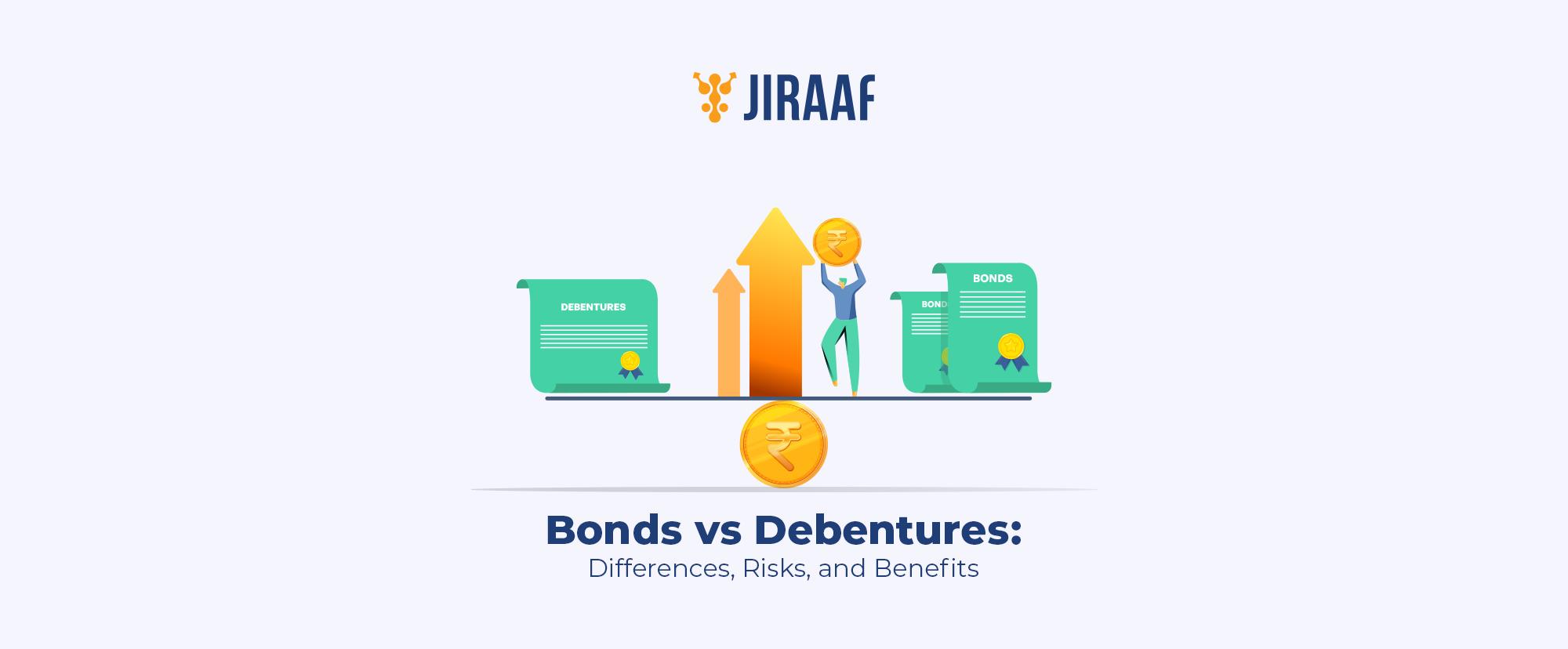
Difference Between Bonds and Debentures
| Parameter | Bonds | Debentures |
| Meaning | Debt Instruments that are issued by private corporations and governments. Backing of collateral or physical assets | Debt Instruments that are issued by private corporations. No backing of physical assets or collateral |
| Tenure | Long-term investment instruments. Longer tenure than debentures | Shorter tenure than bonds |
| Risks | Relatively safer investments since they are backed by collaterals | Riskier because of the lack of backing by any physical assets |
| Collateral | Secured by collateral from the issuing entity | Usually unsecured, approved by the issuer |
| Owner | Known as bondholders | Known as debenture holders |
| Priority of Liquidity | In a situation of liquidation, bondholders get the priority in terms of capital | Debenture holders get second priority after bond holders |
| Rate of Interest | Lower rate of interest, lower risk | Higher interest rate, higher risk |
| Payment of Interest | Payments take place on an accrual basis | Payments are made on a periodic basis |
Bonds vs Debentures: Risk and Return
As with any investment, the investments in bonds and debentures also carry the associated risks like credit risk, interest rate risk, inflation risk, and liquidity risk to varying degrees.
The decision to choose between bonds and debentures ultimately hinges on your risk tolerance and investment goals.
- Risk-Averse Investors: If capital preservation and stable returns are your top priorities, government bonds or secured bonds issued by reputable entities may be a better fit. They offer predictable income streams with a lower risk profile. There is low credit rated bonds available as well to investors that offer higher yields and are riskier than debentures with high credit ratings. All investments carry risk, and investors should read all the information provided and make informed choices on risks and returns tradeoffs.
- Income-Seeking Investors: Debentures can be attractive for investors seeking higher yields. The potential for higher returns, however, comes with the increased risk associated with unsecured debt instruments. It’s crucial to carefully assess the issuer’s creditworthiness before investing in debentures.
Building a Balanced Portfolio with Bonds and Debentures
- Diversification is the Key: Both bonds and debentures can play a role in diversifying your portfolio. By including them alongside other asset classes like real estate, bank deposits, mutual funds, equities, and alternative fixed income investments in your portfolio, you can spread your risk and potentially improve your portfolio’s overall risk-adjusted return.
- Generating a Steady Income Stream: The regular periotic interest payments provide a reliable source of income. We provide access to a carefully chosen range of bonds and debentures, along with detailed information, ratings, and a straightforward transaction process. We ensure full transparency to help you choose the best investment options that match your needs and goals.
Final Thoughts: Bond and Debenture Difference
Bonds and debentures differ primarily in terms of security, risk, and issuer.
Bonds are typically secured and issued by governments or corporations, while debentures may be unsecure and are generally issued by companies. Both instruments offer fixed returns, but the level of risk varies depending on whether the investment is secured or not.
When making investment decisions, it’s crucial to assess your risk tolerance, financial goals, and the credibility of the issuer. Bonds offer more security for conservative investors while debentures can provide higher returns with slightly more risk. By understanding these differences, you can make informed decisions that align with your investment strategy.