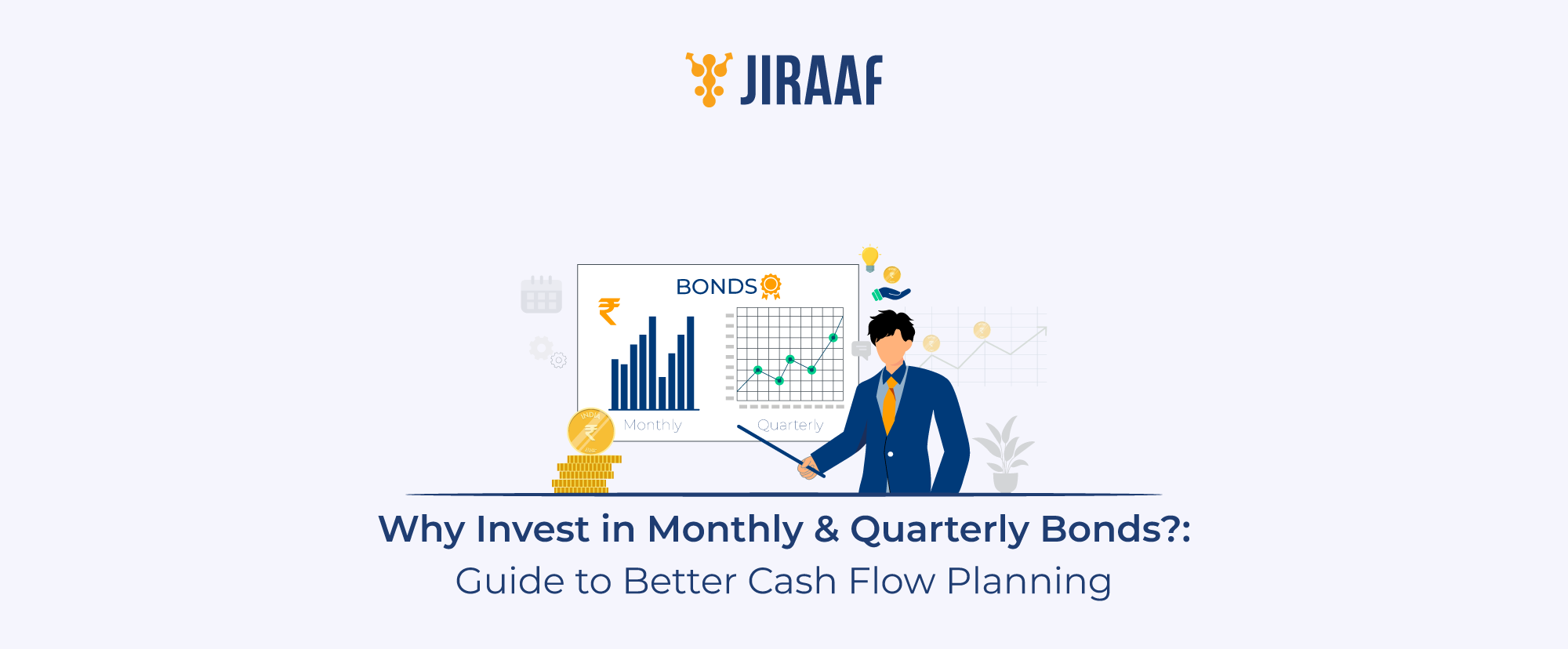
Monthly and quarterly payout bonds help you generate steady income while keeping your investments intact. Understand how they work and how to use them effectively in your portfolio.
Monthly and quarterly payout bonds are designed for one clear purpose: delivering regular income at shorter intervals. This makes them particularly useful when you are managing short-term commitments or looking to maintain liquidity within your overall portfolio.
In this blog, we break down how these bonds work, what to evaluate before investing, and how you can use them more effectively within your portfolio.
Why Investors May Consider Monthly and Quarterly Payout Bonds?
If your financial needs require regular cash inflows, short-term bonds that pay out monthly and quarterly returns can be a practical option. Instead of relying on selling investments or waiting for maturity, you receive income at defined intervals.
This makes them relevant for managing recurring expenses, supporting short-term goals, or creating a steady income stream alongside your primary earnings. They are especially useful when your focus shifts from wealth accumulation to cash flow management, without fully moving out of your volatile investments.
Once you understand where these bonds fit your financial needs, the next step is to examine the unique features they offer.
Features of Monthly and Quarterly Payout Bonds
These bonds are structured to provide regular income at fixed intervals, with clearly defined terms around payouts and maturity.
- Fixed coupon with defined payout frequency
These bonds offer a fixed interest rate, with payouts made at regular intervals such as monthly or quarterly. This creates a predictable income stream for investors like you.
- Cash flow-oriented structure
Unlike cumulative bonds, returns are distributed periodically instead of being reinvested, making them suitable for income-focused strategies.
- Price sensitivity to interest rates
While the income remains fixed, the bond’s market price can fluctuate due to changes in interest rates, especially if traded in the secondary market.
- Defined tenure with income visibility
These bonds come with a fixed maturity period, allowing you to plan both income and capital return timelines in advance.
However, selecting the right bond requires you to look beyond just payout frequency and understand the factors that can impact your returns.
Things to Look for While Investing in Monthly and Quarterly Payout Bonds
Before investing in monthly or quarterly payout bonds, it’s important to evaluate factors that directly impact both the consistency of your recurring income and overall returns.
- Credit rating of the issuer
Since your partial income depends on regular payouts, the issuer’s ability to meet interest obligations becomes critical. Higher-rated bonds may offer slightly lower yields but provide greater reliability in receiving timely payments.
- Coupon rate vs prevailing interest rates
Frequent payouts can feel attractive but always compare the coupon rate with current market yields. A higher payout frequency does not compensate for a lower overall return if the rate is not competitive.
- Payout frequency vs your cash flow needs
Choose between monthly or quarterly payouts based on how your expenses are structured. A mismatch here can lead to either surplus idle cash or gaps in meeting financial commitments.
- Liquidity and exit impact
If you plan to exit before maturity, check whether the bond is listed and actively traded. Since prices fluctuate with interest rates, exiting early may result in gains or losses. Additionally, selling listed bonds after 1 year attracts Long-Term Capital Gains (LTCG) tax at 12.5%, whereas unlisted bonds are now taxed at your income slab rate regardless of the holding period.
- Taxation of periodic income
Interest received from these bonds is typically taxed as per your income slab. Frequent payouts can increase your taxable income visibility, so it’s important to evaluate post-tax returns rather than just the stated coupon.
- Tax implications and TDS on interest
Interest income from these bonds is taxed according to your applicable income slab, so it’s important to look beyond the headline coupon and assess your post-tax returns. Additionally, a 10% TDS is deducted on interest earned from listed corporate bonds under Section 193 regardless of the interest amount, as the ₹10,000 threshold was removed for listed securities in 2023.
Once you have evaluated these factors and chosen the right bond, the role these instruments play in your portfolio becomes clearer.
Benefits of Investing in Monthly and Quarterly Payout Bonds
Here’s how these bonds can support your short-term cash flow needs and overall portfolio structure.
- Supports regular cash flow needs
Frequent payouts may help you meet recurring expenses without relying on selling investments, making them suitable for short-term income planning.
- Better liquidity alignment
With income coming in at shorter intervals, you can maintain a steady flow of funds that can be used or redeployed without waiting for maturity.
- Reduced reinvestment concentration risk
Since you receive smaller amounts periodically, you can stagger reinvestment decisions over time instead of deploying a large sum at once.
While these benefits make them useful for managing regular cash flows, it’s equally important to understand the trade-offs that come with this structure.
Disadvantages of the Monthly and Quarterly Payout Bonds
Before investing, consider these limitations to understand how they may impact your overall returns and portfolio efficiency.
- Limited compounding potential
Since payouts are distributed and not reinvested automatically, you miss out on the compounding benefit that cumulative instruments may offer.
- Frequent reinvestment requirement
Regular payouts mean you need to continuously decide where to redeploy smaller amounts, which can become inefficient over time.
- Lower yield trade-off
Bonds offering frequent payouts may come with relatively lower yields compared to longer-term or cumulative options, as flexibility often comes at a cost.
Despite these trade-offs, you can still improve outcomes by managing how you invest and use the payouts.
Tips to Maximize Returns from Monthly and Quarterly Payout Bonds
Here are a few practical ways to improve outcomes from monthly or quarterly payout bonds:
- Focus on post-tax returns, not just payout frequency
Frequent payouts can make returns appear attractive, but what matters is what you retain after tax. Always evaluate the effective yield after considering your tax slab.
- Align payouts with your actual cash flow needs
Choose payout frequency based on your expenses. If your inflows exceed your needs, idle cash can reduce overall portfolio efficiency.
- Reinvest surplus payouts consistently
If you do not need the entire payout, redeploy the excess into suitable instruments. Even small amounts, when reinvested regularly, can improve overall returns over time.
- Prefer shorter durations in uncertain rate environments
Short-term bonds help reduce interest rate risk and allow you to adjust your investments more frequently as market conditions change.
When used thoughtfully, these bonds can help you maintain liquidity while still keeping your capital productively invested.
Conclusion
Monthly and quarterly payout bonds work best when your priority is keeping cash flow steady without disturbing your investments. They are not meant to maximize returns, but to make your portfolio more functional for day-to-day financial needs.
The real challenge lies in using them efficiently. Frequent payouts can easily sit idle or get spent without intent, reducing overall returns. However, when you align payouts with actual expenses and redeploy excess amounts wisely, they can add structure and discipline to how your short-term finances are managed.