In a W-shaped recovery, economies move through repeated phases of recession and recovery within a short period, creating high uncertainty for businesses and investors. Explore how this recovery pattern works.
Sometimes, after a recession, economies begin showing signs of recovery, and it feels like the worst phase is finally over. Growth begins to return, markets stabilize, and confidence starts to improve. However, it does not always sustain.
In some cases, the economy slips back into another dip before returning to stable growth. Economists call this unusual recovery pattern a W-shaped recovery.
In this blog, we will understand what causes this “double dip” pattern, how it impacts the economy, and one of the most well-known historical examples.
What is W-shaped Recovery

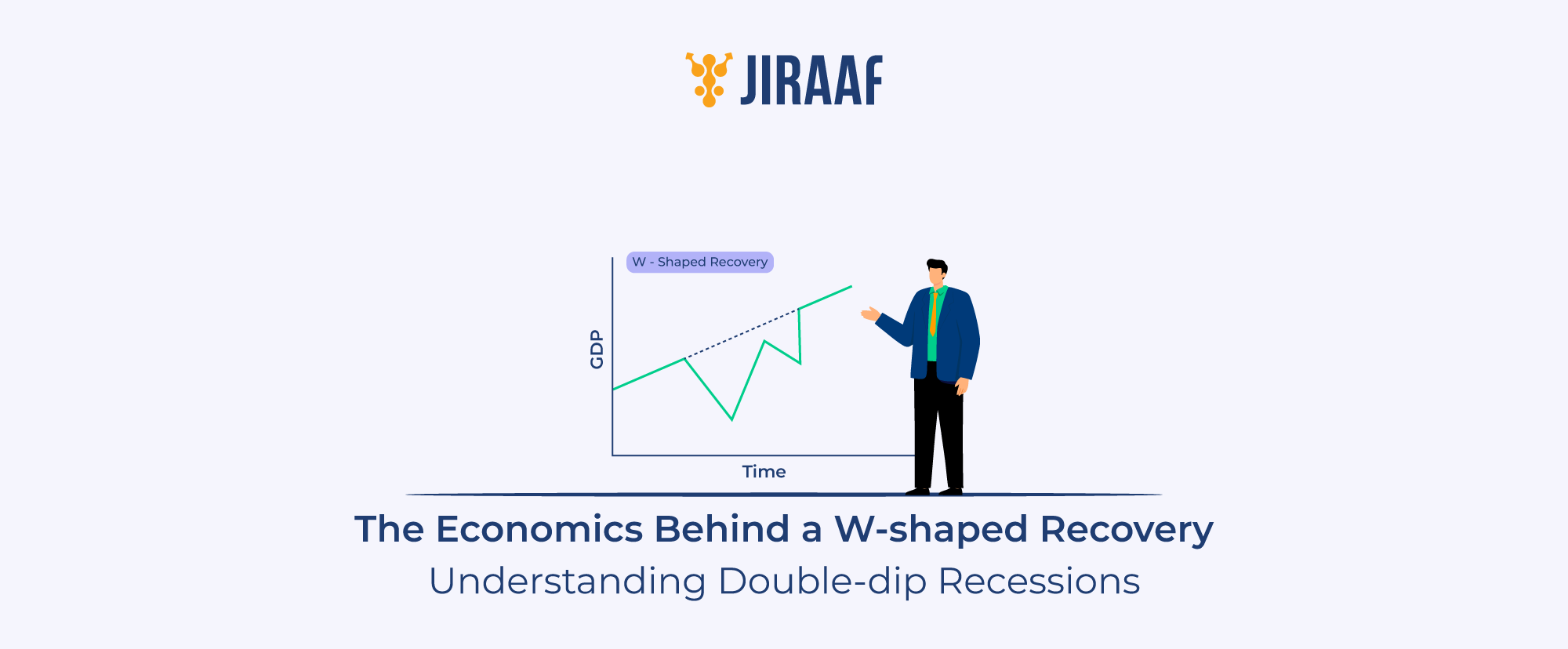
A W-shaped recovery occurs when an economy falls into a recession with a sharp decline but sharply recovers in a short span of time. However, it slips back again, triggering a false alarm before finally bottoming out and recovering above the first recovery leg. Because of these constant “in-and-out” periods of recession and recovery, a W-shaped recovery is considered one of the most volatile and uncertain phases for an economy.
Also known as a “double-dip recession”, a W-shaped recovery resembles the letter “W” when plotted using economic indicators like GDP, employment levels, or industrial output. During this phase, businesses, consumers, and financial markets often face high uncertainty because the economy initially shows signs of recovery before slipping back into another downturn.
How does a W-shaped Recovery Impact the Economy?
- Higher economic uncertainty: Repeated downturns make businesses and consumers cautious about spending and investments
- Volatile financial markets: Stock markets and investor sentiment fluctuate sharply due to unstable economic conditions
- Delayed business expansion: Companies postpone hiring, expansion, and capital investments because recovery momentum remains uncertain
- Weak consumer confidence: Consumers reduce discretionary spending as fears of another recession continue to persist
A mix of temporary economic improvements and unresolved underlying problems usually drives the repeated fall-and-recovery cycle in a W-shaped recovery.
Why W-shaped Recovery Happens
A W-shaped recovery usually begins when the economy enters a recession due to factors like weakening consumer demand, aggressive interest rate hikes, financial instability, supply chain disruptions, or sudden external shocks. As economic activity slows, businesses cut production, unemployment rises, and overall growth begins to decline sharply.
However, after an initial period of downturn, the economic activity starts to pick up sharply. Consumer spending slowly returns; businesses become optimistic again, and the government’s stimulus or lower interest rates begin supporting growth. But this recovery often proves short-lived. Rising inflation, fresh economic shocks, or other factors drag the economy back into another slowdown, signaling a false recovery and often trapping the investors who jumped back into the markets believing the economy had bottomed out. This second decline creates the “double-dip” pattern associated with a W-shaped recovery.
Once inflation stabilizes, demand improves, and economic conditions become more sustainable, the economy finally enters a stronger, more stable recovery phase by surpassing the high reached in the initial recovery and completing the W-shaped recovery.
One of the most widely discussed examples of a W-shaped recovery occurred in the United States during the early 1980s recession.
Historical Example of W-Shaped Recovery
During the early 1980s, the US economy was already struggling with rising inflation, slowing growth, and high unemployment due to weak policy responses and oil price shocks. As a result, inflation had become deeply embedded in the economy, with prices continuing to rise rapidly year after year.
To tame inflation, Federal Reserve Chairman Paul Volcker sharply increased interest rates in late 1979 and early 1980. As a result, borrowing became expensive, consumer spending slowed, businesses suffered, and the economy entered a brief recession in 1980. However, once the Federal Reserve briefly eased restrictions and lifted credit controls later that year, economic activity began to recover, and many believed the worst phase was over.
But the recovery did not last long. Inflation remained high, forcing the Federal Reserve to tighten interest rates once again. This pushed the US economy into a second and much deeper recession between 1981 and 1982, creating the classic “double-dip” pattern of a W-shaped recovery.
Eventually, inflation came under control, economic conditions stabilized, and the economy entered a more sustainable recovery phase starting in late 1982.
Conclusion
A W-shaped recovery highlights how fragile the initial burst of economic recovery can be when the underlying recessionary factors remain unresolved. Even when markets stabilize and growth indicators begin improving, inflation, weak demand, policy tightening, or structural imbalances can quickly drag the economy back into another downturn.
Hence, understanding a double-dip pattern becomes important for businesses, investors, and policymakers to better interpret markets and policy decisions in uncertain economic conditions.