A U-shaped recovery is an economic phase where growth, employment, and consumer demand recover slowly after a downturn. Understand its causes, effects, and real-world examples.
Whenever an economy slips into a recession, the path back for economic activity to reach its pre-recession level can vary widely depending on many factors. Some recoveries are quick, while others take much longer to regain momentum.
When the economy remains stuck in a prolonged slowdown before gradually recovering over several months or even years, it is known as a U-shaped recovery.
In this blog, we will explore what a U-shaped recovery is, how it affects the economy, how past global crises have reflected this pattern, and more.
What is U-shaped Recovery?

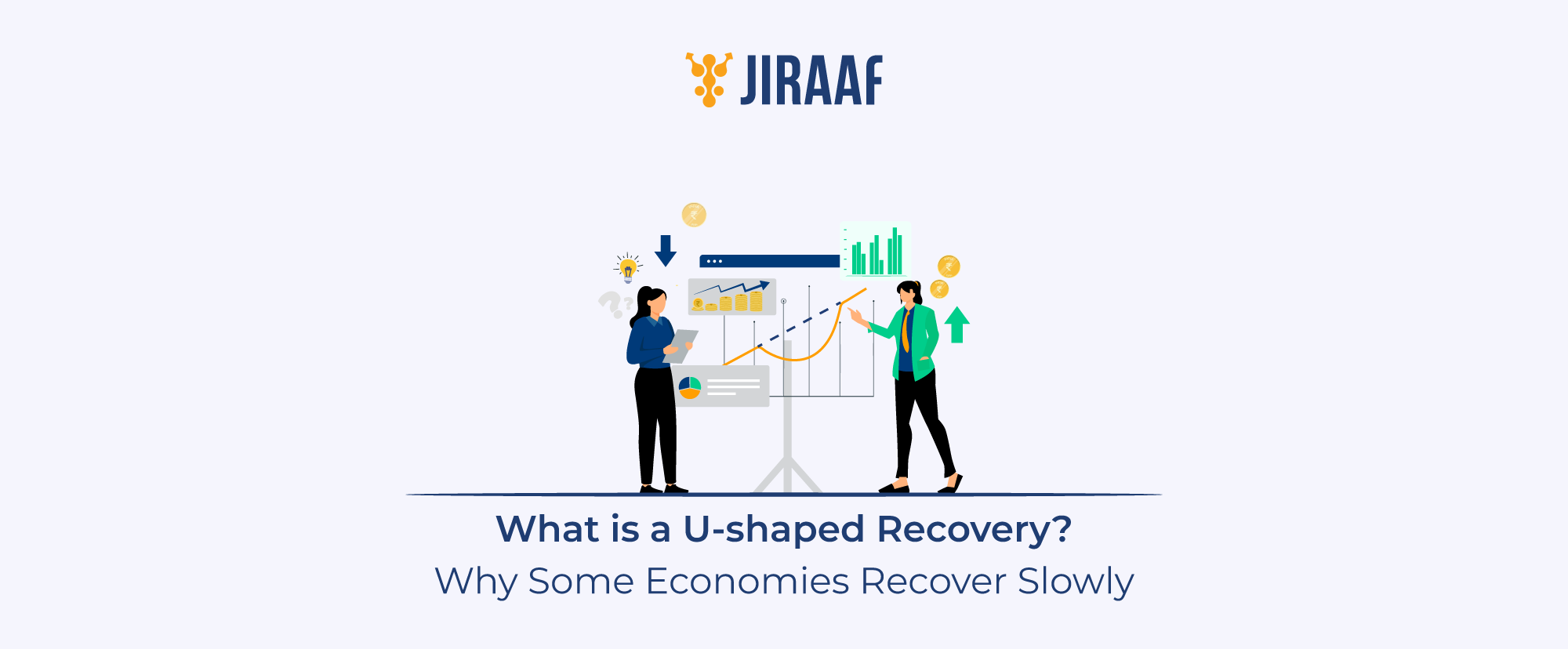
A U-shaped recovery occurs when an economy enters a recession and remains stuck in a prolonged period of weak growth and stagnation before gradually recovering. During this phase, economic activity stays subdued for several quarters as businesses remain cautious, unemployment stays elevated, and consumer spending slows down. Over time, the economy slowly regains momentum and eventually returns to its pre-recession levels, forming a “U”-shaped pattern in the process.
This recovery pattern is typically tracked using indicators such as GDP growth, inflation, employment levels, and industrial output.
Effects of U-shaped Recovery on the Economy
- High unemployment: Businesses delay hiring during the recovery phase, keeping unemployment elevated for longer
- Weak consumer spending: Households become cautious with money, reducing spending on non-essential goods and services
- Slow business expansion: Companies avoid aggressive investments and expansion plans due to weak demand and uncertainty
- Tighter credit conditions: Banks become more risk-averse after a recession, making loans harder to obtain and more expensive
- Muted wage growth: Excess labor supply and weak economic conditions keep salary growth slow for years
- Low investor confidence: Financial markets and investor sentiment recover gradually as confidence rebuilds slowly
Unlike rapid rebounds, U-shaped recoveries involve a gradual healing process where confidence, spending, and investments recover slowly over time.
Why U-shaped Recoveries Take Time?
A U-shaped recovery takes time because economic activity must return to pre-recessionary levels once a crisis is under control.
The economic decline usually begins with falling demand, tighter credit, layoffs, and a collapse in business confidence. As unemployment rises and household incomes shrink, consumers start spending less, deepening the slowdown.
Households focus on reducing debt and saving more, while businesses remain cautious about borrowing, hiring, or building new capacity due to weak demand and uncertainty. Even surviving firms often operate conservatively instead of chasing growth.
The recovery begins gradually as interest rate cuts, government spending, easing credit conditions, and improving demand restore confidence. Businesses slowly restart investments and hiring, while consumers begin spending again. However, employment, wages, and corporate expansion usually recover much later than headline economic growth.
Not every recession follows the same recovery pattern, which is why economists classify recoveries into different shapes based on how economic activity rebounds.
Economic Recovery Types Explained
The pace and duration of economic recovery can vary significantly after a recession, leading to different types of recovery patterns.
- L-shaped recovery
An L-shaped recovery occurs when the economy falls sharply and then remains stagnant for years with little meaningful growth. Japan’s slowdown after the 1990 asset bubble crash is a classic example.
- U-shaped recovery
A U-shaped recovery happens when the economy stays weak for a prolonged period before gradually improving over time. Recovery in jobs, spending, and business activity tends to be slow and steady.
- W-shaped recovery
A W-shaped recovery, or double-dip recession, occurs when the economy briefly recovers after a downturn but slips back into another decline before stabilizing again.
- V-shaped recovery
A V-shaped recovery refers to a rapid economic rebound immediately after a sharp decline. Production, demand, and market activity recover quickly once conditions improve.
One of the most prominent real-world examples of a U-shaped recovery was witnessed during the 2008 global financial crisis in the United States.
Case Study of a U-shaped Recovery
The 2008 global financial crisis is one of the clearest examples of a U-shaped recovery. The crisis began when the US housing bubble burst, triggering bank failures, credit freezes, mass layoffs, and a collapse in consumer confidence. Businesses stopped investing, banks became reluctant to lend, and millions of households focused on repaying debt instead of spending.
What made the recovery “U-shaped” was the long and painful bottom phase. Even after the recession officially ended in 2009, unemployment remained high for years; wages stayed weak, and economic confidence recovered slowly. Massive government stimulus, near-zero interest rates, and bank bailouts eventually helped stabilize the economy, but the US took nearly six and half years (76 months) to return to pre-crisis employment levels.
Conclusion
A U-shaped recovery highlights that economic recovery is often slow because the damage caused during a recession affects every part of the economy simultaneously. Even after economic growth resumes, indicators such as employment, wages, investment, and consumer confidence usually take much longer to return to pre-recession levels. This is why U-shaped recoveries are marked by a prolonged period of weak economic activity before stability and growth gradually return.