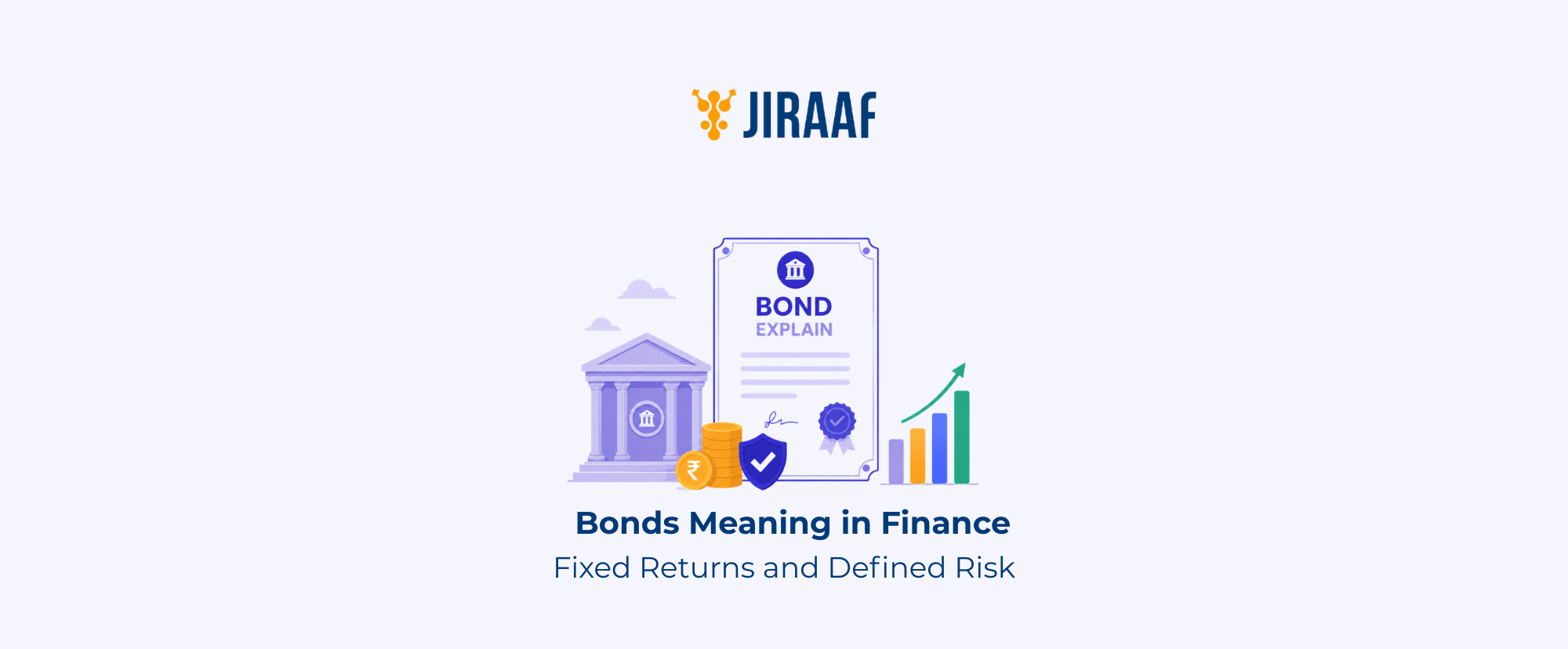
Summary: Bonds are debt instruments that let investors lend money to governments or companies in exchange for regular interest payments and principal repayment at maturity. They can offer a balance of stability, fixed returns, and potentially better yields than traditional savings products, depending on the bond type and market conditions. This guide explains the meaning of bonds in finance.
Quick Overview
- Bonds are debt instruments where investors lend money to governments or corporations in exchange for periodic interest payments and principal repayment at maturity
- Bonds are a type of fixed-income security in which the issuer borrows the funds from the investors
- There is a predefined maturity date for bonds on which the invested amount (principal) is paid back
- Bonds generally offer more stability than equities and may offer higher returns than some traditional savings products, depending on the market conditions and the type of bonds
If you think equities are too volatile and traditional FDs may not offer much capital growth, bonds can be worth considering. Bonds sit somewhere in between these two investment assets by offering relatively stable returns with lower volatility and delivering better yields than traditional fixed deposits.
In this guide, we explain the meaning of bonds in finance, their key features, how they work, and how investors can evaluate different types of bonds.
What are Bonds in Finance?
A bond is a debt instrument that helps investors earn a fixed return by lending money to the issuer of the bond for a defined duration, with fixed terms and interest, and a guarantee of principal repayment at the end of the tenure.
Generally, companies opt to issue debt instruments as a way of raising capital without diluting equity ownership. For example, in 2026, Nippon Steel raised ¥600 billion through convertible bonds primarily to repay bridge loans taken out for its acquisition of United States Steel. Similarly, companies such as Adani Enterprises have issued bonds to fund growth initiatives.
Core Characteristics of a Bond
The basic components of a bond help define its returns, risk, and maturity. These parameters are defined at issuance (in the bond indenture) and help you effectively compare different bond offerings while investing.
Face Value and Principal Repayment
The face value, or par value, is the amount you invest to own a bond. After the bond gets listed, the face value remains constant (which is the amount the issuer will be paying back), but the market price of the bond may change due to market factors. You then start receiving interest payments (coupon) on your invested amount (principal) and get the principal back once the bond matures. In India, the face value of retail corporate bonds is commonly ₹1,000 for public issuances. For privately placed bonds, SEBI reduced the minimum face value from ₹1,00,000 to ₹10,000 in April 2024.
Coupon Rate and Interest Frequency
The coupon rate is the annual interest rate paid on a bond’s face value. The interest on such bonds is usually paid at predetermined intervals, such as monthly, semi-annually, quarterly, or annually.
Maturity Date and Tenure
The maturity date is the date on which the issuer has promised to repay the principal amount. Short-term bonds are usually issued for less than 3 years, medium-term bonds mature between 3 and 10 years, and long-term bonds typically mature after 10 years and can extend up to 40 years or more. Bonds with longer maturities tend to have higher yields because investors like you demand additional compensation for taking on greater uncertainty and interest-rate risk over time.
Together, these parameters define how a bond behaves across its lifetime and help you compare options before investing.
Understanding Credit Ratings and Risk Profiles
Credit ratings indicate the creditworthiness of an issuer and its ability to meet its debt payments on time. Agencies like CRISIL and ICRA rate bonds from AAA (indicative of the highest safety) to D (default). These ratings enable you to assess credit risk objectively.
| Bond Ratings | Typical Yield Range (>60 months) | Risk Level |
| Investment Grade | ||
| AAA/AA+ | 6.2% – 9.2% | Lowest |
| AA/AA- | 8.7% – 11.0% | Low |
| A+/A/A- | 9.1% – 16.1% | Low to Medium |
| BBB+/BBB/BBB- | 11.1% – 14.9% | Medium to High Risk |
| Non-Investment Grade | ||
| Bond Ratings | Indicative Yield Return | Risk Level |
| BB/BB- | Should be avoided by retail investors | High (Should be avoided) |
| B/B- | Should be avoided by retail investors | Very High (Should be avoided) |
| CCC/CCC- | Should be avoided by retail investors | Highest (Should be avoided) |
| CC/CC- | Should be avoided by retail investors | Highest (Should be avoided) |
| C/C- | Should be avoided by retail investors | Highest (Should be avoided) |
| D | Default | Highest (Should be avoided) |
Disclaimer: All yield ranges are indicative as of April 29, 2026, and subject to change based on market conditions, issuer credit profiles, and bond-specific structures.
You can include bonds from various rating tiers to diversify risk and return as per your financial goals. Beyond credit quality, bond prices are also influenced by changes in interest rates.
Inverse Relationship Between Bond Prices and Interest Rates
Interest rates and bond prices share an inverse relationship and move in opposite directions. When market interest rates rise, existing bonds with lower coupon rates become less attractive, causing their prices to fall. Conversely, when interest rates decline, previously issued bonds with higher coupon rates become more valuable, pushing their prices up.
Consider an investor who owns a bond with a coupon of 8%, and new bonds are issued with coupons of 10%; the investor will be inclined to sell the old bond at a discount so that its yield to maturity equals the current market rate.
Factors like these also have a direct impact on the demand and supply of bonds in the secondary market. However, in the scenario when the bond prices are up, investors can sell bonds at a premium, depending on market demand and liquidity conditions.
Understanding the relationship between bond prices and interest rates can help you decide whether to hold to maturity or trade in the secondary market.
Key Bond Types Available in India
Indian investors can choose from a variety of bonds based on the level of risk they can absorb or the type of returns they anticipate. Some of the bond types are:
- RBI issues Government securities (G-secs) on behalf of the Government of India (GOI). These bonds have the lowest risk profile.
- Corporate bonds are issued by firms, including public sector bodies and private companies, to raise funds. These bonds generally offer higher yields than G-secs because they carry relatively higher risk.
- Public sector entities such as NHAI and PFC issue tax-free bonds. The interest from these bonds is exempt from tax, but new issuances are rare, and most trade on the secondary market.
- The RBI issues the Floating Rate Savings Bonds (FRSBs) with sovereign backing. FRSB interest rates change every six months based on prevailing interest rates.
- Sovereign gold bonds (SGBs) were issued on behalf of the government. New issuances are paused, and existing SGBs trade on the secondary market.
Understanding which bond type suits your goal is the first step; the next is assessing the issuer’s credit quality.
How to Start Investing in Bonds Via Online Bond Provider Platforms (OBPPs)
OBPPs give retail investors direct access to corporate bonds without going through a broker or a mutual fund structure. Here is how you can start investing via OBPPs:
- Pick a SEBI-registered platform: SEBI registration means that the platform operates under a defined regulatory framework. Jiraaf, for instance, lists only investment-grade bonds and is registered with SEBI as an OBPP.
- Complete KYC and link the Demat account: Bonds are held in electronic form, so a Demat account is required. It is where the holdings sit after purchase.
- Review what is listed: Study the bond issuer, the credit rating, the yield, and the tenure.
- Invest and monitor: Invest directly through the platform. The dashboard tracks returns and maturity dates from that point forward.
Common Myths About Bonds
Myth: Bonds have no risk
Reality: Bonds are debt instruments with a comparatively low risk profile, but there are still some risks associated with them, such as credit risk, liquidity risk, repayment risk, etc. Risk levels vary according to the credit quality of the issuer, tenure, and stage in the business cycle.
Myth: Rising interest rates make bonds a bad investment
Reality: Rising rates affect existing bond prices but not the returns of investors who hold to maturity. A fixed-rate bond continues to pay the stated coupon payments until maturity, regardless of changes in interest rates. Rising rates are favorable when reinvesting because new bonds issued at higher rates offer better returns on fresh capital. The impact of rate changes depends entirely on whether you plan to hold to maturity or sell in the secondary market.
Myth: Bonds are only for long-term investors
Reality: Bonds are available across a wide range of tenures. For instance, treasury bills (T-bills) often have standard maturities of 91, 182, or 364 days. Short-term corporate bonds can have tenures of one to three years. If you need liquidity within a defined window, you can match bond maturities to your actual time horizon rather than committing to a multi-year lock-in. The secondary market also allows listed bonds to be sold before maturity, subject to available demand.
Myth: A higher yield always means a better bond
Reality: Higher yields reflect higher risk, not better value. A junk bond offering 16% typically carries more credit risk than an investment-grade bond offering 14%. Rating agencies assign lower grades to issuers with weaker financials, and those issuers must offer higher yields to attract investors. Chasing the highest available yield without checking the issuer’s credit rating and financial health is one of the most common mistakes in bond investing. The yield premium over safer bonds is compensation for taking on default risk.
Conclusion
Bonds offer you (the investor) fixed returns and a defined exit point, while enabling the issuers a convenient way to raise money for their needs. However, even though bonds can give you better yields than FDs, they don’t have the same capital appreciation potential as equity. Within a diversified portfolio, bonds may help to reduce the total volatility relative to equities. Before investing in bonds, check the issuer’s credit rating, whether the yield actually justifies the risk, and whether the tenure matches when you’ll need the money back.