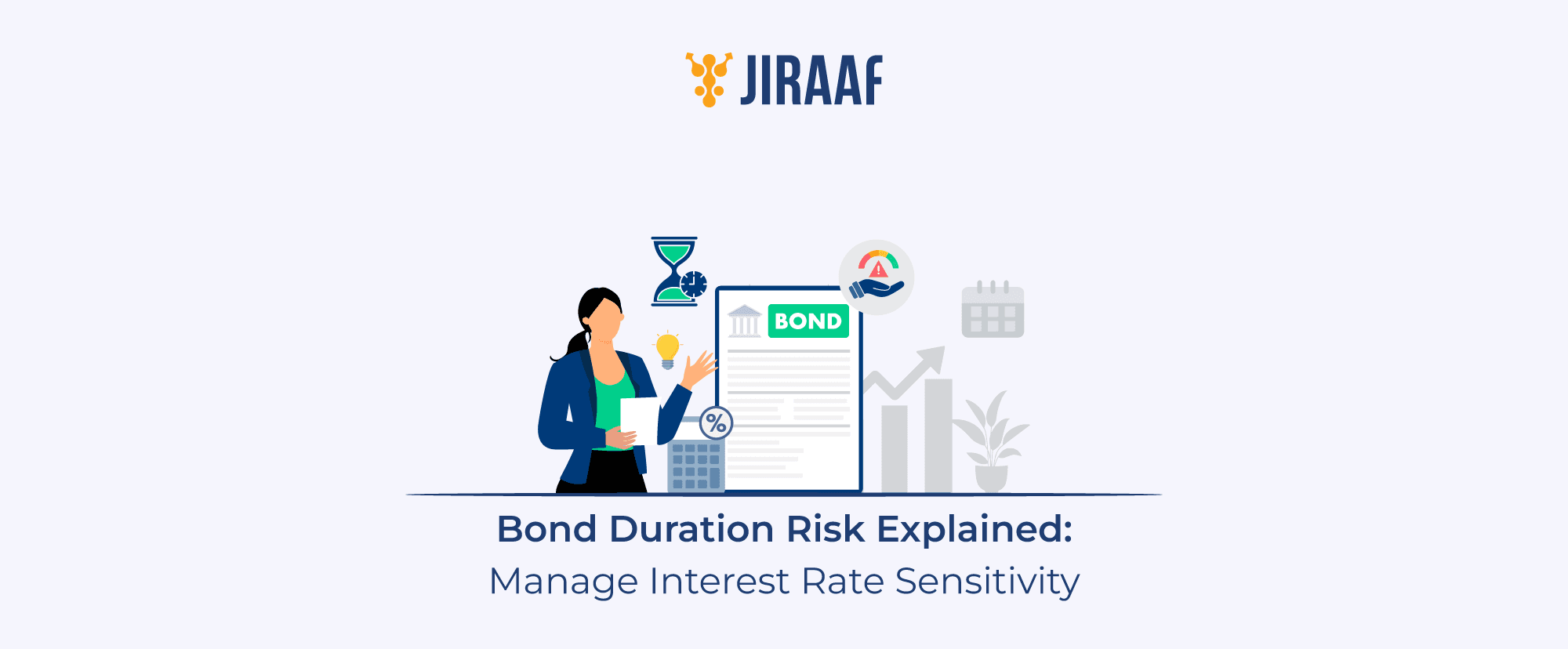
A bond’s holding duration determines how much its price can change when interest rates move, directly impacting your returns. Learn how to measure and manage duration risk to make smarter bond investment decisions.
A bond’s value can change over time as market conditions evolve, even if its cash flows remain fixed. These movements can directly influence the returns you earn from your investment.
Understanding what drives these changes and how sensitive your bond is to them is key to making better investment decisions. Explore how duration works and how you can use it to navigate changing interest rate cycles with greater clarity.
What is the Relationship Between Bond Prices and Interest Rates?
A bond’s price does not remain fixed once it is issued. After entering the secondary market, it begins to fluctuate based on a range of factors that influence how you value its future cash flows.
Some of these factors are relatively objective, such as the time to maturity, the issuer’s credit rating, and the structure of the bond’s cash flows, all of which help determine its price.
However, not all factors are within the issuer’s control or easily predictable. Broader macroeconomic variables, such as inflation expectations and prevailing interest rates, also affect a bond’s price. These forces change over time and directly influence how attractive a bond appears relative to other investment options.
Interest rates, in particular, have an inverse relationship with bond prices. For example, when the central bank changes policy rates, it alters the baseline return in the economy. As a result, newly issued bonds have to reflect the updated rates after such changes. If interest rates rise, new bonds offer higher coupons. If rates fall, new bonds offer lower returns.
This creates a comparison. Existing bonds continue to pay fixed coupons, but their prices adjust to remain competitive with newly issued bonds.
To understand how much these price changes can be, we need to look beyond direction and focus on sensitivity.
What is Duration in Bonds?
Duration measures how sensitive a bond’s price is to changes in interest rates. It is not just the time to maturity, but a weighted measure of when the bond’s cash flows are received. While investors holding the bond for the short term may be less concerned, long-term bondholders are affected more.
This sensitivity gives rise to duration risk, the risk that a bond’s price will change due to movements in interest rates.
How Does Duration Risk Impact Bonds?
Suppose you are holding a bond with a fixed coupon. If interest rates rise, new bonds enter the market offering higher returns. Your bond, with a lower coupon, becomes less attractive. As a result, its price falls in the secondary market, and its yield rises for new investors.
The extent of this price drop depends on duration. A long-duration bond will fall more sharply, while a short-duration bond will see a smaller decline. The opposite scenario plays out when the interest rate falls.
In both cases, interest rates drive the direction of price movement, but duration determines how strong that movement is. This makes duration risk a key factor in understanding how your bond investments behave in changing rate environments.
While duration tells you how sensitive a bond is to interest rate changes, you need a way to measure this sensitivity in a structured manner. This is where Macaulay Duration comes in.
How is Duration Measured using the Macaulay Duration Formula?
Macaulay duration calculates the weighted average time it takes for you to receive a bond’s cash flows, including both coupon payments and principal. It is widely used by portfolio managers and fixed-income investors like you to assess interest rate risk and compare bonds.
It measures the weighted average time to receive a bond’s cash flows, where each payment is discounted to its present value and expressed relative to the bond’s price.
The formula
𝐷𝑀𝑎𝑐=∑𝑛𝑡=1𝑡×𝐶𝐹𝑡(1+𝑦)𝑡𝑃DMac=∑t=1nt×CFt1+ytP
where:
is the time period of each cash flow
is the cash flow at time
(coupons plus principal at maturity)
is the yield per period
is the total number of periods
is the bond’s current price (∑ of all discounted cash flows)
For example, a 5-year bond with annual coupons may have a Macaulay duration of around 4 years. This means, although the bond matures in 5 years, you effectively recover your investment in about 4 years due to interim coupon payments.
While Macaulay duration helps you understand the structure of a bond’s cash flows, you need to go a step further with modified duration to see how prices actually react to interest rate changes.
How does the Modified Duration Formula help in Understanding a Bond’s Sensitivity?
Modified duration converts the concept of duration into a practical measure of price sensitivity. It estimates how much a bond’s price is likely to change for a given change in interest rates, making it especially useful in dynamic rate environments.
In simple terms, it answers, “If interest rates move, how much your bond price moves”.
The formula
𝐷(𝑀𝑜𝑑)=𝐷(𝑀𝑎𝑐)/(1+𝑦/𝑘)DMod=DMac/1+y/k
Where,
is the Macaulay duration
is the yield to maturity (YTM) per year
is the number of compounding periods per year (e.g., 2 for semi-annual coupons)
For example, if a bond has a modified duration of 5, a 1% increase in interest rates would lead to an approximate 5% decline in its price.
Note that this is an estimation, as the relationship between price and yield is convex, meaning the price increase when rates fall is typically larger than the price decrease when rates rise by the same amount.
This makes modified duration a direct indicator of duration risk. Bonds with higher modified duration are more sensitive to interest rate changes, while those with lower duration are relatively more stable.
How Can You Position Your Portfolios When Interest Rates Change?
Interest rates will keep changing, but how your portfolio reacts depends on how you manage duration. If rates are expected to rise, you can reduce risk by focusing on short-duration bonds, which are less sensitive to price declines.
If rates are likely to fall, long-duration bonds can enhance returns as their prices rise more sharply. At the same time, you can balance risk by diversifying across durations, rather than relying on a single interest rate view.
Ultimately, the best way to deal with duration risk is to manage it effectively. By aligning your bond investments with the prevailing interest rate expectations, you can make better investment decisions and navigate market changes with greater confidence.