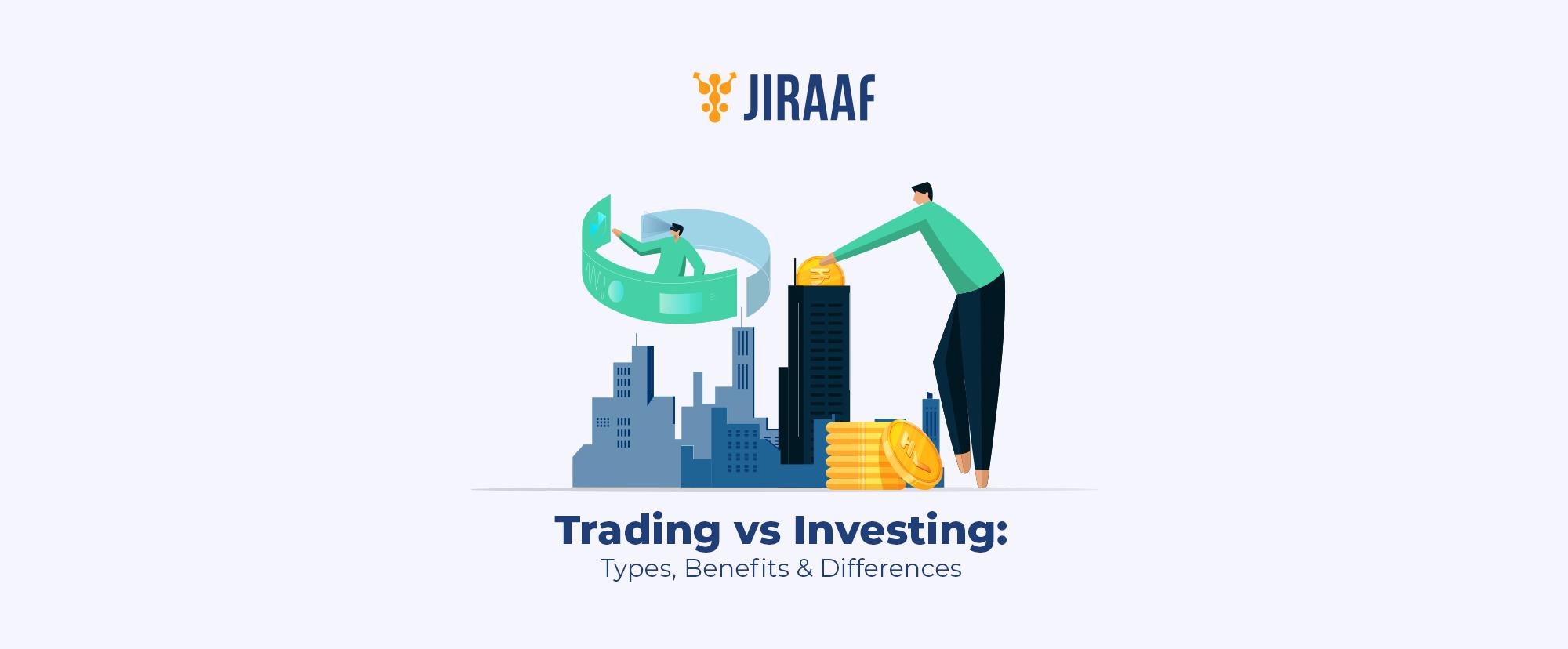
When Robert Kiyosaki said in his book Rich Dad Poor Dad, “Let your money work for you,” he touched on a core principle that often feels overwhelming to many. Where to put the hard-earned money for growth? If you are questioning whether trading or investing suits your financial goals or opting for low-risk options with decent returns, you’re not alone. We understand the uncertainty behind such decisions, and this blog will break down these two essential pillars of financial planning, trading and investing to help you make informed choices for your future.
What is Trading?
Trading involves the buying and selling of assets such as stocks, commodities, and currencies with the aim of making profits from short-term price movements. Traders analyse market trends and employ various strategies to determine when to enter or exit a trade. Successful trading requires a deep understanding of market trends, quick decision-making, and effective risk management.
Types of Trading
Intra Trading
Intra-day trading, or day trading, involves making multiple trades within a single day to capitalise on short-term price movements. As a day trader, you aim to benefit from market volatility by quickly buying and selling assets. All positions must be closed before the market closes to avoid overnight risks. This strategy requires constant monitoring and fast action.
Positional Trading
Position trading is a long-term trading strategy where traders hold positions in securities for extended periods, typically ranging from weeks to months or even years. This approach contrasts sharply with day trading, which involves buying and selling securities within the same trading day.
Swing Trading
Swing trading captures short- to medium-term price “swings” in the market. It offers a balance between quick profits and longer-term gains. Swing traders hold positions for several days or weeks, using a combination of technical and fundamental analysis to identify opportunities.
Long-Term Trading
Long-term trading is used to capitalise on the overall growth potential of assets, allowing traders to benefit from compounding returns on investments. This approach is often based on thorough fundamental analysis, which helps traders identify undervalued assets that may appreciate over time.
Scalping
Scalping aims to make profits from small price changes by executing many trades quickly. Traders implementing this strategy are known as scalpers. It requires a high level of precision and speed, as profits per trade are small. Scalping is more common among professional traders due to the need for advanced technology and tools.
Momentum Trading
Momentum trading is used to capitalise on the continuation of existing market trends. Momentum traders closely follow trends and use technical indicators to adjust positions accordingly.
The Benefits of Trading:
- Quick Gains: Trading allows you to take advantage of short-term fluctuations for quick returns.
- Flexibility & Liquidity: Your money isn’t tied up long-term, providing the flexibility to make timely adjustments or exit when needed.
- Diversification: You can spread financial risk by diversifying assets into stocks, bonds, commodities, and derivatives. With the right strategies, this may help protect your portfolio in volatile markets.
What is Investing?
Investing is the process of allocating money into various assets, such as stocks, bonds, real estate, ETFs or mutual funds, with the expectation of generating a profit or earning a return over time. The primary goal of investing is to grow wealth and achieve financial objectives, such as saving for retirement, funding education, or buying a home. Investors evaluate different opportunities based on factors like potential risks and returns, often taking a long-term approach to build financial security.
Types of Investing
Active Investing
Active investing refers to buying and selling assets frequently to take advantage of market opportunities. You conduct in-depth research to identify undervalued assets and make decisions based on short-term market movements. While active investing offers the potential for higher rewards, it also comes with increased risks and costs.
Passive Investing
Passive investing is a strategy where you buy and hold investments like index funds or ETFs that follow a market index, such as the S&P 500. Instead of constantly buying and selling, you keep your investments for the long term, allowing them to grow steadily. This approach is easier to manage because you don’t need to spend a lot of time researching or making frequent trades, which also helps keep fees and taxes lower.
Value Investing
Value investing involves buying stocks that are trading below their intrinsic or book value. By analysing financial statements and captial market trends, you can identify companies with strong fundamentals and hold onto them until their value appreciates.
Growth Investing
Growth investing focuses on companies expected to grow at an above-average rate. Investors look for firms with strong earnings potential or innovative products, focusing on capital appreciation.
The Benefits of Investing:
- Compound Interest: Your returns can generate additional earnings over time, leading to exponential portfolio growth.
- Inflation Protection: Investments often outpace inflation, preserving the purchasing power of your money.
- Tax Benefits: Certain investments, like retirement accounts, come with tax advantages. These benefits reduce your tax burden, helping you save and grow your wealth over time.
- Returns: Investing allows your money to grow through returns, which can come in the form of interest, dividends, or capital gains. By putting your money into assets that appreciate in value, you can earn significantly more than keeping your money in a savings account.
- Retirement Planning: Investing is crucial for retirement planning because it helps grow your savings over the long term. By investing you can build a nest egg that supports you financially when you retire. The earlier you start, the more time your investments have to compound.
Difference Between Trading and Investing
| Criteria | Investing | Trading |
| Risk | Generally, low to medium risk due to long-term perspective and diversification strategies, less affected by short-term market fluctuations. | Higher risk due to reliance on short-term price movements, requires quick decision-making, which can lead to significant losses. |
| Investment Period | Long-term commitment, often spanning years to decades, focusing on gradual wealth accumulation. | Short-term commitment, often involving holding positions for minutes to days, aiming for quick profits. |
| Capital Growth | Emphasises on steady capital growth over time, often through the compounding effect of reinvested earnings. | Focuses on rapid capital growth, which can lead to higher returns but also greater volatility and potential losses. |
| Effort Involved | Requires less daily effort once investments are made, with periodic reviews and adjustments; more of a buy-and-hold strategy. | Demands constant monitoring of the market and active management of positions, requiring significant time and effort daily. |
Trading and Investing: Can You Do Both?
Yes, you can do both. Some individuals successfully balance both trading and investing by adopting strategies that complement each other. Investors often keep segregated accounts for trading and investing to maintain distinct strategies and risk profiles. By allocating specific times for trading activities and using technology such as automated trading platforms. However, trading also comes with risks, including a significant time commitment, emotional stress from the fast-paced nature of trading, the temptation to overtrade, and the complexity of managing different strategies.
If you are someone who doesn’t have the time to constantly watch the market or take the risks involved in trading, investing is a more sustainable way of building wealth wherein you don’t need to monitor the market on an hourly or daily basis.
Final Thoughts: Trading vs Investing
If we truly want our money to work for us, we must be willing to embrace calculated risks and explore opportunities that challenge the status quo. However, it’s important to assess your risk horizon, investment potential and duration before choosing an investment asset. Remember, you mustn’t put all your eggs in one basket, no matter how tempting the rewards of a certain asset looks like.
Discover fixed income investments with Jiraaf, a SEBI registered online bonds platform that educates and brings access to a wide array of bonds. Sign up today to explore diversified fixed income investment opportunities to support your goal-based wealth creation journey. Start investing!