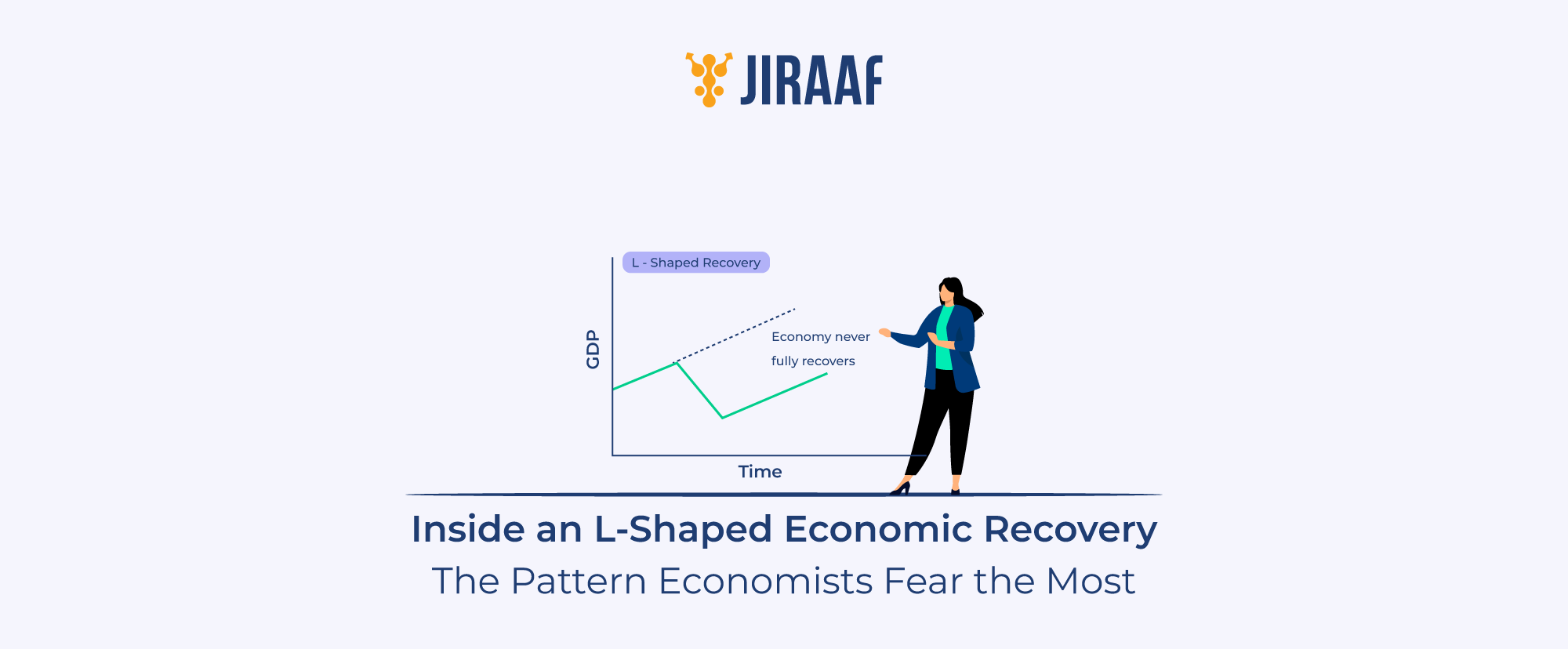
An L-shaped recovery occurs when an economy experiences a sharp decline followed by years of weak or stagnant growth. Learn what causes this prolonged slowdown and how it impacts economic recovery.
Economic slowdowns are common. Most economies eventually recover; businesses reopen; jobs return, and growth resumes. But what happens when that recovery never really arrives?
In some cases, an economic crisis leaves behind scars that last for years. Unemployment remains high; investment remains weak, and consumer confidence in the future declines. And as a result, the economy becomes trapped in a prolonged period of stagnation. Economists call this an L-shaped recovery.
Let’s take a look at what an L-shaped recovery means, why it happens, and why some recoveries take years to unfold.
What is L-Shaped Recovery?

An L-shaped recovery is the slowest and most painful type of economic recovery. It occurs when an economy experiences a sharp decline and then struggles to regain its previous trend growth rate and potential output level for an extended period, sometimes lasting years or even decades. This prolonged period of weak economic activity is why economists often associate L-shaped recovery with periods of depression.
The behavior of an economy experiencing an L-shaped recovery can be identified through the following characteristics:
- Persistent unemployment: Companies delay hiring, reduce expansion plans, and operate with fewer resources. As job opportunities remain limited, household income and consumer spending remain under pressure.
- Weak business confidence: Businesses remain cautious about expansion and investment due to uncertain demand and growth prospects.
- Underutilization of productive resources: Factories, machinery, and infrastructure remain idle or operate below capacity, reducing overall economic productivity.
- Sluggish investment activity: Companies often postpone capital expenditure and long-term projects, limiting economic growth and job creation.
- Slow return of consumer confidence: Households become cautious about spending, resulting in weaker demand across the economy.
While these characteristics explain what an L-shaped recovery looks like, economists continue to debate why some economies become trapped in such prolonged periods of stagnation. Let’s take a closer look at the factors that can lead to an L-shaped recovery.
Why L-Shaped Recovery Happens?
Economists from different schools of thought offer different explanations for why an L-shaped recovery occurs. While they disagree on the exact cause, most agree that the recovery becomes prolonged when businesses, consumers, and financial institutions struggle to regain confidence after a major economic shock.
Some economists argue that excessive debt is the primary reason. After a financial crisis, households and companies often focus on repaying debt instead of spending or investing, which slows economic activity. Others believe prolonged stagnation occurs when weak demand discourages businesses from expanding and hiring.
Another view suggests that aging populations, slower productivity growth, and structural economic challenges can limit long-term growth potential. Some economists also argue that policy interventions may unintentionally delay recovery by keeping unproductive businesses alive and slowing the reallocation of resources.
One of the most widely known examples of an L-shaped recovery was Japan’s “Lost Decade” during the 1990s, when economic growth remained sluggish for several years after the collapse of the asset bubble.
Historical Examples of L-Shaped Recovery
During the 1980s, Japan experienced a massive boom in stock and real estate prices. Easy access to credit encouraged businesses and investors to borrow heavily, pushing asset prices far beyond their actual economic value. However, when the central bank raised interest rates to cool speculation, the bubble burst. Stock markets crashed, property prices plunged, and billions of dollars in wealth disappeared.
The economic slowdown that followed was severe. Many banks were left with bad loans, yet they continued supporting struggling businesses instead of allowing inefficient firms to exit the market. This tied up capital in unproductive sectors and slowed down the flow of credit to healthier businesses.
At the same time, consumer demand remained weak; business investment slowed, and economic growth stagnated for years. Despite repeated stimulus measures and near-zero interest rates, Japan struggled to regain momentum, resulting in a prolonged period of low growth that became known as the “Lost Decade”.
Conclusion
Perhaps the biggest lesson from an L-shaped recovery is that an economic recovery is not guaranteed simply because a recession has ended. The speed and quality of recovery often depend on how quickly confidence, investment, productivity, and demand return to the economy.
That is why economists continue to study episodes such as Japan’s Lost Decade decades after they occurred. These experiences offer valuable insights into how economies respond to shocks, how policy decisions shape recovery outcomes, and why preventing long-term stagnation is often just as important as managing the crisis itself.