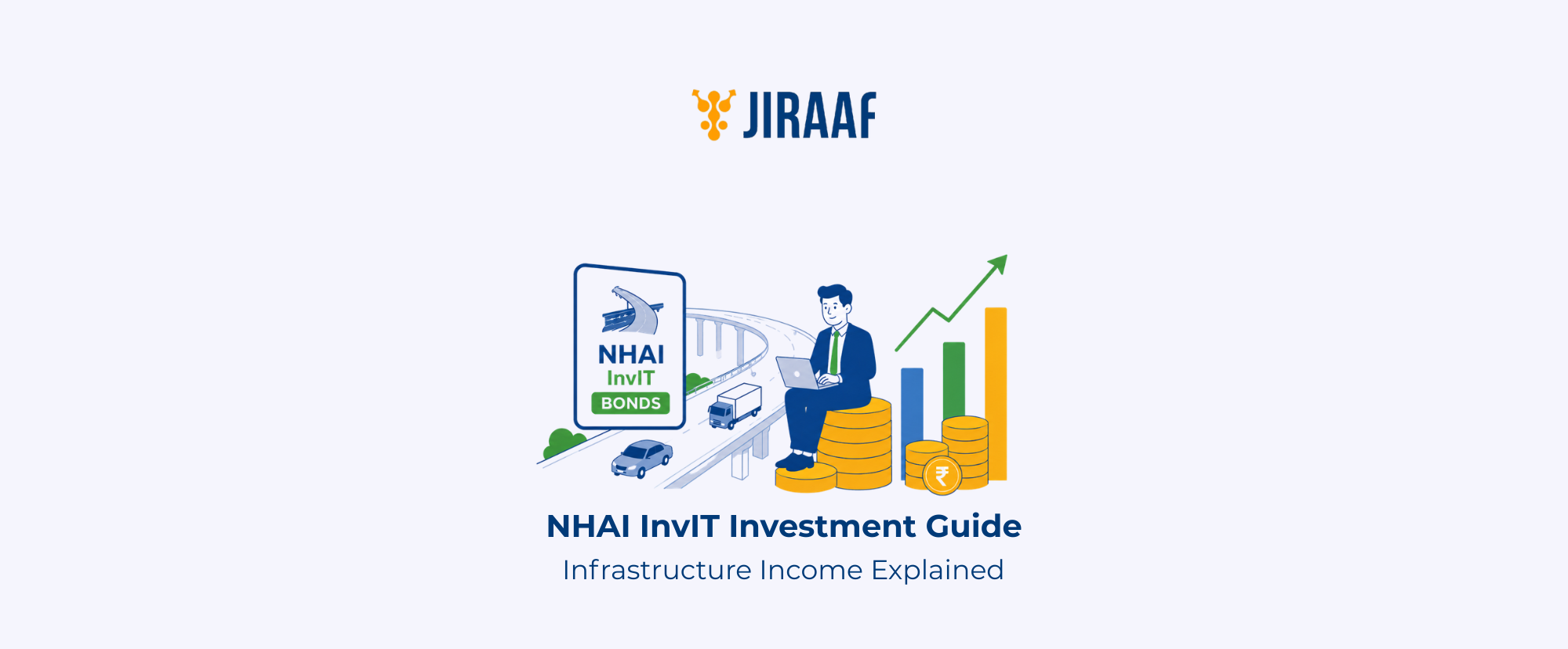
Summary: NHAI InvIT bonds are a way for investors to earn steady returns by putting money into India’s national highways and toll roads. This guide explains how they work, covering what you can expect to earn, how they are taxed, and the risks to watch out for.
Quick Overview
- NHAI InvIT bonds is a term investors use for three different products: traditional NHAI bonds, NHIT NCDs, and NHIT InvIT units.
- NHIT monetizes operational toll roads by transferring them into an InvIT structure that generates cash flows from toll collections
- NHIT NCDs function like fixed-income debt instruments, while NHIT InvIT units generate market-linked distributions tied to toll-road performance
- Several NHIT debt instruments carry AAA ratings, but they are not sovereign-guaranteed and still carry interest-rate, liquidity, and refinancing risks
- Post-tax yield matters more than headline coupon because taxation differs across NHAI bonds, NHIT NCDs, and InvIT distributions
Toll roads are among the most predictable revenue-generating assets in infrastructure because traffic volumes are established, escalation is contractual, and concession periods run for decades. NHIT was built to channel that predictability to investors. But “NHAI InvIT bonds” is not one product. It is a label that covers three different instruments with different risks, different tax treatment, and different return mechanics. Here is how they actually work.
The Three Products Behind One Confusing Term
When someone mentions “NHAI InvIT bonds,” they could mean any of the following:
- NHAI Bonds
Traditional NHAI bonds come in two forms.
Tax-free bonds were issued in tranches between 2011 and 2015, offering coupon income fully exempt from income tax. They no longer come to market fresh; today, you buy them on the secondary exchange at prices that have shifted from face value based on prevailing rates.
Section 85 bonds (formerly 54EC capital gains bonds) serve a different purpose: they allow you to defer long-term capital gains tax, typically from a property sale, by locking proceeds into NHAI bonds for five years. The current interest rate on these is 5.25% p.a., the lock-in is strict, and the investment cap is ₹50 lakh per financial year. These are a tax-planning instrument, not a yield-seeking one.
- NHIT NCDs
NHIT NCDs are debt securities issued by National Highways Infra Trust (NHIT), NHAI’s InvIT vehicle. They function like conventional bonds with fixed coupons, defined maturity, and semi-annual payouts. The 2022 public NCD issue carried a coupon of 7.90%, with an effective annual yield of approximately 8.05% given semi-annual compounding.
- NHIT InvIT Units
NHIT InvIT units are not bonds at all. They are listed trust units whose distributions depend on quarterly toll-road cash flows across NHIT’s portfolio. The distribution amount varies; there is no fixed coupon schedule.
The table below captures the structural differences at a glance:
| Product | Structure | Return | Taxation | Liquidity |
| Section 85/ 54EC bonds | NHAI direct debt | Fixed | Interest taxable at slab | 5-year lock-in |
| NHAI tax-free bonds | NHAI direct debt | Fixed coupon | Tax exempt | Secondary market only |
| NHIT NCDs | NHIT debt | Fixed coupon | Taxable at slab | NSE/BSE listed |
| NHIT InvIT Units | InvIT units | Quarterly distributions | Component-wise | NSE/BSE listed |
How NHIT Works
NHIT is an Infrastructure Investment Trust set up by NHAI in 2020 and listed on the exchanges in November 2021. The structure is straightforward: NHAI builds and matures highways, transfers operational roads into NHIT under Toll-Operate-Transfer (TOT) or InvIT concession agreements, and the trust distributes collected toll revenues to investors as distributions (for unit holders) or coupon payments (for NCD holders).
NHIT holds its assets through three SPVs: NWPPL, NEPPL, and NSPPL, each operating under 20–30-year concession agreements with NHAI. The SPV structure pools cash flows across the portfolio, spreading revenue concentration risk across corridors, geographies, and traffic patterns.
As of the February 2026 investor presentation, NHIT manages 2,345 km of operational highway assets, 26 projects, and 41 toll plazas across 12 states. The trust has raised ₹46,450 crore across four funding rounds, combining unit capital of approximately ₹23,053 crore and debt of approximately ₹23,397 crore. Its enterprise value stands at ₹50,029 crore.
Institutional participation has been extensive. Canada Pension Plan Investments (CPPIB), Ontario Teachers’ Pension Plan (OTPP), KKR & Co., EPFO, and NaBFID have all participated across NHIT’s monetization rounds. EPFO’s participation was particularly noteworthy as the first instance of the provident fund investing in an InvIT structure.
In FY2025–26, monetized highway assets have generated approximately ₹28,307 crore.
Credit Ratings: What AAA Means, and Doesn’t
NHIT’s debt instruments are currently rated by two agencies:
| Rating Agency | Current Rating |
| CARE | AAA / Stable |
| India Ratings (IND) | AAA / Stable |
AAA from both agencies means the lowest assessed credit risk in the current operating environment. What it does not mean: sovereign guarantee, zero risk, or immunity from market price movements. NHAI sponsorship adds institutional credibility but does not extend government repayment backing to NHIT’s obligations.
Interest rate movements, liquidity conditions, and traffic performance can all affect the investment even when credit risk is low. An AAA rating evaluates repayment probability, not return stability or exit pricing.
Yield and Distributions: The Numbers That Matter
For NCD holders, the key figure at the point of purchase is YTM, not the headline coupon. Secondary-market prices move with RBI rate cycles and investor demand. If you buy below face value, your effective yield is higher than the coupon; if above, lower.
NHIT’s annualized distribution yield was approximately 8.05% for 9M FY26, and the trust has distributed ₹29.63 per unit since listing in November 2021.
The right comparison isn’t headline coupon vs. FD rate. It is a post-tax yield across the full holding period, accounting for capital gains treatment on exit and the specific tax classification of each distribution component.
Taxation: Why It Can Be More Complicated Than It Looks
NHAI tax-free bond income remains exempt from tax, but these are secondary-market instruments now, bought at a price, and the yield on your actual purchase price may be far lower than the headline coupon.
NHIT NCD income is taxable at your applicable income tax slab rate. Capital gains apply on sale before maturity.
NHIT InvIT distributions are the most layered. Each quarterly distribution can include interest income, dividend income, repayment of SPV-level debt, and return of capital, and each component is taxed differently. A distribution that appears as 8% pre-tax may yield considerably less after accounting for your slab rate on the interest portion. Post-tax yield is the only number worth comparing across these instruments.
Why Investors Consider NHIT-linked Products
NHIT-linked instruments occupy a specific position in income-oriented portfolios: they offer yields above typical bank FDs and government bonds while being backed by physical, revenue-generating infrastructure assets. Here is what makes them worth evaluating:
- Yields above comparable sovereign instruments: NHIT NCDs have historically offered coupons in the 7.75–7.90% range, meaningfully above equivalent-tenor government securities. With the RBI rate cycle having eased from its FY24 peak, the spread between NHIT debt and g-secs makes the former relevant for investors seeking yield pickup without moving into lower-rated credit.
- AAA-rated with infrastructure backing: Unlike corporate bonds, where repayment depends on the issuer’s business performance, NHIT’s cash flows come from toll roads with traffic histories of 6–20 years. The AAA rating from CARE and India Ratings reflects structural protections: Debt Service Reserve Accounts, pooled SPV cash flows, and SEBI InvIT regulations, not just the sponsor’s name.
- SEBI-regulated with mandatory disclosures: InvITs are governed by SEBI’s InvIT regulations, which require quarterly distributions (where possible), independent valuations, defined leverage caps (49% of InvIT assets), and regular financial disclosures. This gives investors a level of transparency that many comparable private debt structures do not offer.
- Diversification across highways and geographies: NHIT’s portfolio spans 2,345 km across 12 states and 41 toll plazas, with revenue contribution spread across Andhra Pradesh, Uttar Pradesh, Madhya Pradesh, Karnataka, and others. No single corridor dominates the cash flow pool, which limits the impact of any one asset underperforming. The pipeline contiues to expand with plans to monetize 28 national highway corridors to raise ₹35,000 crore in FY27.
- Institutional participation as a validation signal: CPPIB, OTPP, KKR, and EPFO participating across four fundraising rounds is notable. These are institutions with rigorous investment mandates and long investment horizons, the same profile as the underlying assets. Their continued participation across rounds is not a guarantee of returns, but it is a meaningful indicator of how institutional capital has evaluated the structure.
- Exchange-listed and professionally managed: NHIT units and NCDs trade on NSE and BSE, giving investors the option to exit before maturity, unlike fixed deposits or Section 85/54EC bonds. Day-to-day operations are handled by a dedicated investment manager (NHIIMPL) and project manager (NHIPMPL), both within the NHAI ecosystem.
Risks to Evaluate Before Investing
- Interest rate risk affects all listed fixed-income products. When the RBI raises rates, existing bond prices fall. Selling an NHIT NCD in a rising-rate environment before maturity can mean recovering less than you paid. This is not a feature unique to NHIT, but it is frequently overlooked by investors accustomed to fixed deposits, where the price does not move.
- Liquidity risk is more pronounced for NHIT-linked products than for government securities. Bid-ask spreads tend to widen during periods of market stress, and exiting a meaningful position quickly at your target price is not always feasible. The wave of bond withdrawals in late 2024, when AAA-rated issuers including NABARD (₹7,000 crore) and PFC (multiple issues totaling over ₹12,500 crore) pulled planned issuances because investors demanded higher yields, illustrates how quickly pricing dynamics can shift even for top-rated infrastructure names.
- Traffic and revenue risk primarily affects InvIT unit holders. Toll collections are tied to freight movement, vehicle growth, and overall economic activity. A prolonged slowdown or policy change affecting toll structures, such as an exemption expansion, flows directly into distribution amounts.
- Refinancing risk is structural and long-term: NHIT’s concession periods run 20 to 30 years. When debt comes up for refinancing, the rate environment at that point determines how the economics hold up. This is not a near-term concern but is part of the structural exposure you inherit as an investor.
How to Invest in NHAI InvIT Bonds in India
NHIT units, NCDs, and listed NHAI bonds trade on NSE and BSE. They are also available through Online Bond Provider Platforms (OBPPs) such as Jiraaf, which aggregates YTM comparisons, rating details, maturity schedules, and secondary-market inventory in one place.
You need a demat account (linked to NSDL or CDSL) and a trading account with exchange access. The demat account holds listed bonds, NCDs, and InvIT units the same way it holds equity shares: electronically, with no physical certificate involved.
Section 85 (formerly 54EC capital gains) bonds are available through offline application as well, given their purpose-specific, non-exchange-traded nature.
What to Check Before Buying
Regardless of which product you are evaluating, the checklist is the same: read the rating rationale, not just the rating label; calculate YTM on your purchase price, not the coupon; check trading volumes and typical bid-ask spreads; match the maturity profile to your investment horizon; and model the post-tax yield for your specific slab rate. The most common mistake is stopping at headline yield and AAA, both of which are necessary context, but neither of which tells you what you will actually earn, net of tax and market friction, over your holding period.
Conclusion
India’s toll roads collect revenue every hour of every day, independent of equity markets, credit cycles, or investor sentiment. As the monetization pipeline expands, NHAI InvIT-linked instruments will appear in the market with increasing frequency. Each will carry a coupon, a rating, and an institutional backing. Comparing post-tax yield, YTM on purchase price, and liquidity at exit can be useful in selecting the right investment.