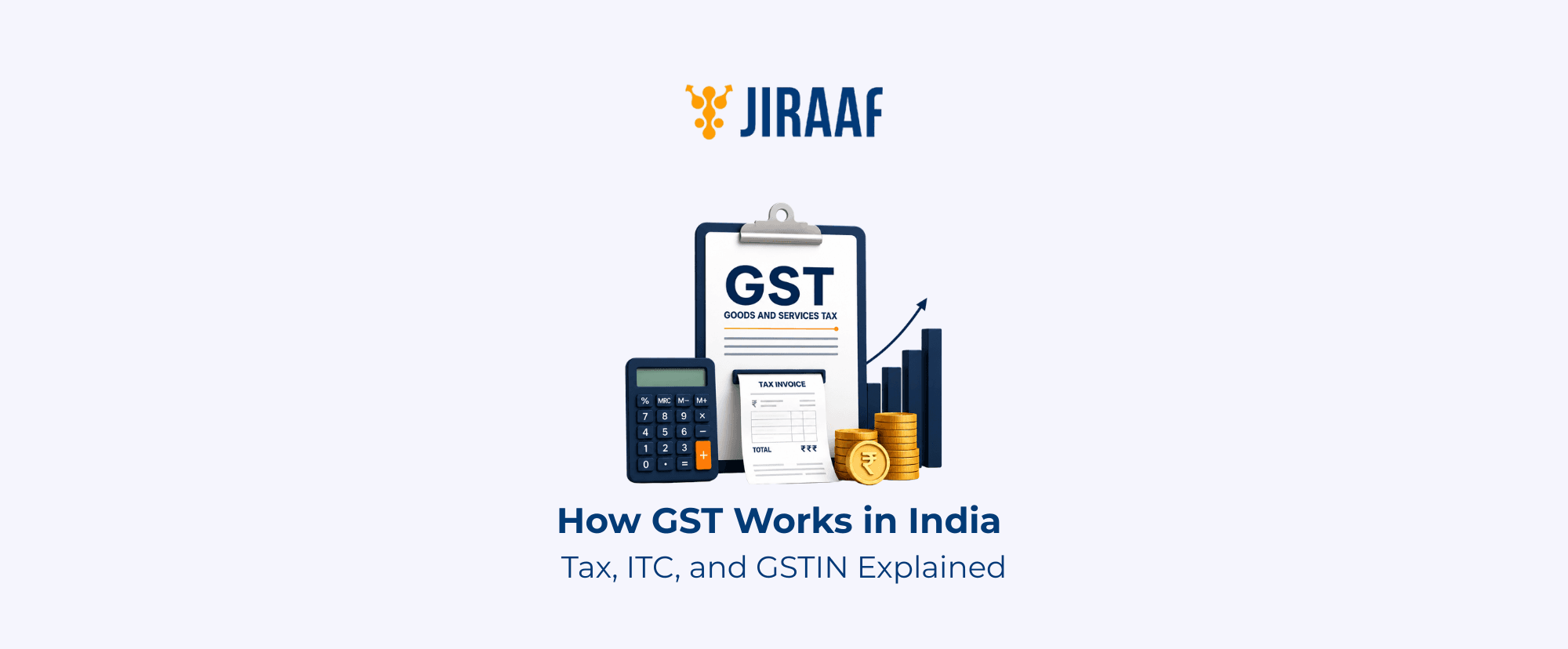
Summary: GST, or Goods and Services Tax, is an indirect, destination-based tax that the government levies on the supply of goods and services in India. This guide explains the GST meaning, key features, how GST works, Input Tax Credit, GSTIN and its main benefits.
Quick Overview
- GST is a destination-based indirect tax on the supply of goods and services in India
- It has replaced several indirect taxes to create a more unified tax framework
- GST applies at different stages of the supply chain, and the system charges tax on value addition
- Input tax credit allows eligible businesses to offset GST paid on purchases against their GST liability
- Registered taxpayers receive a 15-character GSTIN for identification, invoicing, return filing and other GST processes
Almost every bill you pay today includes a GST component. You see it across a wide range of purchases, from groceries, household essentials and medicines to healthcare services, restaurant meals, mobile recharges, electronics and high-value purchases such as cars. While you only see it on the final bill, GST can apply at multiple stages as businesses supply goods or provide services before they reach the final consumer.
That wasn’t always this simple. Before July 2017, the same purchase could attract multiple indirect taxes, such as VAT, service tax, and excise duty, with rules varying across states. GST replaced these taxes with a more unified tax framework that is now a routine part of everyday transactions in India. This guide explains what GST is, how the GST mechanism works, and why it replaced the old tax system.
What is GST?
GST stands for Goods and Services Tax. It’s a single tax on most goods (like electronics and clothes) and most services (like your phone plan or a stay in a hotel) that the government levies. It has two defining characteristics:
- GST is an indirect tax: Generally, you pay GST to the seller when you buy goods or services. The seller collects the tax and remits it to the government on its behalf. This is why GST is classified as an indirect tax. You pay GST when you consume, not when you earn.
- GST is destination-based: GST revenue goes to the state where the goods or services are consumed rather than the state where they are produced. So, if a phone is manufactured in Maharashtra but sold to a customer in Tamil Nadu, the GST revenue is ultimately assigned to Tamil Nadu because that is where the product is consumed.
GST is therefore a destination-based consumption tax that businesses collect on the government’s behalf. Understanding this principle makes it easier to see how the system functions across a country with 28 states and 8 union territories.
Key Features of GST
GST works through a few core mechanisms that define how the system levies, collects, and shares tax.
- GST types: India follows a dual GST model, where both the central and state governments have the authority to levy and collect GST. When you buy goods or services within your own state, GST is split into two parts: Central GST (CGST) and State GST (SGST). If you buy from another state, Integrated GST (IGST) applies. The central government collects IGST and shares the revenue with the destination state. If the purchase takes place in a Union Territory without its own legislature (such as Chandigarh or Lakshadweep), Union Territory GST (UTGST) replaces the SGST component.
- GST slab system: Not all goods and services attract the same GST rate. The government places them into different tax slabs based on their importance, with essential items generally attracting lower or no GST and luxury goods attracting higher rates.
In 2026, certain everyday items, such as fresh vegetables and many unprocessed food grains, remain exempt from GST, meaning you generally do not pay GST on these products. . Most medicines, along with basic clothing and other items of mass consumption, are taxed at 5%, though a specific list of lifesaving drugs is fully exempt. Most services and manufactured goods are taxed at the standard rate of 18%. Luxury and sin goods, such as high-end cars and tobacco, attract higher GST rates.
GST rates vary across goods and services, but the system also determines how tax is collected at different stages of a transaction. For example:
- Multi-stage collection: Businesses collect GST at every stage of a product’s journey, from the manufacturer to the wholesaler to the retailer, and remit it to the government. However, they pay GST only on the value they add at each stage.
- Digital-first administration: The GST Network manages registration, filing, and payment through a single online portal, significantly reducing paperwork and manual processes.
This collection method raises an obvious question: if GST is collected at every stage, why doesn’t the final price keep increasing? The answer lies in how GST taxes only the value added at each stage.
How Does GST Work?
GST is charged on every sale of goods or services. However, businesses can claim Input Tax Credit (ITC) for the GST paid on their purchases, so they ultimately pay tax only on the value they add before selling the product further. Here’s a simple example using a GST rate of 10% (for illustration only):
- The manufacturer sells a shirt to a wholesaler for ₹100 and charges ₹10 GST, remitting ₹10 to the government.
- The wholesaler sells the shirt to a retailer for ₹120 and collects ₹12 GST. After claiming credit for the ₹10 GST already paid on the purchase, the wholesaler remits only ₹2.
- The retailer sells the shirt to you for ₹150 and collects ₹15 GST. Since the retailer already paid ₹12 GST while purchasing the shirt, only the remaining ₹3 is paid to the government.
In total, you pay ₹15 GST, and the government receives exactly ₹15. Of this amount, ₹10 comes from the manufacturer, ₹2 from the wholesaler, and ₹3 from the retailer. Even though three different entities collect tax along the way, the total never exceeds what you actually pay. Each pays tax only on the value it adds, preventing tax from being charged on tax.
This way, GST has replaced a much more complicated tax system that existed before 2017, where each stage of the supply chain added tax to a value that already included taxes charged at an earlier stage.
Why was GST Introduced in India?
Before July 1, 2017, businesses dealt with multiple indirect taxes, including VAT, service tax, excise duty, luxury tax, and more. GST was introduced to address one major issue beneath this complex structure: the cascading effect, or tax on tax.
Let us look at how the price of the same shirt would have changed when tax on tax was applied. For simplicity, assume that central excise duty was 10% and state VAT was 10%.
| Stage | Calculation | Tax Collected | Invoice Price |
| Manufacturer → Wholesaler | Shirt Value = ₹100 | ₹10 Excise | ₹ 121 |
| Excise Duty (10%) = ₹10 | ₹11 VAT | ||
| VAT = 10% of ₹110 | |||
| Wholesaler → Retailer | Wholesaler adds ₹20 profit. | ₹13 VAT | ₹ 143 |
| New Selling Price = ₹130 | (Net paid: ₹2) | ||
| VAT = 10% of ₹130 | |||
| Retailer → Consumer | Retailer adds ₹30 profit. | ₹16 VAT | ₹ 176 |
| New Selling Price = ₹160 | (Net paid: ₹3) | ||
| VAT = 10% of ₹160 |
Look at the first sale. The shirt was worth ₹100, but VAT was charged on ₹110 because the ₹10 excise duty had already been added. So, instead of ₹10 VAT, the manufacturer charged ₹11. That extra ₹1 was effectively tax on tax. The same ₹10 excise component remained embedded in the shirt’s value as it moved through the supply chain.
While businesses could claim eligible credit for VAT paid at the previous stage, they could not use the central excise duty credit to offset state VAT. This break in the credit chain created the cascading effect that GST was introduced to eliminate.
The cascading effect wasn’t the only challenge. The earlier tax system also created barriers to interstate trade. Goods moving across state borders often faced multiple checkpoints and separate tax procedures. GST replaced these with a more unified national tax framework, reducing interstate friction and improving the movement of goods.
GST also made taxation more transparent. Instead of embedding multiple taxes within the product price, it clearly shows GST on the final invoice.
Input Tax Credit (ITC) makes this transparency and price efficiency possible by ensuring GST is levied only on the value added at each stage of the supply chain.
What is Input Tax Credit (ITC)?
ITC is a GST mechanism that allows a registered business to claim credit for the GST it pays on business-related purchases.
When a business purchases inventory from a supplier, it pays GST on that purchase. This payment becomes input tax. Later, when the business sells that inventory, it collects GST from the customer. The GST it collects becomes output tax. Instead of paying the full output tax to the government, the business deducts the input tax it has already paid.
For example, if a business pays ₹10 GST on purchases and later collects ₹15 GST on sales, it remits only the remaining ₹5.
The GST portal’s Invoice Management System (IMS) helps businesses verify invoices before claiming ITC. As a buyer, when your supplier uploads an invoice, it appears in your dashboard. You can review the details, accept the invoice if everything is correct, or flag it if you find a discrepancy. You can claim ITC only on the invoices you accept. This helps you avoid errors and ensures your ITC claim matches the GST your supplier reported collecting and paying on the transaction.
This process encourages businesses to buy from compliant suppliers and helps prevent tax leakage. To claim ITC, every registered business needs a unique GST Identification Number (GSTIN).
What is a GST Number (GSTIN)?
GST assigns every registered business a unique 15-digit identification number called a GSTIN. It has five parts:
- Digits 1-2: State code
- Digits 3-12: 10-digit business PAN
- Digit 13: Entity code (the number of registrations the business has under the same PAN within that state)
- Digit 14: The letter “Z”, which is always the default character
- Digit 15: Checksum digit
GST registration is not mandatory for every business. In general, registration applies when aggregate turnover exceeds ₹40 lakh for businesses exclusively supplying goods and ₹20 lakh for services or mixed supplies. Lower thresholds apply in certain northeastern and hilly states, while some entities, while certain businesses are required to register regardless of turnover, depending on the nature of their activities and the provisions of the GST law.
For you as a consumer, a GSTIN on a bill means the seller is registered, and your tax is actually reaching the government treasury. That same traceability is what makes most of GST’s other benefits possible too.
Benefits of GST
- Reduces cascading of taxes: ITC ensures GST effectively taxes only value addition, which helps keep prices stable
- Creates a more uniform tax system: One common framework replaced multiple indirect taxes across India
- Greater transparency: Your invoice clearly shows the GST you pay, making the tax component easier to understand
- Digital compliance: You complete registration, filing, payments, and refunds all online
- Encourages formalization: Since ITC is available only on eligible transactions involving registered businesses, GST encourages more businesses to obtain a GSTIN
Limitations of GST
- Compliance remains demanding: Many small businesses still find GST rules time-consuming to keep up with
- Digital divide: Small shopkeepers in rural areas may struggle with online requirements like the IMS without a computer or an accountant
- Confusing slabs: Similar products can attract different GST rates; for instance, a box of plain barfi is taxed at 5%, while its chocolate-coated version can attract 18%
- Rigid deadlines: Missing a monthly return can delay tax credits for businesses across the supply chain
Conclusion
GST is no longer just a tax system. It has become the digital backbone of India’s economy. Whether you are a consumer or a business owner, GST gives you a paper trail of trust. For a consumer, it is your guarantee that your money is contributing to national growth. For a small business owner, your GST history is now your greatest asset; it acts as a digital certificate of honesty that makes it easier to get bank loans, find new partners, and grow beyond your local neighborhood.
By knowing how GST works, you are no longer just a passive payer; you are an informed participant in a modern, organized India.