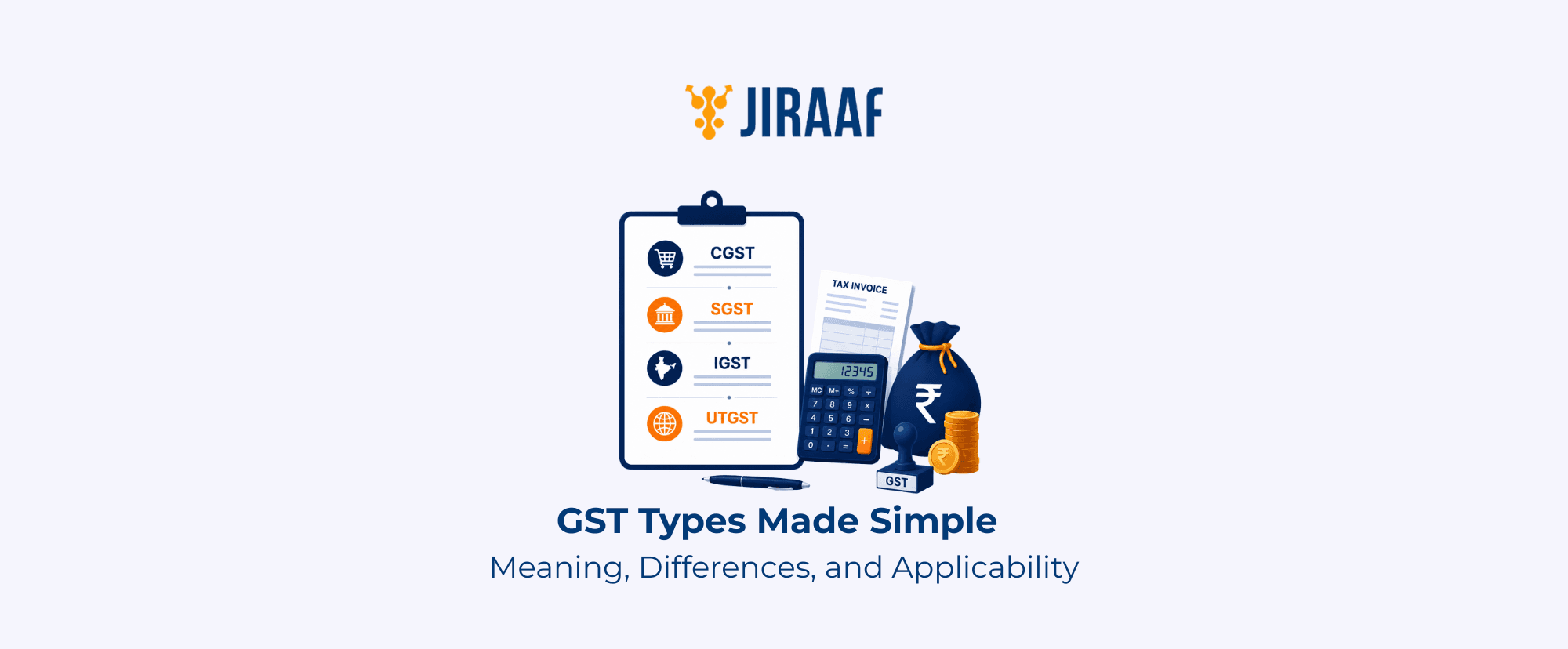
Summary: India has four types of GST: CGST, SGST, IGST and UTGST, which apply based on the nature and location of a supply. This guide explains their full forms, differences, applicability and how to determine which type of GST applies to a transaction.
Quick Overview
- India has four types of GST: CGST, SGST, IGST and UTGST
- Intra-state supplies generally attract CGST and SGST together
- Applicable intra-UT supplies generally attract CGST and UTGST
- Inter-state supplies generally attract IGST instead of CGST and SGST
- Imports are generally subject to IGST under the GST framework
- The supplier’s location and place of supply help determine which GST type applies
Not all GST invoices are structured the same way. Some display CGST and SGST, while others show only IGST. Although the total GST charged may be identical, the tax is divided differently depending on where the supply takes place.
This variance happens because India runs a dual GST structure. Depending on the supplier’s location and the place of supply, the same tax either splits between the center and a state, showing up as CGST plus SGST, or gets collected in one piece as IGST.
Knowing what each component represents makes it easier to determine the correct GST on an invoice.
What are the 4 Types of GST in India?
India has four GST components because the tax is shared differently when a transaction happens within the same state, across different states, or within certain union territories. A sale in Tamil Nadu, sold to a buyer in Tamil Nadu, involves the state government sharing GST revenue with the central government. A sale from Tamil Nadu to Karnataka involves two states plus the center. CGST and SGST cover the first case. IGST covers the second. UTGST covers a third case, supplies within eligible union territories. The sections below break down each one:
Central Goods and Services Tax (CGST)
CGST is the central government’s share of GST on an intra-state supply. For example, consider a business that sells goods worth ₹1,000 within one state, at a 10% GST rate (illustrative number and real GST rates depend on the product or service). The ₹100 GST splits evenly:
- CGST = ₹50
- SGST = ₹50
The Central Goods and Services Tax Act, 2017, sets the rules for CGST.
State Goods and Services Tax (SGST)
When a transaction takes place within the same state, GST is generally split into two components: CGST and SGST. SGST is the state government’s share of that tax. CGST and SGST appear together on an intra-state invoice because they split one tax between two governments. They are not two separate charges stacked on top of each other. For example, 5% CGST plus 5% SGST equals 10% GST total. The customer pays that 10% once.
Integrated Goods and Services Tax (IGST)
That covers a sale within one state. Once the buyer and seller sit in different states, the tax works differently.
IGST applies to inter-state supplies. Both imports and exports count as inter-state supplies under the GST system, governed by the IGST Act, 2017. A sale between two states crosses two tax jurisdictions at once. Splitting the tax into a state share and a central share, the way CGST and SGST do, does not work cleanly when two different states are involved. IGST solves this by putting the full tax under one component.
For example, consider a business in Maharashtra selling to a buyer in Karnataka. The central government collects the IGST on this sale, then splits the revenue with the states under GST rules.
Using the same ₹1,000 sale at a 10% rate, the invoice shows IGST of ₹100. The total tax is still ₹100. Only the tax component changes, from CGST and SGST to IGST.
Because GST is a destination-based tax, the central government later transfers the state portion of the collected IGST to the consuming state, in this case, Karnataka.
Union Territory Goods and Services Tax (UTGST)
That covers two states. A similar question comes up for Union Territories, and the answer is a fourth component.
UTGST plays the same role as SGST, but it applies in Union Territories that fall under the UTGST framework. An intra-union territory supply attracts CGST plus UTGST.
A 10% GST rate on a sale within Chandigarh, for instance, splits into 5% CGST and 5% UTGST.
Not every union territory works this way. Delhi, Puducherry, and Jammu & Kashmir have their own legislatures and their own GST laws, separate from the UTGST framework. Specifically, UTGST applies to Andaman and Nicobar Islands, Lakshadweep, Dadra and Nagar Haveli and Daman and Diu (merged into one UT since 2020), Chandigarh, and Ladakh.
Here’s a quick overview of the different types of GST:
| GST Type | Full Form | Where It Generally Applies | Tax Component |
| CGST | Central goods and services tax | Intra-state supplies | Central component |
| SGST | State goods and services tax | Intra-state supplies in states | State component |
| IGST | Integrated goods and services tax | Inter-state supplies and imports | Integrated tax |
| UTGST | Union territory goods and services tax | Applicable intra-union territory supplies | Union territory component |
Intra-state vs Inter-state GST: Which Tax Applies?
The type of GST that applies depends on where the supply takes place. Intra-state supplies generally attract CGST and SGST; applicable intra-UT supplies attract CGST and UTGST, while inter-state supplies attract IGST. The deciding factor is the place of supply, not the transaction amount or the product itself.
GST follows the destination-based principle, which means tax revenue belongs to the state where goods or services are consumed rather than where they originate. This principle helps determine whether a transaction is treated as intra-state or inter-state and, in turn, whether CGST and SGST, CGST and UTGST, or IGST applies.
The place of supply is the place where the GST law considers a transaction to have happened for taxation. This is not necessarily the same as the customer’s registered address, billing address or delivery address. An invoice can show three different addresses and still have one clear place of supply.
How to Determine Which Type of GST Applies?
To determine exactly which tax applies, you must compare the location of the supplier with the place of supply. If you run a business, knowing the right type of GST to apply while invoicing is crucial:
- Start with the GST registration used to make the supply: Every GST registration is linked to a specific state or union territory. The first two digits of the GSTIN reflect the code of the state to which that registration belongs.
- Apply the relevant place-of-supply rule: The customer’s address is not enough on its own. If goods are being moved, the place where they are delivered is normally important. Services are treated differently, and the rule that applies depends on the type of service. For B2B services, the place of supply is the location of the registered recipient. For B2C services, it is the location of the recipient where the address on record exists; if no address is on record, it defaults to the location of the supplier. For services linked to immovable property (like hotels) or physical performance (like restaurant catering), the place of supply is strictly where the service is physically performed or where the property is located, regardless of where the buyer lives.
- Classify the transaction: Once you know the supplier’s location and the place of supply, classify the transaction:
| Supplier Location and Place of Supply | Transaction Type | Applicable GST Components | Special Inclusions |
| In the same State | Intra-state | CGST + SGST | – |
| In the same Union Territory | Intra-UT | CGST + UTGST | Applies to UTs without a legislature (e.g., Chandigarh, Ladakh) |
| In different States or UTs | Inter-state | IGST | Automatically includes all Imports and Exports |
| Anywhere in India (SEZ) | Inter-state | IGST | Any supply made to or by an SEZ unit or developer |
The taxable value, the rate, and the total tax do not change between these GST invoices. Only the GST component changes, because that depends on whether the supplier’s location and the place of supply match.
Why the Right GST Classification Matters
The total tax can be ₹100 either way. So why does it matter if the invoice shows ₹50 CGST + ₹50 SGST instead of ₹100 IGST? The GST system tracks these tax components separately, even when the total matches.
The correct classification affects the way the supplier reports the transaction and will also impact the Input Tax Credit (ITC). ITC allows eligible registered businesses to reduce the GST payable on sales by claiming credit for GST paid on eligible purchases, subject to GST rules. CGST credit can never be used to pay SGST, and SGST credit can never be used to pay CGST. Misclassifying GST components can lock up your credit and hurt your cash flow.
If you accidentally collect CGST + SGST instead of IGST (or vice versa), you cannot simply adjust the entries. Under Section 77 of the CGST Act and Section 19 of the IGST Act, you must pay the correct tax component to the government and file a separate refund claim for the wrongly paid tax.
Common Mistakes When Applying Different Types of GST
A GST mismatch typically happens when someone reports a transaction under the wrong component. For instance, an inter-state sale wrongly booked as intra-state or vice-versa will impact invoicing, GST reporting and ITC claims, even if the tax amount itself was never wrong. The GST portal does not allow you to adjust or offset a wrong component against the correct one on your monthly GSTR-3B return; you must pay the correct component entirely afresh.
- Charging CGST + SGST when IGST applies: This happens when an inter-state sale gets classified as intra-state. The rate can be correct, but the components are still wrong.
- Charging IGST on an intra-state supply: The same mistake runs the other way too. If the supplier and the place of supply are both in the same state, IGST is the wrong charge, and CGST + SGST should apply instead.
- Getting the place of supply wrong: The address that appears most clearly on an invoice is not always the place of supply. Services are where this confuses people the most, since specific categories carry their own place-of-supply rules.
- Relying only on the customer’s address or GSTIN: A GSTIN’s first two digits do show the state or union territory of that registration, so it looks like a shortcut. A buyer’s address can say Punjab while the supplier and the place of supply are both in Rajasthan, and the sale still counts as intra-state. Compare the supplier’s location with the place of supply. Not the buyer’s address.
- Treating every union territory the same: An address in a union territory does not automatically mean CGST + UTGST. Delhi, Puducherry, and Jammu & Kashmir run their own GST legislation. UTGST doesn’t apply in those UTs.
Conclusion
GST rates may remain the same, but the type of GST on an invoice can change whenever the nature of a transaction changes. Whether you’re buying or selling across states, supplying goods within a union territory, or expanding into a new market can all affect which GST component applies.
The right GST classification starts with correctly identifying the supplier’s location and the place of supply. Once those are determined accurately, applying CGST, SGST, IGST, or UTGST becomes much simpler. As businesses handle transactions across more locations and sales channels, understanding these distinctions can make invoicing, GST reporting, and ITC claims easier to manage.