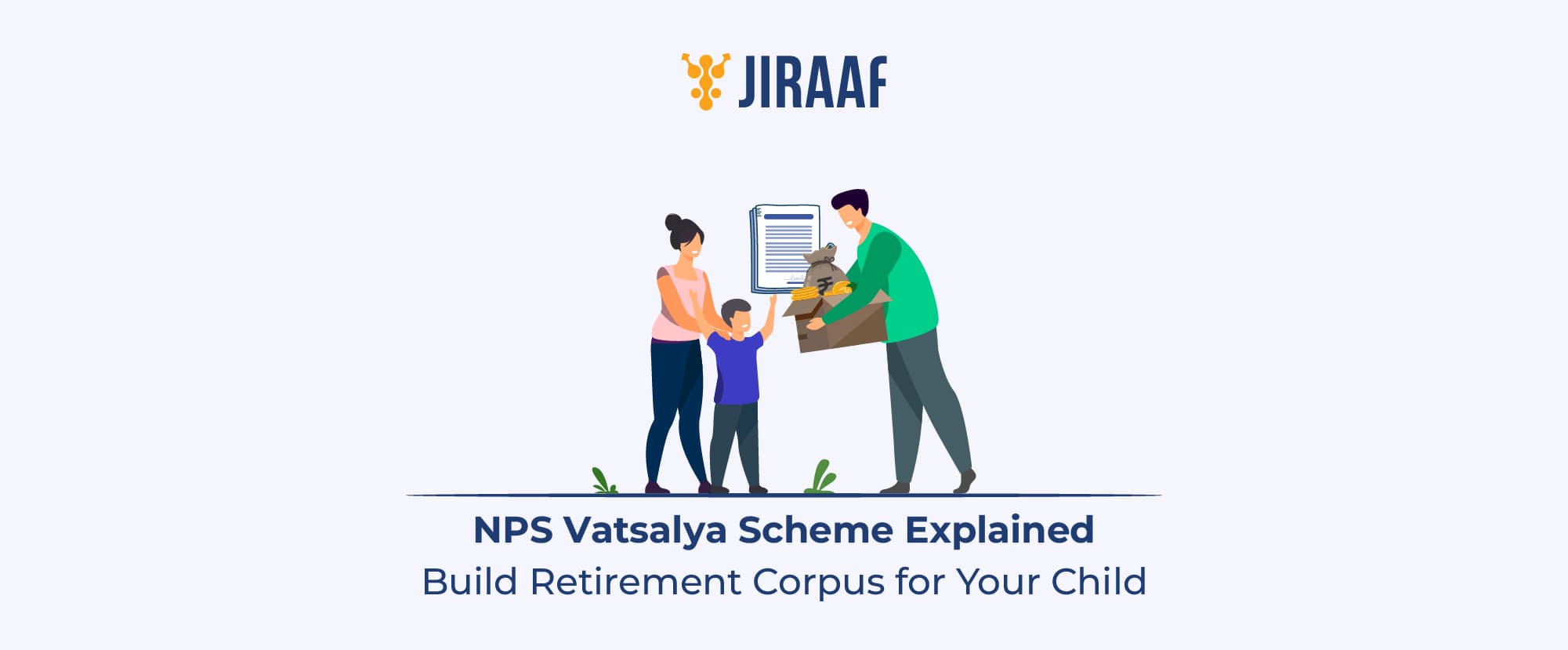
The NPS Vatsalya Scheme is a government-regulated pension plan for minors that allows parents or guardians to start building a long-term retirement corpus early. This guide covers how the scheme works, its key features, tax benefits, and the online application process
Every parent wants to build a secure financial future for their child. And the key to setting aside a corpus for your child lies in starting early. Whether you are building a fund for your child’s education, marriage or even retirement planning, structured investment schemes become your primary bet.
The NPS Vatsalya Scheme offers parents and guardians a way to begin retirement planning for their children from a young age. It offers market-linked growth, disciplined investing, and tax benefits under a single framework.
This blog explains what the NPS Vatsalya Scheme is, how it works, its key features, investment options, eligibility requirements, tax benefits, and the process to apply online.
What Is NPS Vatsalya Scheme?
The NPS Vatsalya Scheme is a subset of the National Pension Scheme (NPS). It falls under the regulation of the Pension Fund Regulatory and Development Authority (PFRDA). The government announced this scheme in the Union Budget 2024-25, and it officially got implemented on 18th September 2024.
NPS Vatsalya Scheme allows parents or legal guardians to plan for their child’s future expenses and retirement from early on. Unlike other retirement schemes, NPS Vatsalya Scheme offer multiple investment options and offers up to 9.5% to 10% returns. However, it should be noted that the returns may fluctuate as they depend on market performance.
Only parents or guardians can contribute to the account, while the child remains the sole beneficiary throughout the tenure. When the child turns 18, they must update the account with fresh KYC details. From the age of 18 up to 21, the guardian can either convert the account into an NPS Tier I account under the All-Citizen Model or choose to exit the scheme. In case of an exit, the guardian can withdraw up to 80% of the corpus as a lump sum, while the remaining 20% goes into an annuity plan. If the total corpus stands at ₹8 lakh or below, the rules allow a full 100% lump-sum withdrawal.
Parents or guardians can start investing with a minimum contribution of ₹250 per year, and the scheme does not impose any upper limit on contributions. After completing three years from the date of account opening, the guardian can also make partial withdrawals of up to 25% of their contributions under specific conditions such as education, medical expenses, or notified disabilities. The scheme permits two such withdrawals before the child turns 18 and two between the ages of 18 and 21, subject to prescribed conditions.
Let’s look at the key features that make it different from other child savings and government-backed investment schemes.
Key Features of the NPS Vatsalya Scheme
Following are the key features of the NPS Vatsalya Scheme.
- Designed only for minors
NPS Vatsalya is a pension plan made specifically for children under 18, where parents or legal guardians open and operate the account on their behalf. The minor remains the sole beneficiary from day one.
- Unique PRAN for the minor
For every NPS Vatsalya account, the Central Recordkeeping Agency issues a unique Permanent Retirement Account Number (PRAN) in the name of the minor child. This PRAN acts as the child’s lifelong unique pension identifier under the National Pension System.
- Allows flexible contributions
You can start with just ₹250 per year and add more with no upper cap. This makes it easy for families of all income levels to invest steadily over time.
- Promotes market-linked growth
Unlike fixed-rate child savings plans, funds in NPS Vatsalya are invested across equity, corporate bonds, and government securities, giving the potential for higher long–term growth.
- Partial withdrawals for life goals
While the corpus is meant for long-term retirement savings, the scheme allows limited partial withdrawals for education, emergencies, or other critical needs before the child turns 18.
One of the most important features of NPS Vatsalya is the flexibility it offers in how the money is invested. To understand this better, it is important to look at the investment choices available under the scheme.
Investment Choices Available Under NPS Vatsalya Scheme
NPS Vatsalya offers multiple investment options, allowing parents or guardians to align the child’s retirement savings with their risk appetite and long-term goals.
Default Investment Option
If no choice is made at the time of registration, the account automatically invests under the Moderate Life Cycle Fund (LC-50).
This option allocates up to 50% of the corpus to equity, while the rest goes into relatively stable debt instruments. It suits guardians who want balanced growth without frequent monitoring.
Auto Choice: Lifecycle Funds
Under Auto Choice, the guardian selects a lifecycle strategy, and the system manages asset allocation based on the chosen risk level.
Available lifecycle funds include:
- Aggressive Lifecycle Fund (LC-75)
Invests up to 75% in equity. Suitable for those comfortable with higher market volatility in exchange for long-term growth.
- Moderate Lifecycle Fund (LC-50)
Maintains equity exposure of up to 50%. It balances growth potential with stability.
- Conservative Lifecycle Fund (LC-25)
Limits equity exposure to 25%. Ideal for guardians with a lower risk tolerance.
Once selected, the fund automatically adjusts allocations over time, reducing the need for active intervention.
Active Choice: Custom Asset Allocation
Active Choice gives the guardian complete control over how contributions are invested. You can decide the allocation across different asset classes, within prescribed limits:
- Equity: up to 75%
- Corporate debt: up to 100%
- Government securities: up to 100%
- Alternate assets: up to 5%
This option suits financially aware guardians who want to actively manage risk and returns.
Once you are clear about how investments work under NPS Vatsalya, the next step is to understand who can open an account and what documents are required to get started.
Eligibility Criteria and Documents Required for NPS Vatsalya Scheme
Before opening an NPS Vatsalya account, you should know who can invest in this scheme and what paperwork is required.
Who Is Eligible for NPS Vatsalya?
Here’s who qualifies under the scheme:
- Indian citizens under 18 years are eligible to enrol
- NRI and OCI minors can also join the scheme, subject to applicable banking and KYC requirements
- A parent or legal guardian must open and manage the account until the child turns 18
- The child remains the sole beneficiary of the account at all times
- The parent or guardian is listed as the nominee for operational and legal purposes
Documents Required to Open an NPS Vatsalya Account
You will need the following documents at the time of opening an NPS Vatsalya Account:
For the guardian
- Valid KYC document such as Aadhaar, passport, voter ID, driving license, or other government-approved ID
- PAN card
- Signature (scanned copy)
- Passport and foreign address proof, if the guardian is an NRI or OCI
For the minor
- Proof of date of birth, such as a birth certificate, school leaving certificate, passport, PAN, or matriculation certificate
Banking and payment details
- Bank account details for withdrawals or exit before age 18
- NRE or NRO account details in case of NRI or OCI subscribers
- Cancelled cheque or bank passbook copy
- Active UPI or internet banking for making contributions
All scanned documents must fall within the prescribed file size limits to ensure smooth submission.
With eligibility confirmed and documents ready, it is equally important to understand the tax benefits that make NPS Vatsalya an attractive long-term investment for parents.
Taxation of NPS Vatsalya Scheme
NPS Vatsalya also offers meaningful tax advantages for parents who invest for their child’s future.
Contributions made to an NPS Vatsalya account qualify for tax deductions under Section 80CCD(1B) of the Income Tax Act, 1961. This allows parents to claim an additional deduction of up to ₹50,000, over and above the ₹1.5 lakh limit under Section 80C (under the old tax regime).
Once parents factor in the tax savings, the focus naturally shifts to execution. This means knowing how to open an NPS Vatsalya account online and complete the process correctly.
How to Apply Online for NPS Vatsalya Scheme
Opening an NPS Vatsalya account online is simple and fully digital. A parent or legal guardian has to complete the process on behalf of the minor through the official eNPS platform.
Step 1: Visit the eNPS portal
Go to the official eNPS website and scroll down to the section for NPS Vatsalya (minors).
Step 2: Start registration
Click on “Register Now” under the NPS Vatsalya option to begin the application.
Step 3: Enter guardian details
Fill in the guardian’s date of birth, PAN, mobile number, and email ID. These details are used for identity verification and future communication.
Step 4: Verify using OTP
An OTP is sent to both the registered mobile number and email address. Enter the OTP to proceed.
Step 5: Note the acknowledgement number
After OTP verification, the system generates an acknowledgement number. This confirms that registration has started. Click “Continue” to move ahead.
Step 6: Provide minor and guardian information
Enter complete details of the minor and the guardian. Upload all required documents in the prescribed format and review the information carefully before confirming.
Step 7: Make the initial contribution
Pay the minimum initial contribution of ₹250 to activate the account.
Step 8: Complete authentication
Finish the process through dual OTP verification or e-Sign, as prompted on the screen.
Step 9: PRAN generation
Once authentication is complete, a Permanent Retirement Account Number (PRAN) is generated, and the NPS Vatsalya account is officially opened in the minor’s name.
This step-by-step process ensures that parents and guardians can complete the application efficiently without needing offline assistance.
Conclusion: Who Should Invest in the NPS Vatsalya Scheme?
NPS Vatsalya is best viewed not as a child savings product, but as a time-allocation decision. This scheme makes the most sense for parents who already manage their own finances with discipline and understand the value of staying invested across market cycles. It suits those who are comfortable separating short-term goals, like education or milestones, from long-term outcomes such as retirement.