This blog breaks down what India’s middle-class expects from Budget 2026; covering income tax relief, GST 2.0, housing affordability, job creation, wage growth, and healthcare spending, and how these measures could ease household finances and long-term financial stress.
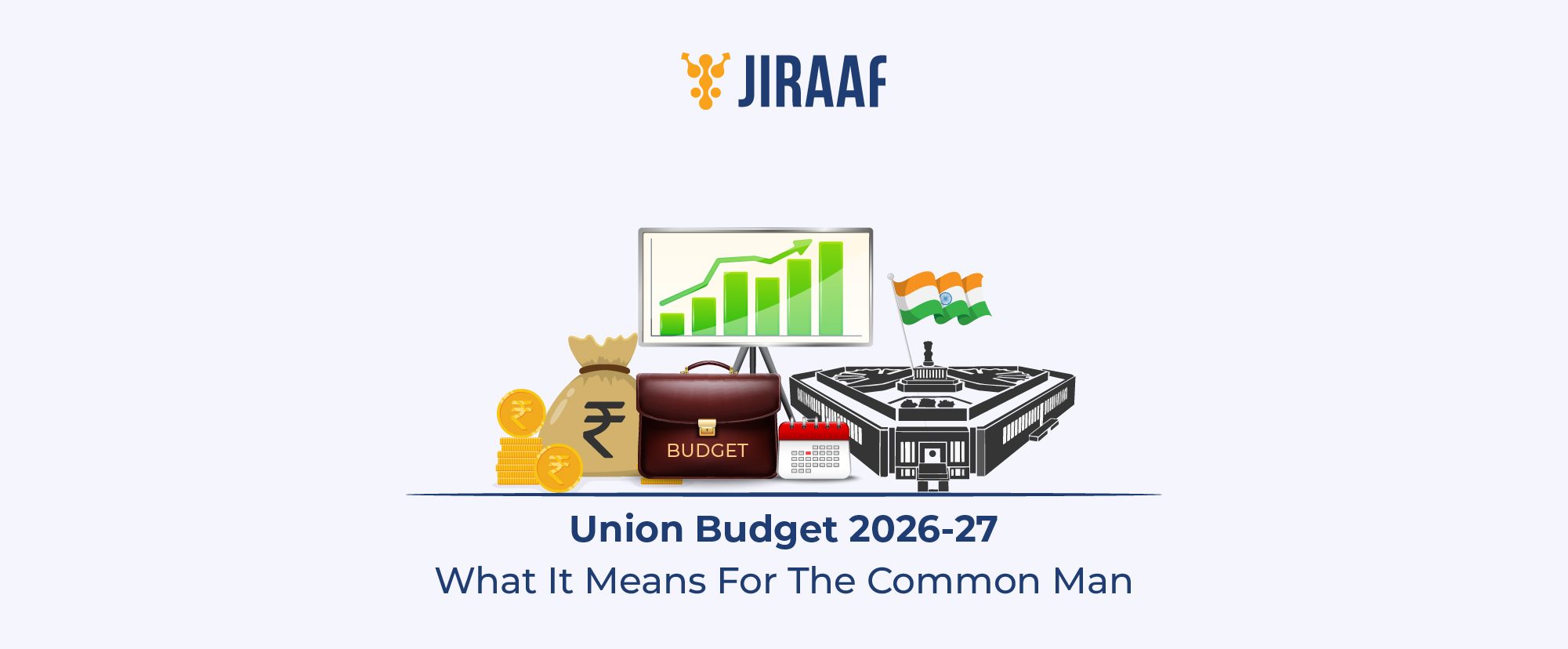
The Budget Session is set to commence on 28 January 2026, with Finance Minister Nirmala Sitharaman scheduled to present India’s 88th Union Budget on 1st February, a Sunday. This Budget arrives at a sensitive juncture for the economy, marked by weak market sentiment, persistent global uncertainty, and tariff-related pressures. However, for most households, the Union Budget will be ultimately assessed on one simple question: does it put more money into their pockets or take it away?
Seen from this perspective, the upcoming Budget places the spotlight squarely on its impact on individual taxpayers, homebuyers, workers, and families. This article examines what the common man wants from the Union Budget 2026.
Taxation Relief: What is The Middle-class is Hoping For?
Taxation remains the most immediate touch point for India’s millions of middle-class households.
Direct Tax
- Income tax slabs
Since the last two budgets have introduced major changes in income tax slabs under the new tax regime, expectations for any major changes in this budget appear more muted. Additionally, experts believe that the old tax regime may be phased out over time since 75% of taxpayers have already shifted to the new tax regime.
- Higher standard deduction
Rising living costs and higher disposable income brings the standard deduction back into focus. Tax experts believe a modest revision in the standard deduction, from ₹75,000 to ₹1 lakh. Such a move will provide relief to the pockets of salaried individuals by increasing their take-home pay.
- Relief on LTCG, STCG and STT
For both retail and foreign investors, recent increases in investment taxation continue to remain a closely watched fault line. Some experts have once again argued that the Securities Transaction Tax (STT) on cash equities adds unnecessary friction and merits reconsideration by the finance minister. At the same time, while discussions around rationalizing long-term and short-term capital gains taxes persist, expectations of any meaningful revision on LTCG or STCG remain relatively muted in this Budget.
- Interest income benefit for senior citizens
Senior citizens are another group for whom targeted tax relief is in continuous discussion. One key expectation is a possible increase in the deduction limit under Section 80TTB, from the current ₹50,000 to ₹1 lakh. This provision, last revised several years ago, has not kept pace with inflation or rising interest income from fixed deposits.
Indirect Tax
- GST 2.0 in focus again
With GST 2.0 already rolled out in FY 2025-26, the spotlight for this budget may shift from rate cuts to execution and simplification. Experts expect policymakers to focus on smoothing GST 2.0 implementation, easing compliance, and improving refund and input tax credit flows so businesses and consumers feel the benefit more directly. There is also talk of continued fine-tuning of rate structures to make everyday goods more affordable and reduce administrative friction.
Sectors likely to benefit from GST 2.0 rate rationalisation include:
- Food processing and dairy
- Construction and real estate
- Consumer goods and retail
- Automobiles and transport
- Textiles and apparel
- Agriculture equipment
- Healthcare and everyday medicines
- Hospitality and tourism
Housing & Home Loans: Will Buying a Home Get Easier?
For the middle-class, owning a house is getting difficult year by year. Property prices across nation have risen sharply over the last decade, with housing indices showing a 45% to 50% increase since 2017. At the same time, the disposable income of the common man has failed to catch up with the rise of the real estate market. As a result, first-time home buyers are finding housing affordability stretched.
Experts believe this budget could play a pivotal role in housing sector. One key expectation is a reset of the affordable housing definition, which has not been revised since 2017. Expanding the price cap to around ₹75 lakh, with higher permissible loan sizes of ₹60 to 70 lakh, could better reflect today’s market realities.
On the financing side, higher tax relief on home loan interest remains a key demand. For instance, increasing the Section 24(b) interest deduction limit from ₹2 lakh to ₹5 lakh would allow a larger portion of interest outgo to be set off against taxable income. To put simply, for a typical first-time buyer with a ₹36 to ₹40 lakh home loan at 8% to 9% interest, this could translate into tax savings that effectively reduce the EMI burden by ₹2,000 to ₹4,000 per month, depending on the borrower’s tax slab.
In addition, a revival of interest subvention of around 2%, even for the initial years of the loan, could further lower EMIs by ₹1,500 to ₹3,000 per month.
Employment Support and Wage Growth: What to Expect?
As India charts its long-term vision toward Viksit Bharat 2047, its young workforce sits at the centre of both opportunity and challenge. An estimated 84 million workers are expected to enter the job market over the next decade. This demographic dividend can become a powerful engine of growth, but only if policy turns potential into productive jobs.
Ahead of Budget 2026, experts believe policymakers will lean into this reality. The focus is likely to be on measures that support employment generation, expand skilling initiatives, and improve wage prospects for a growing workforce.
Much of the focus is expected to revolve around the newly notified labor codes, which is expected to add 7.7 million new jobs in the coming years. These codes aim to simplify hiring, wages, and social security under a single framework. If implemented smoothly, these reforms could encourage businesses to formalize hiring, expand payrolls, and improve wage transparency over time. The Budget may also push harder on skilling, apprenticeships, and industry-linked training to address the gap between education and employability.
Healthcare Spending: Can the Budget Ease Medical Expenses for Families?
Government health spending has been steadily rising. In FY2025-26, the Ministry of Health and Family Welfare’s allocation was close to ₹99,859 crore, an 11% increase from the previous year, but it still falls short of global averages and the National Health Policy’s recommended 2.5% of GDP benchmark
Many healthcare organizations are urging the government to raise health expenditure beyond 2.5% of GDP to build stronger infrastructure, expand preventive care, and manage the rising burden of non-communicable diseases (NCDs).
Experts suggest dedicated funding (e.g., ₹250–300 crore annually) under the National Health Mission for AI/ML-driven health solutions, cybersecurity, and antimicrobial resistance initiatives to modernize care delivery and ease medical expenses for middle-class households.
Final Thoughts
For the middle-class, the true test of Budget 2026 lies far away from fiscal math and policy jargon. The impact of this budget will be felt in moments when a common man’s discretionary income rises or purchasing a house feels less intimidating.
In the end, the success of Budget 2026 will rest on whether it brings stability to household finances, allowing the middle-class to plan with confidence rather than adjust to constant uncertainty.