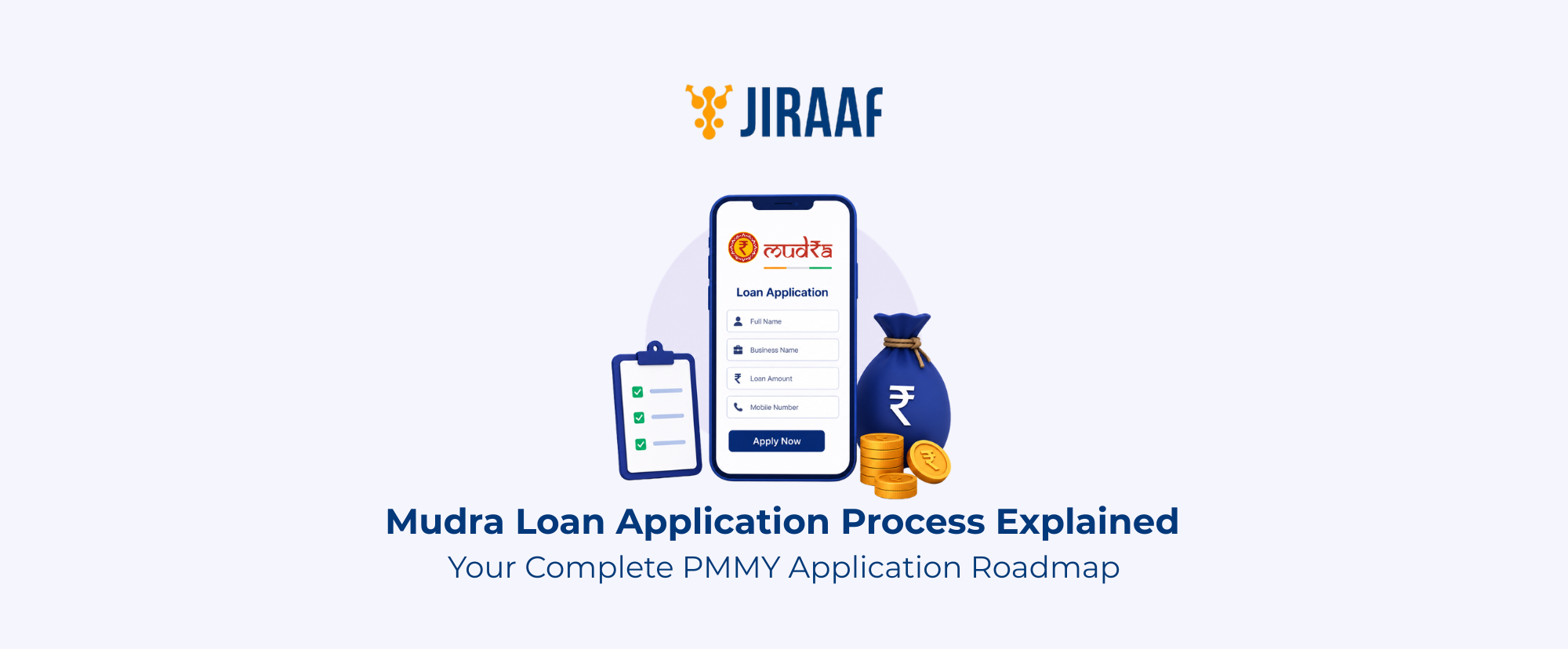
Summary: A Mudra loan under the Pradhan Mantri Mudra Yojana (PMMY) helps eligible micro and small businesses access collateral-free business funding. This guide explains how to apply for a Mudra loan, eligibility, required documents, and the approval process.
Quick Overview
- Mudra loans provide collateral-free funding for eligible micro and small businesses
- The PMMY category should match your funding requirement
- Identity, business, and financial documents are typically required during the application process
- Applications can be submitted through participating banks, NBFCs, MFIs, or official portals such as JanSamarth and UdyamiMitra
- Loan approval depends on business viability, repayment capacity, and document verification
- Mudra loans are processed through authorized lenders, and guaranteed approvals or upfront payment requests are not part of the official application process
Every business starts with an idea, but turning that idea into reality requires access to capital. For many small business owners and first-time entrepreneurs, securing funding can be difficult, especially without a long credit history or collateral.
The Pradhan Mantri Mudra Yojana helps bridge this gap by providing eligible micro and small businesses access to collateral-free loans through authorized banks, NBFCs, and other lending institutions.
This guide explains who is eligible, the documents you’ll need, how to apply for a Mudra loan, and how understanding the application process can improve your chances of approval.
What is the Pradhan Mantri Mudra Yojana (PMMY)?
The Pradhan Mantri Mudra Yojana (PMMY) is a Government of India scheme launched in 2015. It aims to improve access to business finance for non-corporate, non-farm micro enterprises. The scheme helps entrepreneurs start, run, or expand their businesses by providing collateral-free loans through authorized financial institutions.
Many people confuse PMMY and MUDRA, but they are different. PMMY is the government loan scheme. Micro Units Development and Refinance Agency Ltd. (MUDRA) is the institution that supports the scheme by refinancing eligible loans.
It does not lend money directly to borrowers. Instead, Mudra loans are offered by banks, Regional Rural Banks (RRBs), Small Finance Banks, cooperative banks, NBFCs, and Micro Finance Institutions (MFIs).
You can apply for a Mudra loan if your business falls under manufacturing, trading, services, or allied agricultural activities. This includes businesses such as food processing, dairy, poultry, fisheries, and similar income-generating activities.
You can use the loan as working capital to manage daily expenses, like inventory and salaries, or as a term loan to buy machinery, equipment, or expand your business.
One of the biggest advantages of PMMY is that eligible Mudra loans are generally collateral-free. The scheme is also supported by a credit guarantee mechanism, which reduces the lending risk for participating financial institutions and encourages them to lend to small businesses.
PMMY offers four loan categories based on your funding requirement:
| Category | Loan Amount | Suitable For | Typical Use |
| Shishu | Up to ₹50,000 | New businesses | Initial setup, inventory, working capital |
| Kishore | Above ₹50,000 to ₹5 lakh | Growing businesses | Expansion, equipment, additional stock |
| Tarun | Above ₹5 lakh to ₹10 lakh | Established businesses | Capacity expansion, machinery |
| Tarun Plus | Above ₹10 lakh to ₹20 lakh | Borrowers who have successfully repaid a previous Tarun loan | Business expansion and scaling |
If you need funds to start or grow your business, PMMY can be a useful financing option. It supports businesses at different stages and makes formal credit more accessible.
Who is Eligible for a Mudra Loan?
You can apply for a Mudra loan if you are an Indian citizen and run or plan to start a non-corporate, non-farm micro enterprise. Your business should be engaged in a legitimate income-generating activity and meet the lender’s eligibility requirements.
The scheme is open to a wide range of borrowers, including:
- Sole proprietors
- Partnership firms
- Small manufacturers
- Traders and retailers
- Service providers
- Artisans and craftsmen
- Food processing units
- Transport operators
- Self-employed professionals
- Women entrepreneurs
- Startups
- Businesses involved in allied agricultural activities, such as dairy, poultry, fisheries, and beekeeping
To improve your chances of approval, you should have a viable business plan and the required documents. While there is no fixed minimum income requirement under PMMY, the lending institution may also evaluate your repayment capacity, business viability, and credit history before approving the loan.
Common Mudra Loan Myths
| Myth | Fact |
| Mudra loans are only for new businesses | Existing MSMEs can also apply to expand eligible businesses |
| GST registration is mandatory | It isn’t required for every applicant, though some lenders may ask for it depending on the loan amount or business |
| A perfect CIBIL score is required | PMMY doesn’t prescribe a minimum CIBIL score, though lenders may review your credit history |
| Government employees cannot apply | They may be eligible if the loan is for a qualifying business activity and the lender’s criteria are met |
Documents Required for a Mudra Loan
The documents required may differ depending on the lender, loan amount, and type of business. However, most applicants are generally asked to provide the following:
| Document Type | Examples |
| Identity Proof | Aadhaar Card, PAN Card, passport-size photographs |
| Address Proof | Residential proof or other valid address documents |
| Business Documents | Business registration certificate, Udyam Registration, Shop and Establishment Licence, GST registration (if applicable) |
| Financial Records | Bank statements, income details, existing loan information, sales records |
| Business Proposal Documents | Business plan, project report, quotations for machinery or equipment |
Small loan applications may require fewer documents, while larger loan requests may involve additional financial details. Before submitting the application, you may check the lender’s specific document requirements.
How to Apply for a Mudra Loan
Applying for a Mudra loan is a simple process. It involves a few important steps. Knowing the process in advance can help you submit a complete application and avoid unnecessary delays.
Step 1: Assess Your Business Requirement
Identify why you need the loan and estimate how much funding your business requires.
Common purposes include:
- Buying inventory
- Purchasing equipment
- Meeting working capital needs
- Expanding your business
Step 2: Select the Right PMMY Category
Choose the loan category based on your business stage and funding requirement.
- Shishu: For new businesses and smaller funding needs
- Kishore: For growing businesses that need higher funding
- Tarun: For established businesses seeking larger loans
- Tarun Plus: For eligible borrowers who have successfully repaid a previous Tarun loan
Step 3: Choose a Lender
Compare participating banks, NBFCs, and Micro Finance Institutions (MFIs).
Check the following before applying:
- Interest rates
- Repayment terms
- Application process
- Customer service
MUDRA loans are sanctioned only through participating lenders and official PMMY portals. The scheme does not appoint agents or middlemen, and guarantees of loan approval or requests for upfront payments do not form part of the official application process. PMMY also operates toll-free helplines (18001801111 and 1800110001) for applicant support.
Step 4: Submit Your Application
Fill out the Mudra loan application form with your business and personal details and attach the required documents. Online applications can be submitted through your lender’s website or official portals such as JanSamarth and Udyamimitra, where the form can be completed digitally or downloaded as a PDF. Offline applications are submitted at participating lender branches using the same information and supporting documents.
Step 5: Application Review and Approval
Once submitted, your application moves into the lender’s review process, covering document verification, business assessment, and credit checks, all covered in detail in the next section.
What Happens After You Submit Your Application?
Submitting your application is only the first step. After the lender receives it, the application goes through several stages before a lending decision is made.
1. Initial document review: The lender first checks your application for completeness. They verify that all the required documents have been submitted and that the information provided is accurate and consistent.
2. Verification and assessment: Next, the lender verifies your identity and business details, reviews your financial information, and may assess your existing loan obligations, repayment capacity, and credit history, if applicable.
3. Business feasibility review: The lender then evaluates your business proposal, checking whether your business can generate enough income to repay the loan. Depending on the loan amount, they may also review your business plan, project report, or equipment quotations submitted with the application.
4. Loan approval: If your application meets the lender’s requirements, it moves to the approval stage. You will receive a Mudra loan approval letter outlining the sanctioned loan amount, interest rate, repayment tenure, and other applicable terms and conditions before you accept the loan offer.
5. Loan agreement and disbursement: After you accept the loan offer, you sign the loan agreement. Once the required formalities are complete, the lender disburses the approved loan amount to your bank account or working capital facility, depending on the type of loan.
Common Reasons for Delay
Your application may take longer to process if:
- Required documents are missing
- The application form is incomplete
- The information provided does not match the supporting documents
- The lender requests additional documents or clarification
Submitting complete and accurate information can help speed up the process.
Common Reasons for Rejection
Not every application is approved. Some common reasons for rejection include:
- Your business activity is not eligible under the PMMY scheme
- The lender finds your repayment capacity insufficient
- The required documents are incomplete or inadequate
- Your business proposal is not considered financially viable
If your application is rejected, the lender may provide the reason. Their feedback can help identify the gaps before a future application.
Conclusion
A Mudra loan can be more than just a source of business funding. It can also be the starting point for building a stronger financial track record. Responsible borrowing, timely repayments, and steady business growth can strengthen your credit profile and improve access to larger financing options as your business grows.
As government-backed lending platforms become more integrated and application processes continue to digitize, accessing formal business credit in India is likely to become faster and more transparent. Understanding the scheme, maintaining organized financial records, and choosing the right lender can also make the application process smoother when funding opportunities arise.