Summary: The Digital Rupee (e₹) is India’s central bank digital currency issued directly by the Reserve Bank of India. This guide explains how e₹ works, where you can use it, how it differs from UPI and crypto, and the key rules that apply.
Quick Overview
- The Digital Rupee is India’s RBI-issued central bank digital currency
- e₹ is held in a dedicated wallet and can be loaded from a linked bank account
- You can use e₹ for person-to-person transfers and merchant payments, including supported UPI QR codes
- e₹ represents the digital form of money itself, unlike UPI, which sends a payment instruction from your bank account
- e₹ is different from cryptocurrency because it remains equal to one Indian rupee and is issued by the RBI
Scanning a QR code at a tea stall or sending money instantly via Google Pay or PhonePe has become second nature for most Indians. So when you hear about the RBI’s Digital Rupee (e₹), it is natural to ask: “If my digital payments already work perfectly, why do I need this new type of digitally transacted currency? What is this? Where does this money live? Is it like crypto, and why should I care?”
e₹ is a digital form of the Indian rupee, issued by the Reserve Bank of India (RBI). Let’s see what it is, how it works, and why it even exists, further in the blog This guide explains what the Digital Rupee is, how it works, and how you can start using it.
What is India’s Digital Rupee (e₹)?
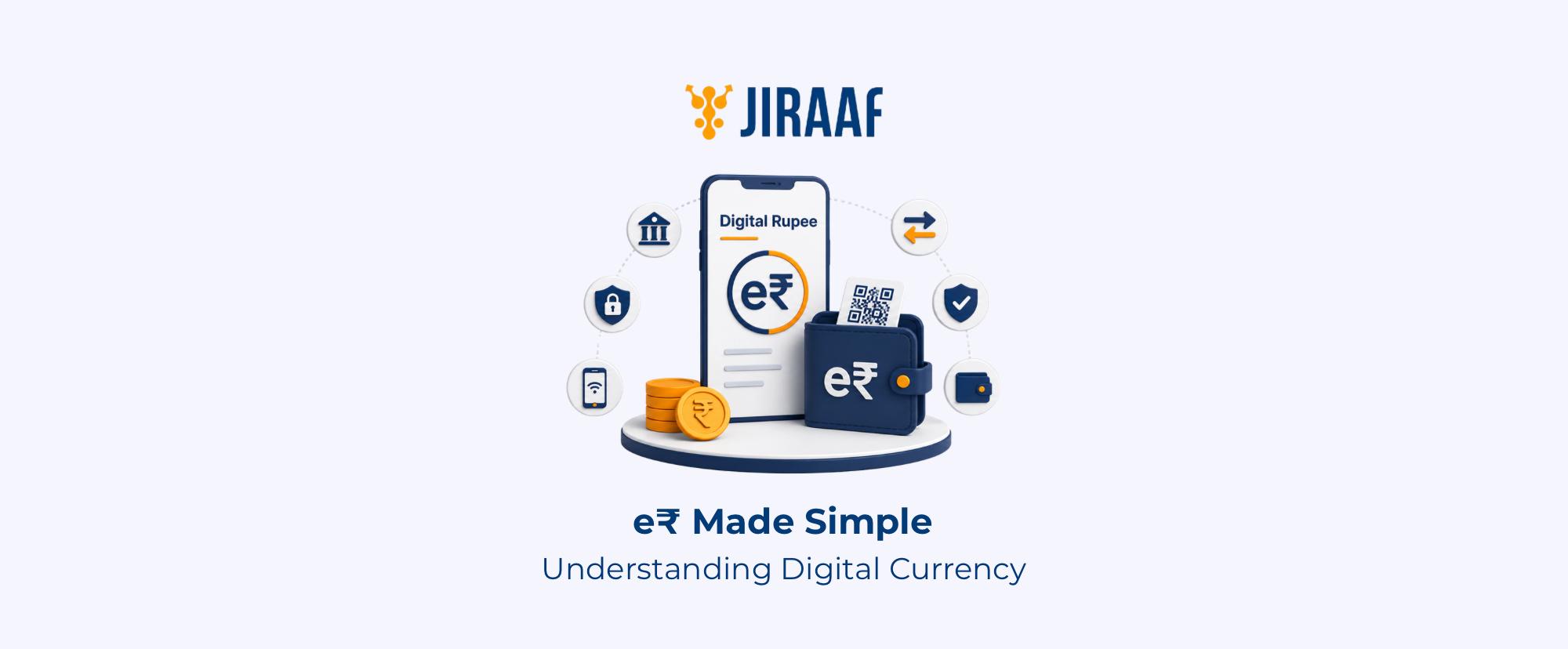
The Digital Rupee, or e₹, is India’s official Central Bank Digital Currency (CBDC), issued directly by the Reserve Bank of India (RBI) rather than any commercial bank. It’s designed to work much like cash, just in digital form.
Under Section 26 of the RBI Act, 1934 (inserted via the Finance Act, 2022 to explicitly define bank notes in digital form), every e₹ token is legal tender across the country and carries the Central Government’s guarantee. An e₹ token is the money itself, in digital form. You can hold, spend, or transfer e₹ much like a currency note, without a bank account coming between you and the money.
Unique Features of Digital Rupee in India
e₹ isn’t just a digital copy of cash. It doesn’t require you to link a debit or credit card. Its key features include:
- Automatic change: If you owe ₹15 and only hold a ₹20 token, the app deducts exactly ₹15 for the merchant and returns the remaining ₹5 to your wallet on its own. The Digital Rupee also supports payments to two decimal places, so fractional amounts settle to the exact value rather than rounding up or down.
- Zero fees and no damage risk: There are no charges for using e₹ or maintaining an e₹ wallet, and unlike a torn or faded note, an e₹ token can’t tear, fade, or be counterfeited.
- Programmability: A sponsoring entity, a government body, or an employer can restrict how a recipient spends a batch of e₹ tokens. An employer could issue tokens that only work at fuel stations or medical clinics, with parameters like merchant category or expiry date built into the token itself.
- Offline capability: Aimed at areas with patchy or no internet, pilots are currently testing both telecom-based and Near Field Communication (NFC) methods to let wallet transactions go through even when a network signal isn’t available.
RBI is still exploring the programmability and offline features, while change and fee-free transactions already work. These features explain what e₹ can do. But unlike a physical note, you cannot simply put digital cash in your wallet or pocket. So where does it actually stay?
Where Do You Keep Your Digital Rupee?
e₹ stays inside a dedicated e₹ wallet app, offered by your pilot bank. Depending on your bank, this is either a standalone app or a secure, dedicated section built directly into your existing mobile banking app.
e₹ is a token-based currency, which means it behaves as a bearer instrument, similar to a currency note. Whoever holds the digital token owns it, the same way a note in your hand is yours.
Because your device’s app securely stores these tokens rather than a traditional, centralized commercial bank ledger, using your e₹ wallet offers a genuine benefit. Your daily, small-value transactions won’t clutter your main bank account statement or passbook.
That raises the obvious worry about what happens if you lose the phone. Your e₹ balance stays protected because the wallet is tied to your bank-registered mobile number and SIM card, not just the device itself.
If your phone breaks or goes missing, you can download the app on a new device, verify your phone number through SIM binding, and restore access to your wallet after completing the provider’s verification process.
Once you know where your e₹ is held, the next step is understanding how money moves in and out of the wallet when you actually use it.
How to Use the Digital Rupee in Everyday Life?
Using e₹ day-to-day follows a very simple, familiar rhythm once you have completed a quick, one-time setup (verifying your bank-registered mobile number via SIM binding and creating a secure 6-digit Wallet PIN). From there, the daily cycle works in four straightforward steps:
- Loading: Move an amount from your linked savings account into your e₹ wallet, which credits the equivalent amount in e₹. Nothing about the rupee changes; it simply switches form.
- Transacting: Send tokens directly to a friend or family member’s e₹ wallet for person-to-person transfers, or pay a merchant for person-to-merchant payments. Settlement happens between the two wallets directly, without routing through either party’s bank account.
- Scanning: Your e₹ app can scan the same everyday storefront UPI QR code you’d use for any UPI payment, since RBI has enabled full interoperability between e₹ wallets and UPI QR codes. No merchant needs a separate e₹-specific setup.
- Redeeming: Use the unload option to send your e₹ tokens straight to your linked bank account.
You can handle all of this through your bank’s app without having to visit a branch physically. That covers what e₹ is and how it works day to day. The process may sound familiar if you already use UPI, so here’s exactly what’s different.
How is Digital Rupee Different from UPI?
When you pay through UPI, the money remains in your bank account. UPI simply gives you a way to instruct your bank to transfer that money to another bank account. With e₹, you first convert money from your bank account into a digital rupee and hold it in an e₹ wallet. You can also use an e₹ wallet to scan a compatible UPI QR code at a merchant, so the two systems can work together. Even when scanning a UPI QR code with an e₹ wallet, the transfer settles directly from your digital wallet as central bank money, rather than through UPI’s interbank clearing backend.
Here are the differences between the two:
| Digital Rupee (e₹) | UPI |
| Digital form of the Indian rupee | Payment system |
| Issued by the RBI | Developed as a payment infrastructure |
| Held in an e₹ wallet | Money remains in your bank account |
| Can be transferred between e₹ wallets | Enables payments and transfers using linked bank accounts |
| Does not earn interest | Your bank account may earn interest, depending on the account |
| Can work with UPI QR codes at supported merchants | Used widely for everyday digital payments |
This digital form of money may also leave you wondering whether e₹ is simply a government-backed cryptocurrency.
Is the Digital Rupee More Like Crypto?
e₹ is digital, RBI-issued, and moves through an app, so it may initially look like a government-backed version of cryptocurrency. The resemblance stops there.
Many cryptocurrencies are privately issued or decentralized assets whose values can fluctuate with market demand. One bitcoin, for example, can be worth a very different amount tomorrow. e₹ carries no such price uncertainty. One e₹ is always worth one rupee, by design rather than by market sentiment.
Unlike decentralized cryptocurrencies such as Bitcoin, e₹ is a direct liability of the RBI, backed by the Central Government. You aren’t betting on e₹ appreciating or depreciating. You’re simply holding the Indian rupee in digital form.
e₹ is therefore tied to the Indian rupee and India’s financial system rather than operating as an independent asset. Its use is also currently linked to India’s payment infrastructure.
Is Digital Rupee the Same as e-RUPI?
No. This is useful to clarify because the two are sometimes confused. e-RUPI, developed by NPCI and launched in August 2021, is a digital voucher, not a currency.
e-RUPI is a person- and purpose-specific prepaid e-voucher. A sponsor can issue it for a specific purpose, such as paying a hospital bill or providing a welfare benefit. The beneficiary receives it through an SMS or QR code and can redeem it for the intended purpose at participating merchants.
e₹ works differently. It is the digital form of the Indian rupee that you can hold in an e₹ wallet and use repeatedly for payments and transfers.
Think of e-RUPI as a purpose-specific digital voucher. e₹ is digital money that you can hold and use as rupees.
So can you use e₹ beyond India’s borders?
Can e₹ Be Used for International Transfers and Exchanges?
Individual users cannot use e₹ for international transfers today. Cross-border e₹ payments aren’t available as a routine retail service, and you can’t use e₹ to send money directly to someone outside India.
This restriction is likely temporary rather than permanent. RBI’s 2025-26 annual report says it will explore bilateral and multilateral cross-border CBDC pilots during the current fiscal year.
RBI has signed a memorandum of understanding with the Monetary Authority of Singapore on digital asset collaboration and held bilateral discussions with Singapore and the UAE on operationalizing cross-border CBDC pilots.
One potential benefit of cross-border CBDC arrangements is reducing the number of intermediaries involved in some international settlements, which could improve speed and cost over time. RBI is still testing that design and its benefits, and for now, this roadmap remains a work in progress rather than something you can use.
Retail vs Wholesale Digital Rupee: What is the Difference?
e₹ actually splits into two separate versions, built for two very different users. As an everyday consumer, you use the retail version designed for public payments.
- Retail CBDC (e₹-R): The consumer-facing version that lets you make everyday purchases, send money to friends, and scan storefront QR codes through a mobile app
- Wholesale CBDC (e₹-W): This version is invisible to the public, and you will never open a wallet for it. It’s designed for financial institutions and intermediaries, primarily for large-value transactions and interbank settlements. Some of the institutional use cases are:
- Government bonds: Speeding up how massive government securities are bought and traded between large banks
- Inter-bank lending: Settling emergency, short-term loans that commercial banks give to each other overnight to maintain stability
- Certificates of Deposit (CD): Managing tokenized bank investments securely on a central bank ledger
Using central bank money for these settlements can reduce settlement risk and transaction costs by cutting out some of the layers a traditional third-party clearance process would otherwise need.
That brings us to its current status and the banks that support e₹.
India’s Digital Rupee Status and Supported Banks
e₹ has moved well past a small closed trial. The retail pilot began on December 1, 2022, in four cities with four participating banks.
19 banks currently offer e₹ wallets, including SBI, HDFC Bank, ICICI Bank, Axis Bank, Kotak Mahindra Bank, and Federal Bank, among others, along with a growing number of non-bank apps. App availability and onboarding can vary by provider and platform, so check what your specific provider currently offers.
You no longer need an exclusive invite to join. If your bank or payment app participates in the pilot, you can check its e₹ onboarding process and set up a wallet.
If your bank isn’t currently on the list, you’ll need a participating provider to access e₹ for now. RBI has said the pilot’s scope will continue to expand.
Having access to an e₹ wallet does not mean you can hold or move unlimited amounts. Like other forms of money, e₹ comes with certain rules and limits that you should know before you start using it.
Digital Rupee Regulatory Safeguards, Caps, and Crucial Rules
Here are three crucial regulatory rules you should keep in mind while using e₹:
- No interest: Funds held in an e₹ wallet do not earn interest, unlike eligible bank-account balances.
- Wallet and transaction caps: Limits depend on the applicable RBI framework and your provider’s current terms; they are not a single number that applies everywhere. As one example, Axis Bank lists a ₹1,00,000 wallet holding limit, while Indian Bank lists a ₹50,000 daily transaction limit (limits may vary by provider). Check your provider’s latest terms before transacting.
- Cooling periods: Some providers apply a temporary cooling period after wallet registration or certain security changes, during which transaction limits run lower than normal. The duration and exact restriction vary by provider, so this isn’t a single RBI-wide rule. This helps prevent fraud on newly set up or recently modified wallets.
Conclusion
The Digital Rupee is still evolving as the RBI expands its pilot and tests features such as programmability, offline payments, and cross-border use. How it fits into your everyday payments will depend on how these capabilities develop and how more banks and payment providers bring e₹ into their apps.
For now, e₹ exists alongside your bank account and UPI as another way to hold and move rupees, rather than a replacement for either. Retail e₹ in circulation has fallen over the past year, even as the pilot has grown, so its place in India’s everyday payments is still being worked out rather than settled.