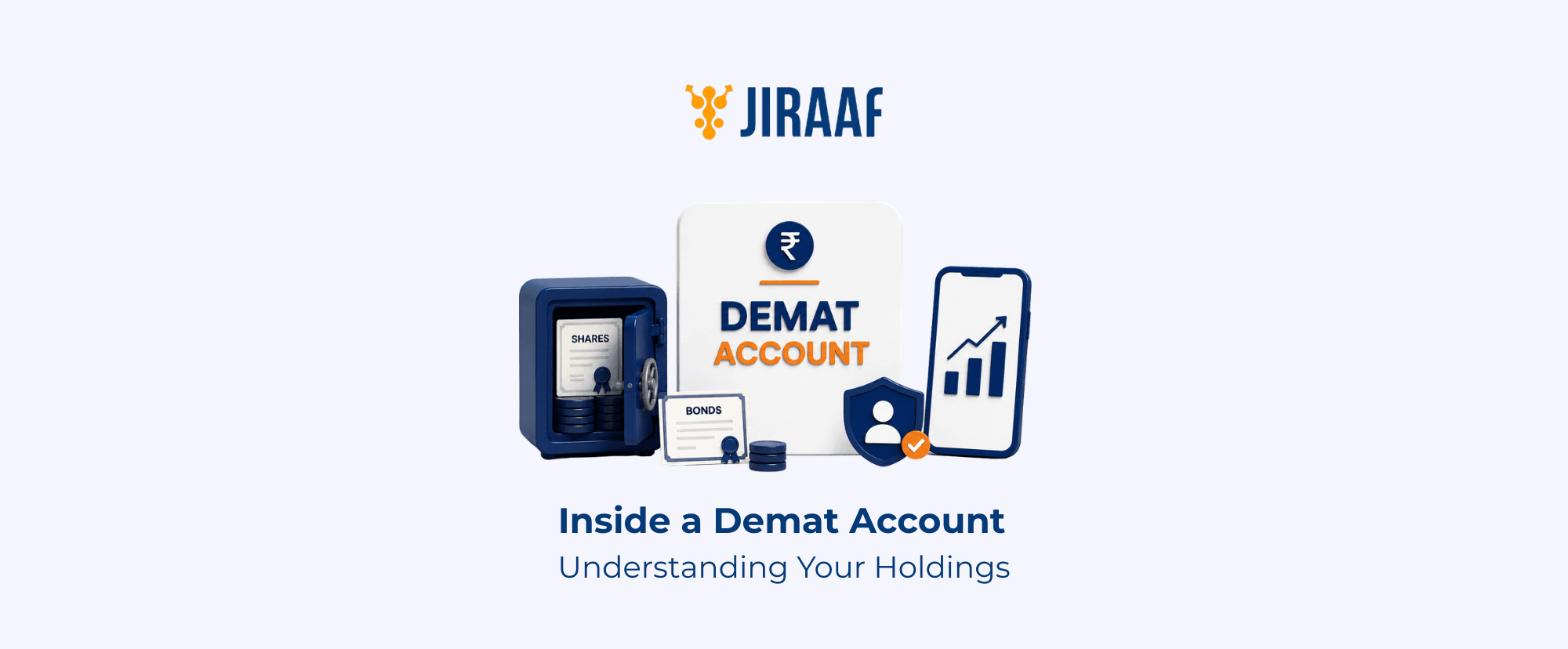
Summary: A demat account holds your shares, bonds, and other securities in electronic form, similar to how a bank account records the money you hold. This guide covers what a demat account is, how it works, its types and charges, and how to open, manage, and close one.
Quick Overview
- A demat account stores securities electronically. It does not hold cash
- Demat is short for dematerialized, since the account replaced physical share certificates
- India has two depositories, NSDL and CDSL, accessed through a Depository Participant (DP)
- A Basic Services Demat Account (BSDA) offers reduced or nil charges below a SEBI-set holding threshold
What is a Demat Account?
A demat account holds your securities, including shares, bonds, and mutual fund units, in electronic form instead of paper certificates. “Demat” is short for “dematerialized,” meaning securities converted from physical certificates into an electronic record. In simple terms, a demat account is the electronic record of the securities you hold. A depository maintains this record through a Depository Participant (DP).
For example, you buy 50 shares through your broker’s app, and once the trade settles, those shares appear as a line item in your demat account rather than a certificate in the mail. Sell them later, and the securities are debited from your demat account as part of the settlement process.
The purpose of a demat account is to remove the paperwork and settlement delays that came with physical certificates and give you one place to see everything you hold within that account, regardless of which company issued it.
Features of a Demat Account
A few traits define how a demat account behaves once it’s open, regardless of which DP you choose.
- Electronic holding: Securities exist as book-entry records, not physical certificates
- Multi-asset storage: One account holds shares, bonds, ETFs, and other eligible securities together
- Unique identifiers: Your demat account is identified through a DP ID and Client ID
- Book-entry transfers: Securities move electronically, not by physical handover
- Nomination facility: You can nominate up to 10 persons to receive your securities after your death, subject to applicable legal requirements
- Consolidated statements: Your DP provides statements showing your holdings and transactions
- No minimum holding: You can hold a single share or leave the account empty
How does a Demat Account Work?
Here’s how the process works when you buy securities in India:
- Bank account: You fund your trading account from your bank account
- Trading account: You place a buy order, which reaches the stock exchange
- Stock exchange: The exchange matches your order with a seller
- Settlement: The trade is cleared and settled, generally on a T+1 basis for equity trades, while optional T+0 settlement is also available for eligible securities
- Demat account: Once settlement is completed, the securities are credited to your demat account
When you sell, the securities are debited from your demat account as part of the settlement, and the sale proceeds are credited to your trading account and can then be transferred to your bank account. Your demat account itself holds securities, not cash.
Why were Demat Accounts Introduced?
Physical share certificates could be lost, stolen, or forged, and transferring ownership meant lodging paperwork with a company’s registrar, often taking weeks to settle. The Depositories Act, 1996, created the legal framework for electronic depositories, enabling the shift to demat accounts.
Converting existing paper certificates into electronic form is called dematerialization. The reverse, converting electronic holdings back to a physical certificate, is called rematerialization. It’s rarely used today since exchanges generally require securities to be in demat form to trade.
Demat Account vs Trading Account vs Bank Account
Since people often use these three interchangeably, here’s how their roles actually split.
| Account | Holds | Function |
| Bank account | Your money | Funds purchases, receives sale proceeds |
| Trading account | No holdings of its own | Places buy/sell orders on the exchange |
| Demat account | Your securities | Holds securities once a trade settles |
In a typical retail setup, your bank, trading and demat accounts work together to complete a securities transaction.
Depositories, DPs, NSDL and CDSL Explained
Securities exist only as electronic records maintained by a depository. India has two, both SEBI-regulated, National Securities Depository Limited (NSDL), operational since 1996, and Central Depository Services Limited (CDSL), operational since 1999.
Neither depository deals with investors directly. You open your demat account through a Depository Participant (DP), typically a bank or broker registered with either depository. Your DP handles your KYC, account queries, and transfer or closure requests on the depository’s behalf.
NSDL and CDSL perform the same core depository function for investors and operate under the same SEBI regulatory framework. Neither is inherently better, and which one you get usually depends on your DP’s affiliation rather than an active choice you make.
What can you Hold in a Demat Account?
A demat account isn’t limited to equity shares. It covers most eligible securities you’re likely to invest in.
- Listed equity shares
- Government Securities (G-Secs) and Treasury Bills
- Corporate bonds and other eligible debt securities
- Exchange-Traded Funds (ETFs)
- Mutual fund units, when held in demat mode
- Sovereign Gold Bonds (SGBs)
- Preference shares and warrants, where applicable
Fixed-income holdings go into the same demat account as equity. Whether you buy a bond or G-Sec directly or through a broker, it lands in your demat account alongside everything else you hold. You don’t need a separate account type for debt versus equity.
Types of Demat Accounts
Not every investor needs the same account. The type that fits depends on your holding size and residency status.
- Regular demat account: No cap on holding value, available to any resident Indian investor
- Basic Services Demat Account (BSDA): It is a lower-cost option for smaller holdings (where the value of holdings does not exceed ₹10 lakh), with SEBI’s BSDA framework automatically opting eligible investors in unless they choose a regular account instead
- Repatriable demat account: For NRIs, generally linked to an NRE account for eligible repatriable investments
- Non-repatriable demat account: For NRIs, generally linked to an NRO account for investments whose proceeds are subject to applicable repatriation restrictions
A demat account can have up to three holders, with the first holder being relevant for BSDA eligibility. To qualify for BSDA, you must generally have only one demat account in which you are the sole or first holder, subject to applicable conditions. You can maintain only one BSDA across depositories. Minors can also have demat accounts through a guardian, subject to applicable rules.
Advantages and Disadvantages of a Demat Account
Like any account structure, a demat account trades certain conveniences for certain costs.
Advantages
- Eliminates the risk of loss, theft, or forgery associated with physical certificates
- Enables electronic settlement without physical handover
- Consolidates shares, bonds, ETFs, and other eligible securities in one account
- Simplifies transfers, pledging, and nomination
- Enables electronic credit of eligible securities benefits, such as bonus shares
- Facilitates the credit of cash benefits, such as dividends, to the registered bank account
Disadvantages
- Applicable AMC even when the account remains inactive, unless it qualifies for nil-AMC BSDA treatment
- Dependence on the DP’s service quality
- Potential access issues caused by technical problems at the DP or depository level
- Greater complexity in managing multiple linked accounts and IDs
What are Demat Account Charges?
A demat account isn’t free to run. These are the fee categories you’ll typically see on your statement.
- Account opening charges: DPs do not charge a fee to open a demat account, although you may still have to pay applicable statutory charges
- Annual Maintenance Charges (AMC): A recurring fee that may apply regardless of trading activity, depending on the account type and DP
- Transaction charges: A per-debit fee when securities leave the account
- Dematerialization/rematerialization charges: Apply only when converting between physical and electronic form
Rather than quoting a regular-account AMC figure, which varies by DP, it’s more useful to know the official BSDA ceiling, under SEBI’s current BSDA framework. AMC for a BSDA is nil up to ₹4 lakh in holdings, and capped at ₹100 a year between ₹4 lakh and ₹10 lakh. If the account no longer meets the BSDA eligibility criteria, it is treated under the applicable regular-account framework.
SEBI’s December 2025 update excludes certain non-tradable instruments, such as Zero Coupon Zero Principal (ZCZP) bonds, delisted securities, and suspended securities, from the BSDA eligibility calculation and requires DPs to review eligibility every quarter, effective March 31, 2026.
How to Open a Demat Account
Opening a demat account is a one-time process, and most DPs now handle it end-to-end online. Here’s what each step involves:
- Choose a registered DP: Pick a bank or broker registered with NSDL or CDSL. This is who you’ll interact with day to day, even though the depository maintains the securities electronically.
- Complete KYC: Submit your PAN, address proof, a photo, and a canceled cheque or bank statement so the DP can verify your identity and link your bank account.
- Complete identity verification: Most DPs do this through video KYC, a short video call to confirm you’re who your documents say you are.
- eSign the form: Sign the account opening form digitally, typically using your Aadhaar-linked e-signature.
- Receive your account details: Once approved, you’ll get your DP ID, Client ID, and login credentials, everything you need to start using the account.
Most DPs bundle the demat and trading account application into a single sign-up, so you’ll likely open both together even though they serve distinct functions.
How to Find and Manage Your Demat Account Details
A DP ID (eight characters, identifying your DP) and a Client ID (unique to your account with that DP) are the two numbers that together form your 16-digit Demat Account Number (or Beneficial Owner ID). Your PAN isn’t your account number. You use it to verify your identity across accounts and brokers.
You can usually find your demat account details through your broker or DP’s app or website. To manage your account:
- Check holdings and run a demat account status check through your broker’s app or the NSDL/CDSL portal
- Request a statement of demat holdings, which your DP must send periodically and which you can also generate on demand
- Track transaction history, including corporate actions, within the same statement
How to Transfer Securities between Demat Accounts
Reasons to transfer shares from one demat account to another include switching brokers, consolidating accounts, or moving holdings to a family member. Two methods exist:
- Online, through CDSL’s Easiest or NSDL’s SPEED-e, once registered through your DP. Enter the receiving account’s details and the securities to move.
- Offline, using a Delivery Instruction Slip (DIS). Fill in the receiving DP ID, Client ID, and ISIN, and submit it to your current DP.
Timelines, charges, and exact steps vary by DP and by whether the transfer is within one depository or across NSDL and CDSL. Confirm both with your DP before initiating.
How to Close a Demat Account
You need to clear securities first, either transferred to another demat account in your name, sold, or, in specific cases, rematerialized. You generally can’t close a demat account while it still holds securities.
Once cleared, submit a closure request to your DP, confirm there are no pending transactions or pledges, settle any outstanding charges, and wait for confirmation. Check for pending corporate actions, such as an upcoming dividend, before initiating closure, since these can delay it.
Is a Demat Account Safe?
A demat account operates within a regulated framework. NSDL and CDSL are SEBI-regulated, and your DP must register with one of them to operate. That doesn’t guarantee safety on its own, but it means defined custody rules, audit requirements, and grievance redressal apply, rather than an unregulated intermediary’s own records.
Practical safeguards include two-factor authentication at login, transaction alerts by SMS or email, periodic statements to cross-check, and the nomination facility. Account security still depends on you. Keep login credentials private, verify alerts promptly, and report anything unusual to your DP without delay.
Conclusion
A demat account, once it’s open, is easy to take for granted because much of what it does happens in the background when you buy or sell securities. What matters is knowing what’s actually in it, including which securities are held, which DP maintains it, and whether your nomination and KYC details are current.
Understanding your demat account isn’t just useful when you first open one. It helps you read statements of holdings, status updates, and settlement notices with greater clarity. As rules and settlement practices evolve, keeping track of your account details can help you stay informed about how your investments are held and processed.