Opening a demat account is largely a digital process today, but choosing the right DP and understanding the charges and requirements are equally important. This guide covers the demat account opening process step by step, the documents and charges involved, the types of accounts available, and what to check before choosing a Depository Participant (DP).
Quick Overview
The short version, in case you’re pressed for time:
- You generally need a PAN, address proof, a photograph, and bank proof to open a demat account
- Online demat account opening can be completed relatively quickly when your documents and verification are in order; offline opening may take longer
- You can open more than one demat account, including across different DPs
- NSDL demat account opening and CDSL demat account opening follow the same process for you as an investor
What Does a Demat Account Hold and Who Can Open One?
A demat account is where you hold your shares, bonds, and other securities electronically once you buy them. Think of it as similar to a bank account, except it holds securities instead of cash. Every time a trade you place settles, the securities land in this account. When a trade settles, the securities are credited to or debited from your demat account accordingly.
Resident Indians and NRIs can open demat accounts; minors can hold them through a guardian; and accounts can also be held jointly, subject to applicable KYC and account-opening requirements. You’ll generally need a demat account to hold securities purchased through the market, including listed shares, bonds, and ETFs.
How to Open a Demat Account Online
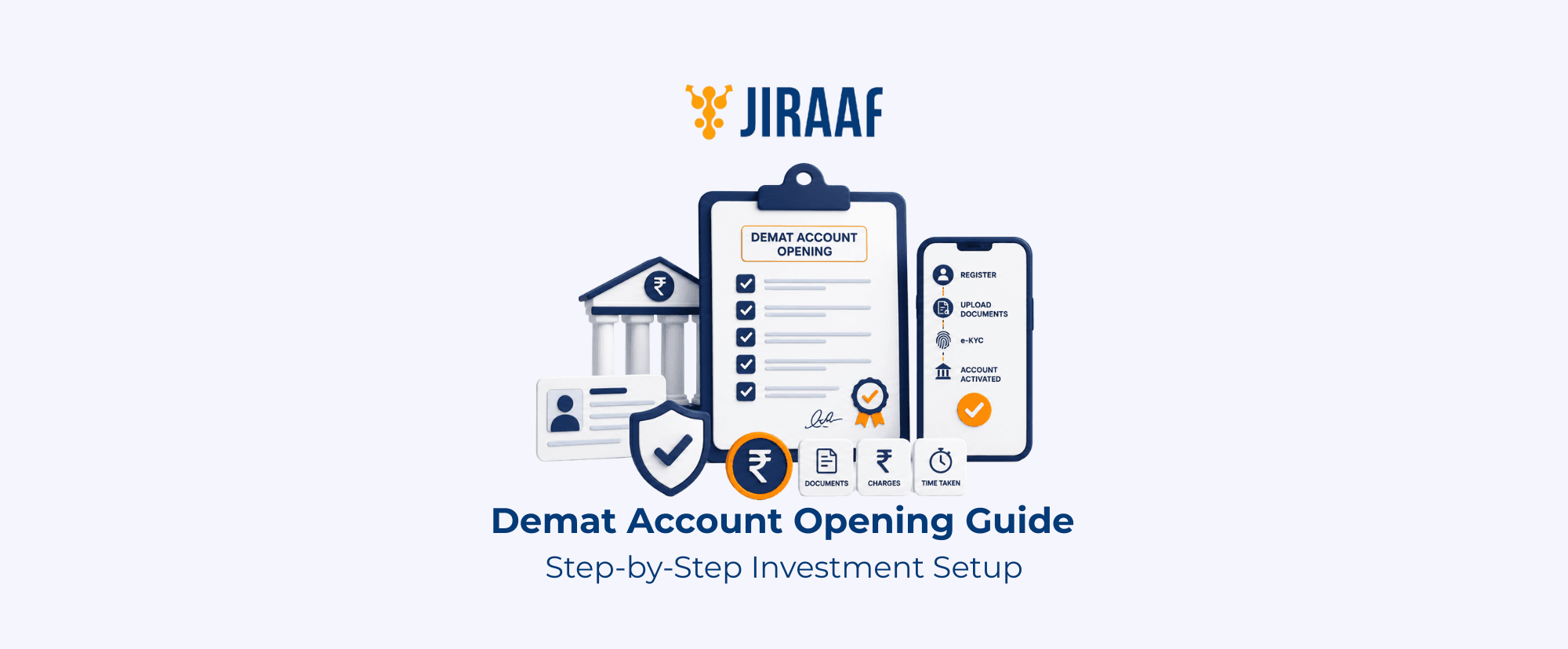
The demat account opening process, step by step:
- Choose a registered DP: Confirm it’s registered with NSDL or CDSL before proceeding
- Enter your basic details: Name, PAN, Aadhaar number, and mobile number, usually through the DP’s app or website
- Complete your KYC: Upload your PAN, address proof, and a photograph, then link a bank account via a canceled cheque or statement
- Authenticate via Aadhaar OTP or video KYC: SEBI permits you to complete in-person verification (IPV) remotely through a live video call instead of a branch visit
- eSign the account opening form: Typically, through Aadhaar-based e-signature
- Receive your account details: Your DP shares your DP ID, Client ID, and login credentials once the account is active
Most DPs open your demat and trading account together in one application, though they remain functionally separate accounts.
Documents Required for Opening a Demat Account
Most DPs ask for the same core set of documents, regardless of which one you choose:
- PAN card: Mandatory, and the core identifier used across your investment accounts
- Address proof: Aadhaar, passport, voter ID, or a recent utility bill
- Photograph: A recent passport-sized photo, or a live selfie for online applications
- Bank proof: A canceled cheque or bank statement, used to link your bank account
- Income proof: Needed only if you also intend to trade in futures and options
If you’ve already completed KYC through a SEBI-registered intermediary, such as a broker, DP, or mutual fund, you generally don’t need to repeat it from scratch with a new DP. A common KYC Registration Agency (KRA) maintains your KYC records for use across registered intermediaries, subject to the applicable KYC process.
Demat Account Opening Charges
Charges typically fall into three categories:
- Account opening fee: Many DPs waive this for online applications, though some still charge a one-time fee
- Annual Maintenance Charge (AMC): A recurring yearly fee for maintaining the account
- Transaction charges: May apply when securities are debited from your demat account, such as when you sell or transfer holdings
If your demat account meets SEBI’s Basic Services Demat Account (BSDA) eligibility criteria, your DP must assess that eligibility at the end of each quarter. From March 31, 2026, an eligible account is to be converted to BSDA unless you give consent through an authenticated and verifiable channel to continue with a regular demat account. BSDA charges depend on the value of your holdings, with nil AMC for holdings up to ₹4 lakh and a maximum AMC of ₹100 per year for holdings above ₹4 lakh and up to ₹10 lakh.
How Long Does Demat Account Opening Take?
Online opening can be completed quickly when your documents and verification are in order; offline opening may take longer. The offline route, using physical forms and manual verification, usually takes 3 to 7 business days. Incomplete documents, mismatched details between your PAN and Aadhaar, or additional checks some DPs run can extend either timeline.
Can I Open More Than One Demat Account?
Yes. There’s no rule against holding multiple demat accounts, including with different DPs and even across NSDL and CDSL. Investors may do this to separate holdings or use more than one broker.
Holding multiple demat accounts can affect your eligibility for BSDA benefits. If you want to use the BSDA facility, check the current SEBI eligibility conditions, particularly for accounts where you are the sole or first holder.
NSDL vs CDSL Demat Account Opening: Does It Matter?
For you as an investor, the account-opening process is similar whether the DP is affiliated with NSDL or CDSL.
| Aspect | NSDL | CDSL |
| Operational since | 1996 | 1999 |
| Regulator | SEBI | SEBI |
| Account opening steps | KYC, IPV, eSign | KYC, IPV, eSign |
| Investor experience | Same | Same |
You don’t usually choose between them directly. The depository where your account is held depends on which one your chosen DP is affiliated with. If a specific DP matters more to you than the depository behind it, that’s the decision worth focusing on instead.
How to Choose the Right Demat Account or Depository Participant (DP)
A few things worth checking before you commit to a DP:
- Charges beyond account opening: AMC, transaction charges, and applicable fees for statements or physical requests
- Depository affiliation: Whether the DP operates under NSDL, CDSL, or both
- Platform usability: Whether the app or portal makes it easy to check holdings, statements, and transaction history
- Range of eligible securities: Whether the DP supports the instruments you actually plan to hold, such as equity, bonds, or ETFs
- Customer support and grievance redressal: How the DP handles queries and complaints, and whether it responds appropriately to grievances raised through SCORES, SEBI’s official complaints redressal system
A DP that’s cheapest to open an account with isn’t necessarily the cheapest to hold and trade through over time. Check the full charge structure, not just the headline opening offer.
Common Mistakes to Avoid During Demat Account Opening
A few errors come up often enough to be worth flagging in advance:
- “Free” opening alone: Ongoing AMC and transaction charges matter more over time
- Mismatched KYC details: A name or date of birth that doesn’t match exactly between PAN and Aadhaar can delay verification
- Skipping nomination: A nominee can help simplify the process of transferring your holdings after your death
- Not checking DP registration: Check with NSDL or CDSL before submitting documents
- Opening multiple accounts: Each one may add AMC without necessarily adding value
Conclusion
Opening the account is the easy part; most of it takes minutes once your documents are ready. What actually shapes your experience happens afterward: things like the DP you picked, whether you’ve filed your nomination, whether your KYC details still hold up years from now after you’ve changed your address or phone number.
That last one matters more than it used to. SEBI now reassesses BSDA eligibility every quarter and converts you automatically unless you opt out, so the rules keep shifting even after you’ve opened the account.
If you’re exploring eligible fixed-income investment opportunities, Jiraaf offers easy access to listed high-yield investment-grade corporate bonds and other securities that are held in your demat account.