A planned economy is an economic system where the government controls production, pricing, and resource allocation to achieve national goals, often used during early development or periods of economic crisis.
Imagine running a country where poverty is widespread, industries are weak, and markets are too fragile to drive growth on their own. Infrastructure must be built quickly, and jobs need to be created at scale to stimulate consumption across the economy. In such conditions, waiting for supply and demand to revive on their own can seem like a luxury the country cannot afford, leaving the state with little choice but to step in and direct key industries in order to revive economic activity.
In the early 20th century, many countries faced similar challenges due to extreme income inequality, frequent market crashes, and the economic fallout of global conflicts. As a result, the governments of these nations chose to take direct control of their economies. This approach later came to be known as a planned economy. This blog explores what it is, its key examples, and its major advantages and disadvantages.
What is a Planned Economy?
A planned economy, also known as a command economy, is one in which the government has the authority to control key economic decisions related to the production, distribution, and allocation of goods and services. Through this approach, the government aims to utilize its resources to their fullest capability, meet its goals, and reduce the underlying volatility in its economy.
In such systems, most large enterprises are state-owned, giving the government direct authority over major industries. While private players may also operate in some variations, their activities are closely regulated, with prices, wages, and production levels capped or guided by the state.
Understanding what a planned economy is naturally leads to the question of how such a system functions in practice and how governments translate central control into day-to-day economic activity.
How a Planned Economy Works
A planned economy runs on targets and instructions issued by the central authority rather than on thousands of decentralized demand and supply cues. Here, the planners slice the economy into broader sectors, set production targets (how many tons of steel will be required, how much electricity, etc.), allocate inputs (labor, raw materials, investments), and often fix prices and wages.
Key operational elements of a planned economy include:
- Planning agency & plans: A central body prepares economy-wide plans (e.g., five-year plans) that set sectoral targets and investment priorities.
- Quotas & directives: Factories and farms receive output quotas and input allocations instead of responding to market demand.
- State ownership: Most large firms and key assets are publicly owned, so the state can legally enforce plan compliance.
- Price/ wage controls: Prices and wages are frequently fixed or tightly regulated to meet social or political objectives.
- Information & enforcement: The system depends on vast information flows (reports, audits) and administrative enforcement to try to keep the plan on track.
While these mechanisms explain the structure of a planned economy, a historical example would further help us understand this economic framework better.
An Example of a Centrally Planned Economy
From the late 1920s, Gosplan (the State Planning Committee of the Soviet Union) drafted multi-year plans (the famous five-year plans) that prioritized rapid industrialization in heavy industry and infrastructure. These plans succeeded in transforming an agrarian economy into a large industrial power. However, they also produced chronic mismatches: persistent shortages of consumer items, surpluses of unwanted goods, and incentives to meet quantitative targets even at the cost of quality.
Over time, the real-time information gap and weak incentives, often called the “calculation problem” by economists (originally proposed by Ludwig von Mises), and the inability to capture local demand, made it difficult for the Soviet system to allocate resources efficiently.
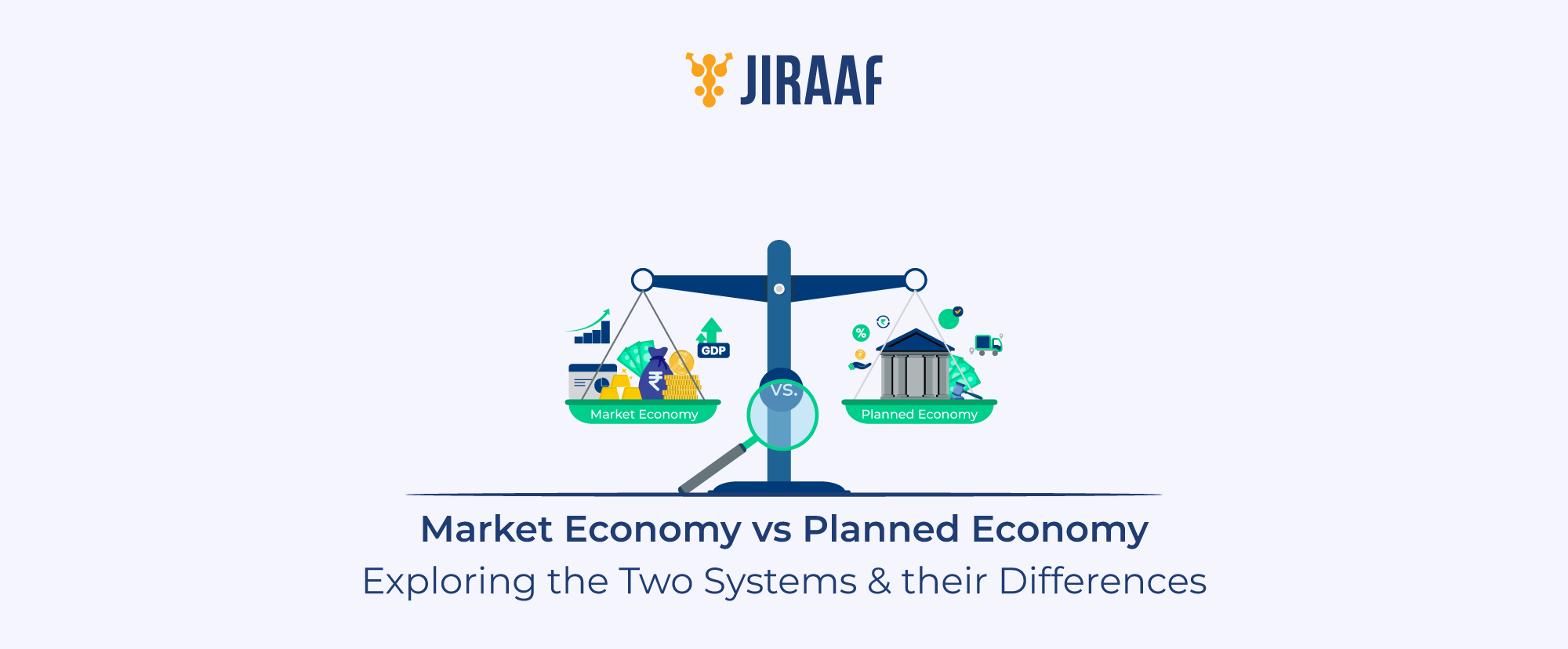
Challenges like these have always raised questions about how effective a planned economy can be when compared to a market economy, where prices and production are guided by demand and competition. To understand this contrast better, let us compare the two systems side by side.
Key Differences Between Planned vs Market Economies
| Aspect | Planned Economy | Market Economy |
| Decision-making | Central authorities decide what to produce, how much to produce, and how resources are allocated | Production decisions are driven by consumers and businesses through demand and supply |
| Role of the state | The state plays a dominant role by owning and directing major industries | The state has a limited role, focusing mainly on regulation and public goods |
| Pricing mechanism | Prices are fixed or controlled to meet planning objectives | Prices adjust freely based on market demand and supply |
| Incentives | Firms focus on meeting production targets and plan quotas | Profit, competition, and innovation guide economic activity |
| Efficiency and adaptability | Often struggles to respond quickly to changing demand and information gaps | More flexible and responsive to consumer preferences and market signals |
Advantages and Disadvantages of a Planned Economy
A planned economy is often adopted during periods of economic stress or early-stage development, when governments seek greater control. Here are the strategic benefits it offers.
Advantages of a Planned Economy
- Coordinated economic development: Central planning allows governments to channel resources into priority sectors such as infrastructure, heavy industry, and defense, supporting rapid nation-building.
- Economic stability and employment: By controlling production and investment, the state can reduce unemployment and limit sharp economic fluctuations (at least in the short term).
- Focus on social objectives: Planned systems can prioritize universal access to essentials like food, housing, and basic services over profit-driven outcomes.
However, the same level of central control that enables coordination and stability can also create structural limitations.
Disadvantages of a Planned Economy
- Inefficient resource allocation: Without market-based price signals, planners struggle to match production with actual demand, leading to shortages and surpluses.
- Weak incentives and innovation: Limited competition and profit motivation can reduce efficiency, quality, and technological progress.
- Lack of flexibility: Centralized decision-making makes it difficult to respond quickly to changes in consumer preferences or economic conditions.
Ultimately, a planned economy can be effective under specific conditions, particularly during early development or crisis periods, but its long-term success depends on how well it balances control with efficiency.
Conclusion
Many governments used the framework of a planned economy at the beginning of 20th century, particularly nations facing periods of scarcity, reconstruction, and industrialization.
However, over time, this framework struggled to keep pace with changing consumer needs and technological progress. History explains why purely planned economies are largely seen as a transitional framework rather than a permanent solution.
Today, the global trend has moved toward market-oriented or mixed economic systems that aim to find a “sweet spot”: using state direction to secure essential infrastructure and social safety nets, while allowing the “invisible hand” of the market to drive innovation and efficiency. While the era of the total command economy has largely passed, its legacy lives on in modern industrial policies where states still step in to guide economies through 21st-century challenges.