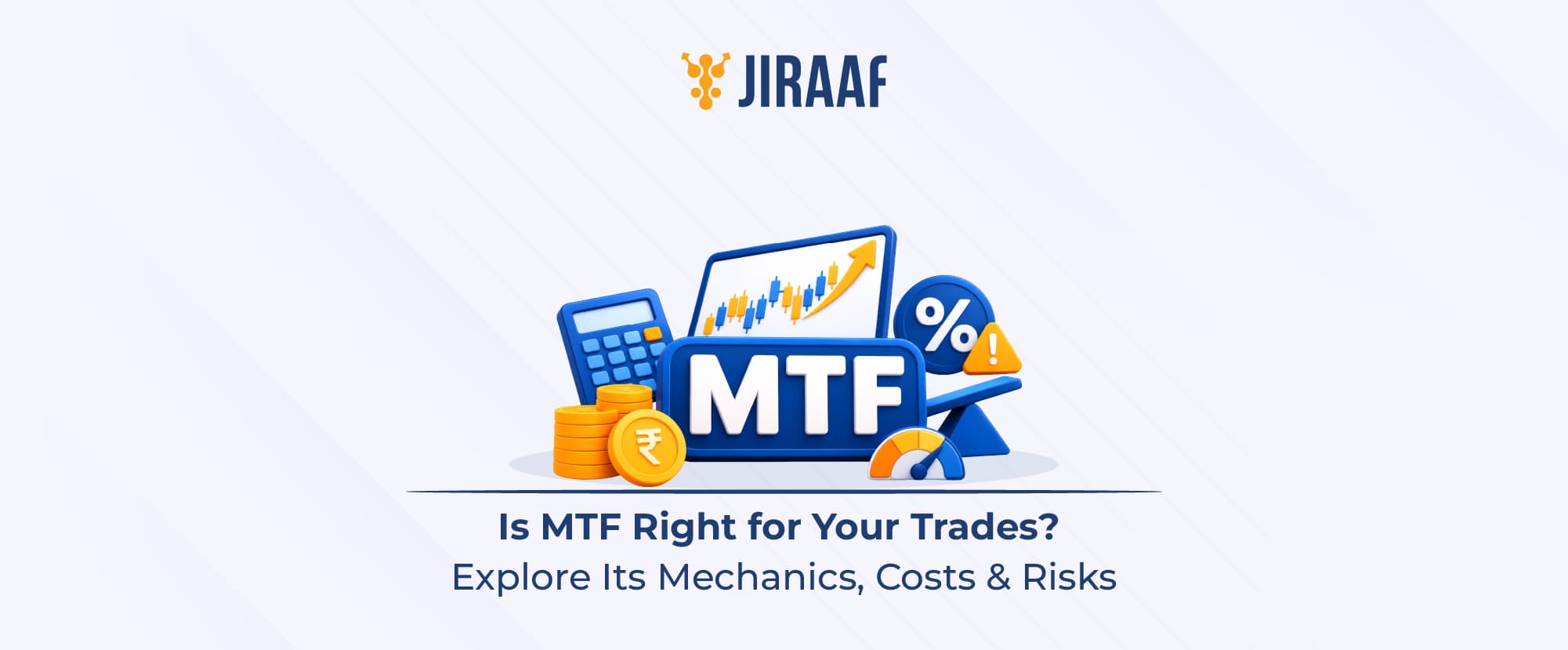
A Margin Trading Facility (MTF) is a broker-funded stock market service that lets you buy approved shares for delivery without paying the full trade value upfront.
In the stock market, having limited capital can force you to scale down promising trades, or miss them altogether. Margin Trading Facility (MTF) changes that equation by allowing you to leverage your existing funds to take larger equity delivery positions without paying the full amount upfront.
Here’s everything you need to know about MTF, from its meaning and mechanics to its costs, benefits, and risks.
What Is MTF? Full Form and Meaning
Margin Trading Facility (MTF) lets you buy stocks by paying only a partial amount upfront. Once you provide the initial margin, your broker funds the remaining balance. Generally, Indian brokers fund up to 75% of your trade value. So, if you want to buy stocks worth ₹1,00,000, you only need to pay ₹25,000 to execute the trade, while your broker covers the remaining ₹75,000.
MTF was introduced to the Indian stock market in 2004 and has been regulated by SEBI ever since. In practice, MTF works much like a loan, where the shares you purchase using borrowed funds act as collateral for your broker. In return, your broker charges interest, typically ranging between 9.85% and 18% p.a., on the funded amount for every day you hold the position.
How Does Margin Trading Facility Work?
You cannot trade any stock with MTF; only eligible securities qualify as per SEBI. Also, MTF is only available through eligible brokers authorized to offer the facility under applicable SEBI and exchange regulations. The following three aspects explain how MTF works in detail.
Stock Eligibility
You can use MTF to purchase eligible Group 1 stocks and ETFs that meet prescribed liquidity criteria. These securities must have been traded on at least 80% of trading days over the preceding 18 months, with an impact cost of 1% or less. These criteria help ensure that the securities can be liquidated without significantly affecting their market price.
What Happens After an MTF purchase?
Once your MTF order is executed and settled, the purchased shares are held in a pledged state against the broker-funded amount. Although you retain ownership of the shares and benefits such as dividends and other corporate action entitlements, you cannot freely transfer or pledge them elsewhere while the existing pledge remains active.
What is a Maintenance Margin?
Maintenance margin is the minimum margin you must maintain against your ongoing MTF position. If the share price falls or the margin requirement increases, your available margin may become insufficient. Your broker can then issue a margin call, requiring you to deposit additional funds or collateral. If you fail to meet the shortfall within the stipulated time, your broker may liquidate the pledged shares to recover the funded amount.
Now that you understand how MTF works and what happens after you purchase shares through it, let’s look at how the borrowed capital affects your profits and losses as the stock price changes
How are Profits and Losses Calculated in MTF?
Suppose you purchase shares worth ₹10,000 at ₹100 per share using MTF, with a 25% margin requirement. You pay ₹2,500 from your own funds, while your broker finances the remaining ₹7,500.
- Profit scenario: If the share price rises to ₹110, your holdings are worth ₹11,000, generating a gross profit of ₹1,000. This translates to a 40% return on your ₹2,500 margin.
- Loss scenario: If the share price falls to ₹90, your holdings are worth ₹9,000, resulting in a loss of ₹1,000, or 40% of your invested margin.
However, your actual profit or loss will be lower or higher after accounting for interest and other applicable charges.
MTF Interest Charges and Other Costs
With MTF, you only pay interest on the borrowed amount. Interest accrues as long as you use the broker’s funds, so your holding period is an important factor in determining the total cost of your trade.
Assuming you purchase shares worth ₹10,000, contribute ₹2,500 as margin, and borrow the remaining ₹7,500 from your broker at an annual interest rate of 11%, your interest cost would be as follows:
| Particulars | Amount |
| Broker-funded amount | ₹7,500 |
| Annual interest rate | 11% |
| Interest for 1 year | ₹825 |
| Interest for 30 days | ₹68.75 |
| Interest for 15 days | ₹34.38 |
Besides interest, an MTF trade may involve pledge and unpledge charges for creating or releasing the pledge on shares, brokerage on transactions, STT, exchange transaction charges, stamp duty, and GST. Depending on the broker, there may also be processing fees or other MTF-specific charges.
These costs can affect your final returns even if the share price moves in your favor. Therefore, evaluate the expected price movement against the total borrowing and transaction costs before taking an MTF position.
Advantages and Disadvantages of MTF
MTF changes how much capital you need to take a stock position, but it also changes the cost of holding that position and the risks you carry. Understanding both sides helps you decide when using borrowed funds makes sense and when investing with your own capital is the better choice.
Advantages of MTF
- Deploy capital more efficiently: You don’t have to commit the entire purchase value to a single stock position. By paying only the required margin, you retain a portion of your capital for other investments or financial needs.
- Gain greater exposure to a stock: Broker funding allows you to take a larger position than your available cash would otherwise permit. This can increase your returns relative to your invested margin if the stock moves in your favor.
- Hold positions beyond intraday trading: MTF lets you carry eligible shares beyond the trading session without paying the full purchase value upfront, giving you the flexibility to act on price movements that may take time to materialize.
However, the flexibility MTF offers in deploying capital comes with added costs and risks that can affect your returns and limit your ability to manage a position when the market moves against you.
Disadvantages of MTF
- Losses can outweigh your initial margin: Your exposure is based on the entire value of the shares, not just the margin you contribute. A price decline can therefore consume a disproportionately large portion of your invested capital.
- Holding costs can weaken your investment thesis: Even if the stock moves sideways or takes longer than expected to appreciate, interest continues to accrue on the funded amount. This means your position needs to generate enough returns to justify the borrowing cost.
- A margin shortfall can force you to exit: If your margin falls below the required level, you may need to add funds at short notice. Failing to meet the requirement can lead to your broker liquidating pledged shares, potentially at an unfavorable market price.
Your decision to trade or invest with MTF should ultimately depend on whether the expected gains justify the borrowing costs and whether you can comfortably manage the position if the market moves against you.
Final Thoughts: Who Should Use Margin Trading Facility?
MTF is better suited to you if you approach the stock market with a plan rather than react to every price movement. Additionally, a well-researched investment thesis alone isn’t enough; you also need sufficient liquidity to meet margin requirements, patience to manage your position, and clarity on when to exit.
If you rely on borrowed funds because your savings are limited or may need the money at short notice, MTF warrants caution. It demands financial discipline beyond stock selection, making your financial preparedness just as important as the investment opportunity itself.